Performing solo on the acoustic guitar is one of the purest and most challenging expressions of musicality. Without a band behind you, every note, chord, and rhythm must work together to create a rich, full sound. Successful solo performers must think like arrangers—layering textures, voice-leading chords, and weaving melodic fills—while maintaining a deep connection with their listeners. It’s not just about technical prowess; it’s about tapping into the guitar’s emotional core and delivering a performance that resonates with any audience.
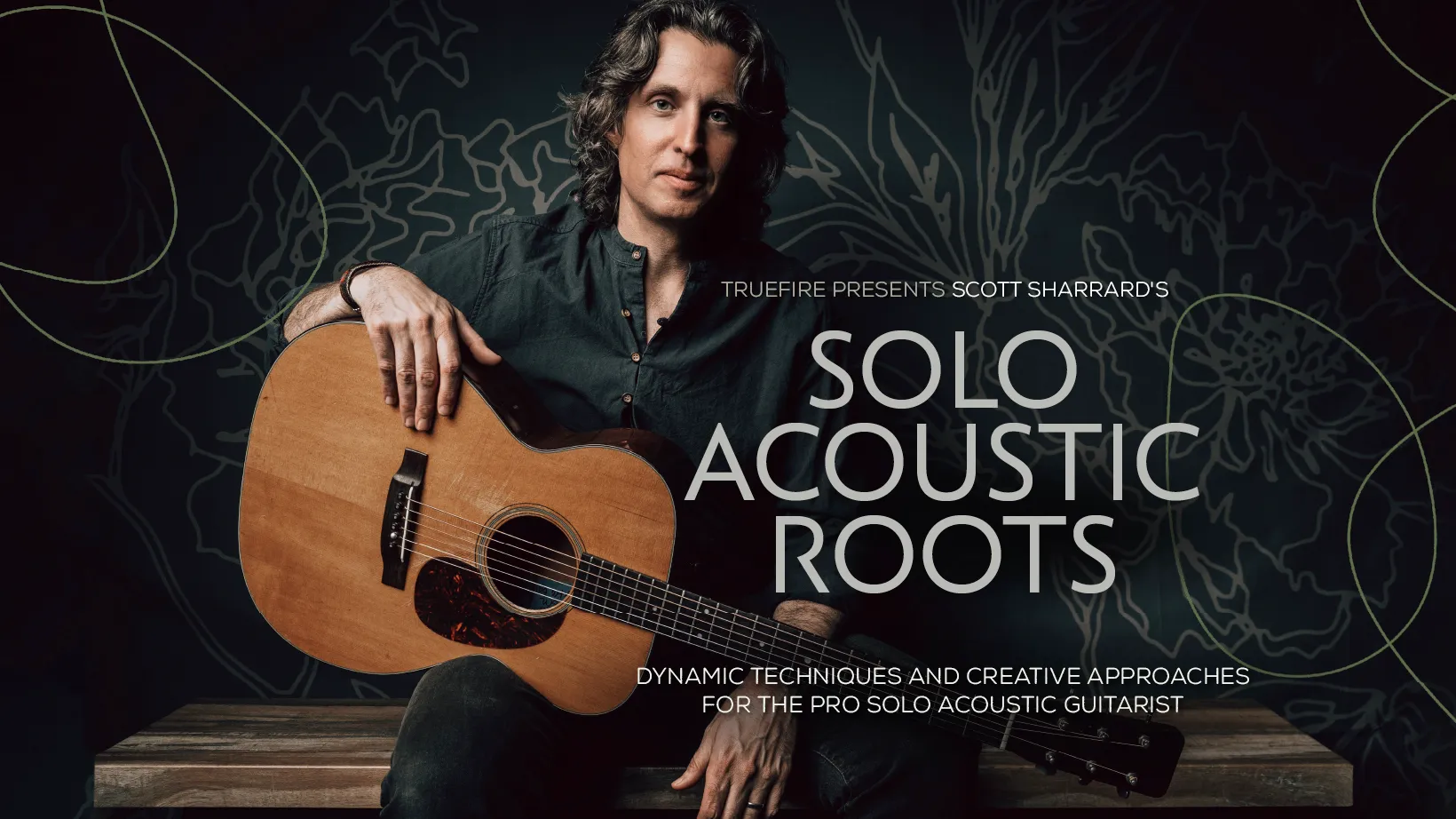
In Solo Acoustic Roots, Scott Sharrard provides the guidance and techniques you need to elevate your solo playing. You’ll learn how to transform basic chords into vibrant, textured arrangements, craft compelling rhythms, and use melodic fills to add depth and momentum. Scott also explores open tunings, slide guitar techniques, and creative voicings that draw from blues, roots rock, and Americana traditions. You’ll gain not only a versatile skill set but also the confidence to orchestrate a solo performance that stands on its own—captivating, dynamic, and undeniably authentic.
From Scott Sharrard:
“Whether you’re an aspiring singer-songwriter, playing solo gigs, or backing up a vocalist, the guitar is laid bare in a solo acoustic setting. You need a range of dynamic techniques to fill out the sound and really connect with your audience. In this series, we’ll dive into 10 lesson sets, covering blues, roots rock, and Americana styles. I’ll walk you through my favorite rhythm patterns, tasteful fills, innovative chord voicings, crucial open tuning moves, and my go-to slide techniques. You’ll get plenty of practice tips, performance examples, and detailed breakdowns to help you build your skills and confidence on the guitar at its most ‘naked’ level.”
Your Learning Experience:
You’ll have TrueFire’s interactive learning tools at your fingertips, allowing you to customize your workspace and learn at your own pace. Demonstrations and performances are fully tabbed, notated, and synced to the video lessons, with looping, slow motion, fretboard animation, and other features designed to accelerate your progress. Plus, you’ll receive printable tab and notation files, as well as downloadable Guitar Pro files.
Grab your guitar, and let’s dig in with Scott Sharrard!
What you'll learn
Create bass fills between chord changes
Apply right hand rhythm patterns as a percussive element
Incorporate rhythmic variation and syncopation into chord progressions
Discover new chord voicings through experimentation
Develop arrangement strategies for solo acoustic playing
Hey, I'm Scott Sharrard, and I'm thrilled to welcome you to Solo Acoustic Roots. Whether you're an aspiring singer-songwriter, playing solo gigs, or backing up a vocalist, when you’re playing in a solo acoustic setting, the guitar is naked. You need to master a handful of dynamic guitar techniques in order to build momentum and orchestrate a full, rich, sound to connect emotionally with your audience. In this series, we'll dive into 10 lesson sets focusing on styles ranging from blues and roots rock to Americana. I'll share many of my favorite rhythm techniques, tasty fills, diverse chord voicings, essential open tuning moves, and some of my go-to approaches to playing slide. Along the way, I'll give you helpful practice tips, performance examples, and detailed breakdowns designed to help you build your confidence and capability on the guitar in its most naked state. Plus, there’s tab-sync and notation, along with slow-mo controls, looping, and fretboard animations to help you learn at your own pace. So grab your guitar, and let's make some music that moves both the heart and the soul!
In this lesson series, we’re diving straight into the heart of American music: the blues. It’s the foundation of countless genres, and all my musical heroes, across styles, have reinforced its importance. We’ll kick things off with a 12-bar blues in the key of E, a key that’s incredibly open-string friendly—something I’ll emphasize throughout the course as a cornerstone of creating a rich, orchestral sound on acoustic guitar. This approach is especially valuable for solo or duo performances where the guitar needs to fill the space like a piano, drawing inspiration from the stride tradition in blues piano. I’ll show you how to interpret stride’s bassline with a classic guitar pattern, often called the Jimmy Reed pattern, which remains a favorite of mine for its simplicity and versatility. We’ll explore variations on this bassline, how to build accompaniment with seventh chords, and techniques like hammer-ons and stabs to enhance your sound—perfect even if you’re singing over the blues. For soloing, the possibilities are endless, but we’ll start with the basics and layer in turnarounds, chords, and single-note lines to develop a full, dynamic solo performance. We’ll start things off with a performance and then break it all down in detail.
In this lesson series, we’re diving straight into the heart of American music: the blues. It’s the foundation of countless genres, and all my musical heroes, across styles, have reinforced its importance. We’ll kick things off with a 12-bar blues in the key of E, a key that’s incredibly open-string friendly—something I’ll emphasize throughout the course as a cornerstone of creating a rich, orchestral sound on acoustic guitar. This approach is especially valuable for solo or duo performances where the guitar needs to fill the space like a piano, drawing inspiration from the stride tradition in blues piano. I’ll show you how to interpret stride’s bassline with a classic guitar pattern, often called the Jimmy Reed pattern, which remains a favorite of mine for its simplicity and versatility. We’ll explore variations on this bassline, how to build accompaniment with seventh chords, and techniques like hammer-ons and stabs to enhance your sound—perfect even if you’re singing over the blues. For soloing, the possibilities are endless, but we’ll start with the basics and layer in turnarounds, chords, and single-note lines to develop a full, dynamic solo performance. We’ll start things off with a performance and then break it all down in detail.
In this lesson series, we’re diving straight into the heart of American music: the blues. It’s the foundation of countless genres, and all my musical heroes, across styles, have reinforced its importance. We’ll kick things off with a 12-bar blues in the key of E, a key that’s incredibly open-string friendly—something I’ll emphasize throughout the course as a cornerstone of creating a rich, orchestral sound on acoustic guitar. This approach is especially valuable for solo or duo performances where the guitar needs to fill the space like a piano, drawing inspiration from the stride tradition in blues piano. I’ll show you how to interpret stride’s bassline with a classic guitar pattern, often called the Jimmy Reed pattern, which remains a favorite of mine for its simplicity and versatility. We’ll explore variations on this bassline, how to build accompaniment with seventh chords, and techniques like hammer-ons and stabs to enhance your sound—perfect even if you’re singing over the blues. For soloing, the possibilities are endless, but we’ll start with the basics and layer in turnarounds, chords, and single-note lines to develop a full, dynamic solo performance. We’ll start things off with a performance and then break it all down in detail.
In this lesson series, we’re exploring the eight-bar blues, a less common but equally captivating form of the blues. One of the most iconic examples is "Key to the Highway," famously recorded by Big Bill Broonzy, Freddie King, and Eric Clapton with Derek and the Dominos. We'll focus on the key of A, where many eight-bar classics, like "East St. Louis Blues," are often played. The eight-bar form shifts more unconventionally between the one, four, and five chords, creating a unique feel while using the familiar shuffle rhythm of a standard 12-bar blues. I’ll teach you a fingerpicking approach inspired by John Hammond Jr.'s version of "East St. Louis Blues," moving through different positions on the neck and incorporating bass notes, chordal improvisation, and single-note lines. By the end, you’ll learn how to accompany yourself, develop call-and-response elements, and expand into improvisation. We'll start things off with a performance and then break it all down in detail.
In this lesson series, we’re exploring the eight-bar blues, a less common but equally captivating form of the blues. One of the most iconic examples is "Key to the Highway," famously recorded by Big Bill Broonzy, Freddie King, and Eric Clapton with Derek and the Dominos. We'll focus on the key of A, where many eight-bar classics, like "East St. Louis Blues," are often played. The eight-bar form shifts more unconventionally between the one, four, and five chords, creating a unique feel while using the familiar shuffle rhythm of a standard 12-bar blues. I’ll teach you a fingerpicking approach inspired by John Hammond Jr.'s version of "East St. Louis Blues," moving through different positions on the neck and incorporating bass notes, chordal improvisation, and single-note lines. By the end, you’ll learn how to accompany yourself, develop call-and-response elements, and expand into improvisation. We'll start things off with a performance and then break it all down in detail.
In this lesson series, we’re exploring the eight-bar blues, a less common but equally captivating form of the blues. One of the most iconic examples is "Key to the Highway," famously recorded by Big Bill Broonzy, Freddie King, and Eric Clapton with Derek and the Dominos. We'll focus on the key of A, where many eight-bar classics, like "East St. Louis Blues," are often played. The eight-bar form shifts more unconventionally between the one, four, and five chords, creating a unique feel while using the familiar shuffle rhythm of a standard 12-bar blues. I’ll teach you a fingerpicking approach inspired by John Hammond Jr.'s version of "East St. Louis Blues," moving through different positions on the neck and incorporating bass notes, chordal improvisation, and single-note lines. By the end, you’ll learn how to accompany yourself, develop call-and-response elements, and expand into improvisation. We'll start things off with a performance and then break it all down in detail.
I have definitely improved my acoustic rhythm, in just doing two of the lessons.
This course will be used for months to come.
Great course.
Brendan
A
arpeggio5
Verified buyer
03/04/25
smooth course
explained very well & clear
R
Rob
03/01/25
I'm inspired!
As a professional guitarist and educator myself, I'm always looking for fun and inspiring new techniques. I have found so many gems throughout this course. Great work Scott!