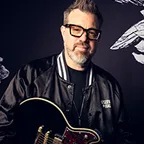
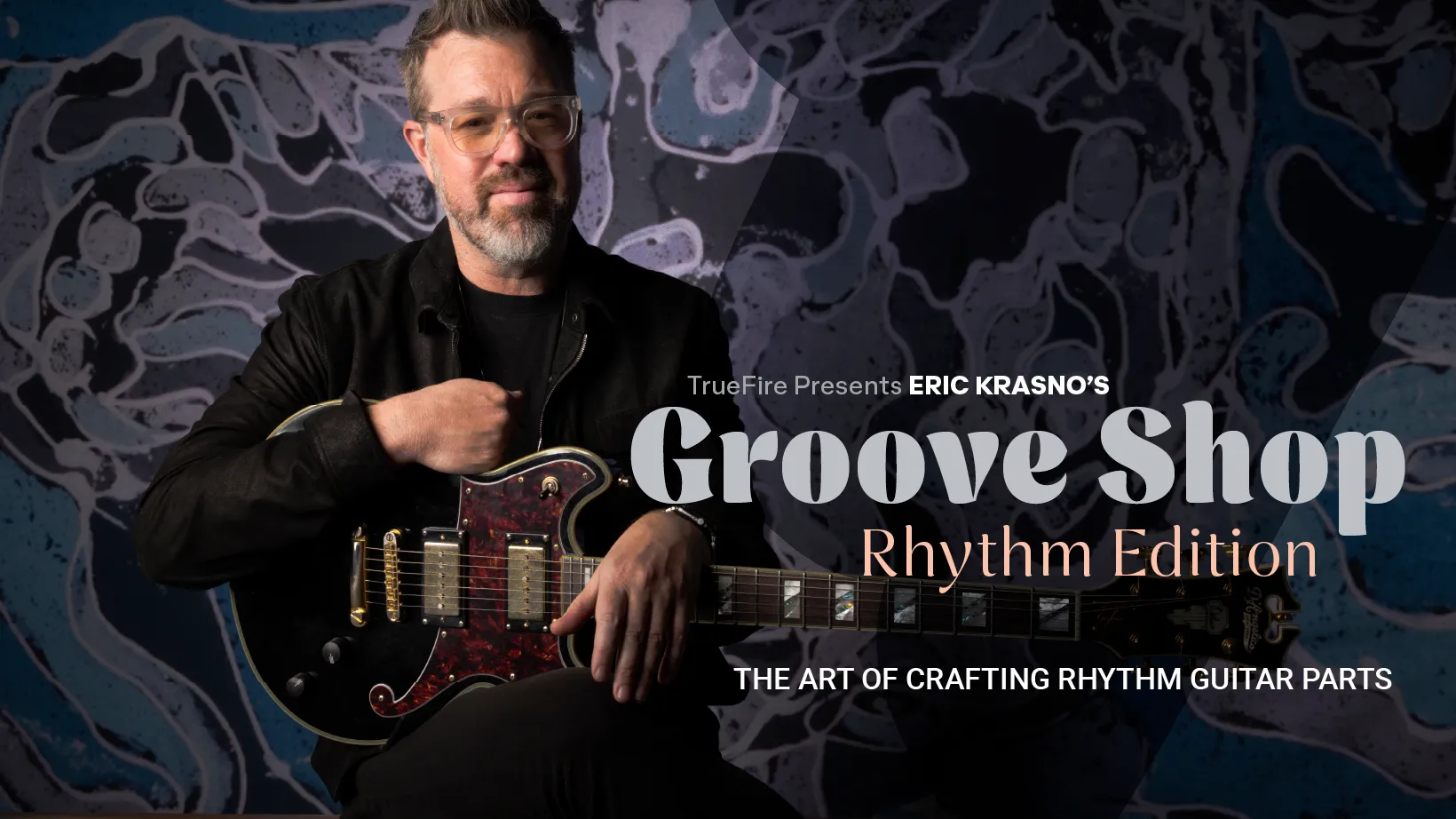
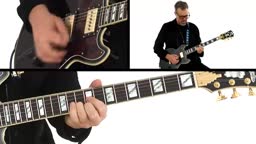
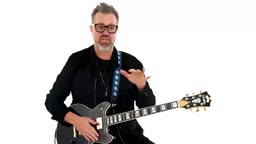
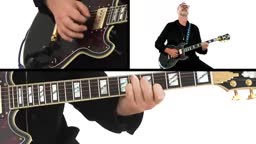
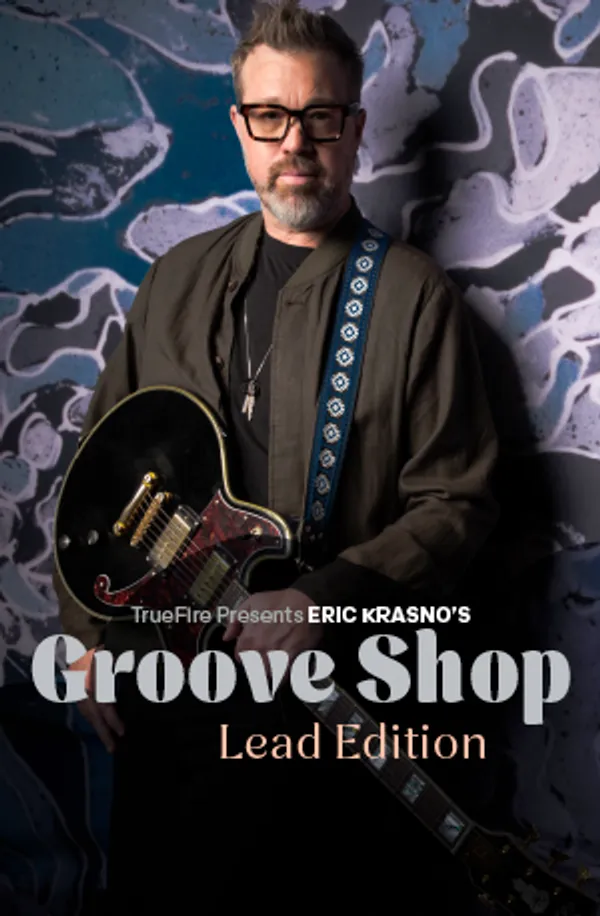
Eric Krasno is a Grammy Award-winning guitarist, songwriter, and producer known for his work across a wide range of genres, particularly jazz, funk, and soul. Eric has produced and collaborated with artists like Norah Jones, Talib Kweli, and Robert Randolph. With a deep passion for playing and teaching, Krasno has earned a solid reputation as one of his generation's most versatile and innovative guitarists.
We’re thrilled to welcome Eric to the family with his first TrueFire masterclass, Groove Shop: Rhythm Edition. Eric guides you on a deep dive into the art of crafting funk, soul, and R&B rhythm guitar parts that support the song and lock in the feel and pocket of these vibrant styles.
”I’ll perform and break down multi-layered rhythm performances for ten tracks from my own solo and band recording projects in various keys and feels in funk, soul, and R&B.
With practical lessons about techniques, layering, finding pockets, and more, you'll gain a lot of insight into how I create rhythm parts that resonate with the energy and groove of funk, soul, and R&B.
Hopefully, you’ll learn a few things that you can use to create more engaging, funky, and soulful guitar parts that enhance your songwriting and rhythm guitar playing.”
Eric demonstrates and breaks down multiple rhythm approaches over the ten studio-recorded backing tracks. As you play your way through the masterclass, Eric presents priceless concepts and techniques, including Smaller Chords & Inversions, Melodic Double Stops, Trills, Playing Behind the Beat, Influences for Rhythm, Chord Fills, Layering Guitar Parts, Stacking Bass & Guitar, Creating Fills Around the Vocal, Funky Chord Vocabulary, and a Gear & Tone rundown.
You’ll have TrueFire’s interactive learning tools at your fingertips to customize your workspace and learn at your own pace.
The demonstrations and performances are tabbed, notated, and synced to the video lessons with controls for looping, slow motion, fretboard animation, and other tools designed to accelerate your progress.
You’ll also get the tab and standard notation files to print out, downloadable Guitar Pro files to edit if desired, and backing tracks to practice and record with.
Grab your guitar, and let’s dig in with Eric Krasno!
What you'll learn
Execute dual-hand muting technique for rhythmic control
Create 'freight train' rhythm patterns
Double bass lines accurately with proper tone
Arrange guitar parts to support both melody and improvisation
Understanding key rhythm guitar influences in funk and jazz
Hey there, I'm Eric Krasno. Welcome to Groove Shop: Rhythm Edition I want to invite you to dive deep into the groove with me in this course, exploring the art of crafting funk, soul, and R&B rhythm guitar parts that support the song and lock in the feel and pocket of these vibrant styles. I’ll perform and break down multi-layered rhythm performances for ten tracks from my own solo and band recording projects in a variety of keys and feels. With practical lessons about techniques, layering, finding pockets, and more, you'll get a ton of insight about how I create rhythm parts that resonate with the energy and groove of funk, soul, and R&B. Hopefully you’ll pick up a few things you can use to build more engaging, funky, and soulful guitar parts that enhance your own songwriting and rhythm guitar playing. Plus, the course features tab-sync and notation, along with slow-down, looping, and fretboard animations to help you learn at your own pace. Ready to groove? Let's dig in!
All right, I'm going to play a bit of what I did on a King Canyon track called "Giving It Up." King Canyon is a project I made with Otis McDonald and Mike Chavarro on bass. We did it all remotely during the pandemic, sending tracks back and forth. I’d send a guitar part, Otis would send drums, and Mike would lay down a bassline. We had a lot of fun layering tracks and adding different rhythms. The main idea was to create music people could enjoy while driving, cooking, or just relaxing. Since a lot of people were doing that during the pandemic, we wanted to give them something cool to listen to. The tracks have a mix of psychedelic, surf, funk, and soul elements. The beds of music were simple but melodic, allowing us to build the tracks layer by layer. I’d often lay down two or three guitar parts myself and build from there. I'll break down how I put that together for this track. The first part is mainly in the key of B minor.
All right, I'm going to play a bit of what I did on a King Canyon track called "Giving It Up." King Canyon is a project I made with Otis McDonald and Mike Chavarro on bass. We did it all remotely during the pandemic, sending tracks back and forth. I’d send a guitar part, Otis would send drums, and Mike would lay down a bassline. We had a lot of fun layering tracks and adding different rhythms. The main idea was to create music people could enjoy while driving, cooking, or just relaxing. Since a lot of people were doing that during the pandemic, we wanted to give them something cool to listen to. The tracks have a mix of psychedelic, surf, funk, and soul elements. The beds of music were simple but melodic, allowing us to build the tracks layer by layer. I’d often lay down two or three guitar parts myself and build from there. I'll break down how I put that together for this track. The first part is mainly in the key of B minor.
In this lesson breakdown, we're exploring rhythmic variations in B minor, focusing on pull-offs and the pentatonic box at the seventh fret. I’m incorporating the B minor chord with extensions like the nine chord, adding depth by pulling off from the nine, seven, and minor third notes. I move between chords, using double stops and transitioning from the four to the five, creating melodic tension and release. I also use a personal rhythm language, referring to sharp rhythms as "Fredericks" and more percussive strums as "Franks," inspired by legends like Jimi Hendrix and Curtis Mayfield. By muting the strings with my palm, I add a percussive flavor, allowing space for other parts to breathe while making the rhythm feel more dynamic.
All right, I'm going to play a bit of what I did on a King Canyon track called "Giving It Up." King Canyon is a project I made with Otis McDonald and Mike Chavarro on bass. We did it all remotely during the pandemic, sending tracks back and forth. I’d send a guitar part, Otis would send drums, and Mike would lay down a bassline. We had a lot of fun layering tracks and adding different rhythms. The main idea was to create music people could enjoy while driving, cooking, or just relaxing. Since a lot of people were doing that during the pandemic, we wanted to give them something cool to listen to. The tracks have a mix of psychedelic, surf, funk, and soul elements. The beds of music were simple but melodic, allowing us to build the tracks layer by layer. I’d often lay down two or three guitar parts myself and build from there. I'll break down how I put that together for this track. The first part is mainly in the key of B minor.
In this breakdown, I explore the technique of doubling the bass line with guitar, while leaving room for bass fills and adding a percussive element through palm muting. The key is in my right-hand technique, where I palm mute and play octaves to create a rhythmic, percussive feel. This style is inspired by old James Brown records and Bob Marley, where a muted guitar or clavinet would mimic the bass. By keeping a steady rhythm with my right hand, I enhance the groove without overpowering the track, giving it a subtle lift. My background in bass playing also influences how I approach these doubled lines.
All right. I've worked with a lot of bands that have multiple guitars, and I do a lot of layering in the studio. One thing I like to focus on is figuring out where I fit in the song. To do that, I think a lot about upper inversions on the guitar because there's often an organ or bass covering the low end. I wanted to show a little bit about how I use the top of the neck and some inversions. For example, we were just in the key of B minor, right? Now, we can add the nine, and then we've got this inversion. By moving those notes around different inversions, you can create really cool melodies, and you'll hear that a lot in my playing. Then, if we move down to A major, I'm just shifting between A major and B minor, which can be used in so many contexts. I use that all the time for rhythm playing. I'm a huge fan of The Meters, and Leo Nocentelli did an amazing job of finding that sweet spot in his playing. A lot of times, those guitar parts became melodic hooks. You know what I mean? Like that iconic funk guitar moment that changed everything.
What an excellent and inciteful course, packed with inspirational ideas and approaches -all presented with such a calm and concise delivery! Highly recommended!
A
arpeggio5
Verified buyer
11/29/24
smooth course
the way explained very good and examples
O
Osokin
Verified buyer
11/11/24
Hip Grooves!
Some great ideas for freshening up your rhythm playing.