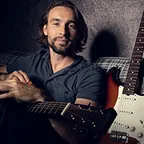
Presenting "The Complete Scale & Arpeggio System," an exhaustive online guitar course available exclusively on TrueFire and masterfully produced by JamPlay. This course is the key to unlocking your potential as a guitarist by providing a comprehensive understanding of scales and arpeggios, integral elements of mastering the guitar.
"The Complete Scale & Arpeggio System" offers an in-depth exploration of the world of scales and arpeggios. You will dive into a wealth of knowledge, learning to navigate the fretboard fluidly, understand scale positions, and construct melodic arpeggios. This will all contribute to increasing your ability to improvise, compose, and truly express yourself through music.
Crafted by professional guitarists with years of experience, the course delivers detailed lessons on major and minor scales, pentatonic scales, modes, and various arpeggio forms. It doesn’t matter if you are a beginner seeking to understand the basics or an advanced player looking to deepen your theoretical knowledge - this course caters to all.
High-quality video lessons can be viewed at your own pace, with the ability to pause, rewind, and fast-forward as needed. Each lesson is complemented by interactive tablature and notation, practice exercises, and play-along tracks to reinforce learning and improve your playing style.
"The Complete Scale & Arpeggio System" is more than just a course; it's an essential toolkit, arming you with the skills and knowledge needed to elevate your musical journey.
What you'll learn
Apply directional rules for box patterns based on string number
Execute the connecting exercise combining half notes and eighth notes
Change arpeggio direction when chords change to create voice-led lines
Connect horizontal single-string playing with vertical box positions
Understand the difference between playing the changes and harmonic generalization
Lance Ruby will kick off this series by introducing and discussing his scale and arpeggio system. This series is designed to give you a familiarity with the fretboard from a scale and arpeggio standpoint so that you can begin the transformation of that knowledge in to playing lead guitar.
Let's get started with the primary tools that you'll use for this course: Box #1 and Box #2. In this lesson, Lance will introduce you to his scale and arpeggio system.
Let's get started with the primary tools that you'll use for this course: Box #1 and Box #2. In this lesson, Lance will introduce you to his scale and arpeggio system.
There are specific rules to the ways Box #1 and Box #2 can be combined. Here, Lance will cover the rules of the combinations going forward.
There are specific rules to the ways Box #1 and Box #2 can be combined. Here, Lance will cover the rules of the combinations going forward.
Intervals are just one of the ways to commit Lance's system to memory. In this lesson, Lance will discuss intervals as well as some useful tools for implementing his system into our improvisations.
Intervals are just one of the ways to commit Lance's system to memory. In this lesson, Lance will discuss intervals as well as some useful tools for implementing his system into our improvisations.
excellent teacher and method for guitar training with triads /arpeggios . camera angles and recording is bar none. highly recommended for intermediate guitarists that need just a little ump added to their playing. 2 thumbs up
H
honeycombkid
Verified buyer
01/13/25
Arpeggios
I was mostly interested in having a reference in all modes (scales?). I was not expecting to contend also with his “ box” system. That said, there is a compelling logic to the system and resulting patterns.
R
Roadstar2
Verified buyer
01/12/25
Describes the intent of the course.
Material is well structured and organized. The course promotes learning the notes on the guitar neck.
A
Ace H.
12/22/24
Somewhat Limited In Usefulness and Bit Scattered Overall
Maybe it's just because I'm coming to this lesson with a decent understanding of the CAGED system, but I find the early reliance on a few patterns in one key, that are so closely tied to that key, to be a frustrating limitation. Lance suggests we take the boxes we've learned (essentially playing out of E and G shapes in CAGED) and then apply them to every key, while also realizing how they are interconnected horizontally on the fretboard so as not to get stuck in boxes. That latter part is great advice, however, based solely on the shapes he provides, that becomes really awkward, really fast in keys that don't fit the patterns as naturally as the key of C. Admittedly, for folks who have kind've built a lot of their understanding of the fretboard around CAGED, anything that isn't CAGED can seem inefficient, inelegant, somewhat clumsy and limiting. . . but still. . . I just feel like the first 25% of this course will be of very limited use to most players just starting to get a feel for the fretboard for anything other than playing in C. I'd also argue it tries to cram in too much. Modes really would best be taught separately, while a longer section on scales and the fretboard, perhaps expanding the early concepts into 5-6 additional keys, would have been more effective. As it stands, this course suffers from the same problems of so many TrueFire course. . . some good info, but often presented in less-than-ideal arrangements. Improving the pedagogical aspect of these, and most lessons on TrueFire, would be really helpful. At the very least, at least Lance tried to give these a good feel of building on each lesson, as opposed to the often completely random feel of a lot of TrueFire courses. I actually think he'd be an excellent one-on-one teacher.