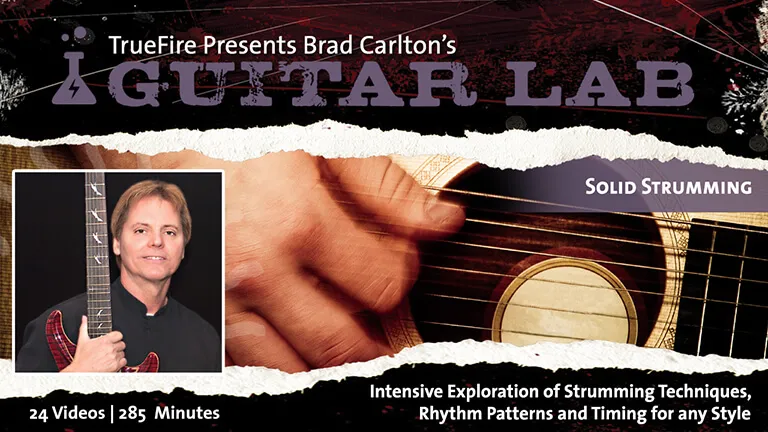
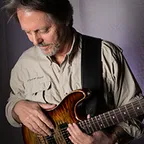
Guitar Lab: Solid Strumming

Intensive Exploration of Strumming Techniques, Rhythm Patterns and Timing for any Style

Marty FriedmanTommy EmmanuelSteve VaiEric GalesEric Johnson

Get this course and 1,000+ more with All Access

Try 14 days free. Cancel any time.

Purchase Individual Course for $5.00
Guitar Lab: Solid Strumming

About this course

Brad Carlton is back with another intensive series of interactive video guitar lessons covering essential techniques and know-how for optimizing your rhythm guitar skills.

As always, Carlton drills down deep, working through all of the basic techniques involved in plectrum rhythm guitar. Topics covered include technical issues such as how to hold the pick, various positions of the wrist and fingers, pick angles, free strokes, rest strokes, accents, palm muting, palm slaps, choking, tonal variation, down and up strokes, string groups, pivot and guide fingers, and ghost strokes.

Carlton also covers the art and science of rhythm as it relates to strumming. From a rhythmic standpoint you will learn to understand quarter notes, eight notes, and 16th notes. You will receive a number of variations involving the mixing of these three different time values to develop an inventory of strum patterns. The question of pick stroke direction will also be explained.

To ice your strumming cake, Carlton takes you to school on the theoretical aspects playing rhythm guitar. From a theory standpoint you will learn the diatonic triads in the following keys: C, G, D, A, and E. You will also receive a chart listing 30 different two chord building block progressions which will develop your facility at changing chords as well as enhancing your ability to hear these progressions. You will be encouraged to be creative by mixing a combination of these diatonic triads.

What you'll learn

  • Navigate between all seven diatonic chords systematically
  • Play reggae and polka feels with proper rhythmic subdivision
  • Apply triplet feel to previously learned 8th note rhythm patterns
  • Count and play triplet rhythms using '1-trip-let' counting method
  • Understand the relationship between drum patterns and triplet rhythms
Release date: 01/05/2012 • 4h 45m runtime
Start Course
Sample lessons
Viewing Chords as Voices
The harmonic approach
Bass Chord Strumming
Straight and swing rhythms
Diatonic Progressions in C
Key of C diatonic progressions
Diatonic Triads in E
Key of E triads

What's included

24 lessons • 3 charts • 1 Jam Tracks

Solid Strummng
View the Guitar as a Drum Kit
This lesson will get you thinking of the guitar as a drum kit. I will demonstrate with muted strings, various rhythms across many styles. You will see how I use the bass strings as the kick drum of the drum kit, and the higher strings as a snare drum. You'll also hear the hi hat throughout the rhythms. This is important because a guitarist has to be rock solid at rhythm. Throughout all the exercises in this course, be sure to practice with a metronome at a tempo that allows you to maintain an even rhythm.
Picking Hand Posture
This lesson covers many facets of the picking hand. The first principle is how to hold the pick. I will demonstrate the principle of relaxation by addressing the muscles of the forearm, wrist, hand, and fingers. Economy of motion is critical for precision, so you will see in the video how to minimize your effort while maintaining accuracy. I will address the following techniques in this video: all four positions of the wrist and fingers, all three pick angles, free strokes, rest strokes, palm mute, palm slap, choke, down strokes, up strokes, and accents.

You will learn how to view strumming as a series of rest strokes which allows you to control the dynamics and tone of each string(voice) of a chord. You will clearly see in the video how dynamics are controlled with the thumb and index finger. To play softer, you hold the pick loosely. To play louder, you simply squeeze the pick harder. This technique is especially effective in creating accents in your strumming.
Viewing Chords as Voices
One of the most important concepts in rhythm guitar is viewing chords as a group of voices. Each string is a voice and as such should be dealt with in regards to dynamics and tonal color. Let's begin with the bass note. For this lesson we will adhere to the following rule: the root of the chord will always be the lowest voice. This is probably one of the most common mistakes that I have witnessed with students. This will train not only your picking hand but also your ear. A great place to start is to just practice picking a particular bass note. Learn to feel where that string is by focusing on all aspects of your picking hand, wrist, and arm. Then use that bass note as the foundation of your strum.

I will demonstrate 26 open position chords that are commonly used in all styles of music. You will learn left-hand dampening in some of these chords as a means of muting both higher pitched and lower pitched strings.
Quarter Note Rhythm
This lesson is rhythm guitar 101. We start with a basic quarter note rhythm which means you will be strumming with each foot tap. Every strum will be a downstroke and your goal is to execute the chord change on beat one. Many times people get concerned with playing all of the previous measures and come in late with the chord change. We will start with level I. Level I would be defined as follows: you strum the chord on beat one and then allow yourself the following three beats of the measure to execute your chord change. Once you can do level I, move to level II which means you strum the chord for two beats and allow yourself only two beats for the chord change. Level III would be three strums with only one beat for the chord change. Your final goal would be level IV which means you strum all four beats and then quickly change to the new chord.

The next principle presented in this lesson is a concept of sharing the texture of your strumming by utilizing different string groups. This develops accuracy with your picking hand.
Eighth Note Rhythm
This lesson deals with eighth note rhythm. Eighth notes are twice as fast as the quarter notes because they ring half as long. Straight eighths are counted one and two and three and four and. We'll adhere to a basic rule at first, up down on the number and up on the and. This will be strict alternate picking.

In the video you will see how I address some up stroke exercises to help you get relaxed and accurate. Only pick two or three strings on your up strokes. Be sure to practice all string groups to develop your accuracy and variety in the texture of your chords.
Quarter - Eighth Note Combos
This lesson combines the quarter notes and the eighth notes to give you a variety of strum patterns. You will receive 16 exercises that demonstrate these various combinations. Adhere to the rule of strict alternate picking for your eighth notes. Once you're comfortable with that approach, then apply consecutive down strokes for eighth notes. These are used for more driving rhythm. I cannot over emphasize the importance of counting every rhythm you play. I guarantee that if you can count it you can play it.

If you're going to be executing a chord change in the next measure, I suggest you use the rhythms that only have a quarter note on beat four. This will give you time to execute the chord change.

+ 17 more lessons

Start Course

Reviews

20 results

237Learner

Verified buyer

11/09/25

A very good course, which enables me to be more creative

Joop

Verified buyer

06/24/25

A great way to improve your strumming

An extensive course to improve your strumming. Brad Carlton is a great teacher learning you everything there is to know. From the basics to the finest details. A must have!

bill27mask

Verified buyer

06/21/25

Everything you need to get your strumming together

Really good coverage of strumming essentials. Highly recommended.

DesmondT1

Verified buyer

01/31/25

Solid Strumming Brad Carlton

Brad gives a very structured approach from how to hold the pick and count time then developing technique through a progression of strumming patterns. I am finding it really helpful to build a solid foundation for my playing

emastin

Verified buyer

01/12/25

Lab review

Easy to follow course. Felt like enough to learn practile things.

Stop searching. Start improving with All Access.

Try 14 days free. Cancel any time.