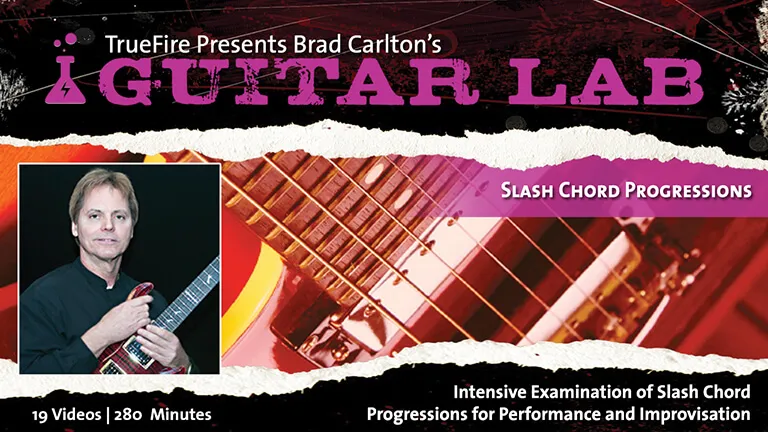
Guitar Lab: Slash Chord Progressions

Intensive examination of slash chord progressions for performance and improvisation

Marty FriedmanTommy EmmanuelSteve VaiEric GalesEric Johnson

Get this course and 1,000+ more with All Access

Try 14 days free. Cancel any time.

Purchase Individual Course for $5.00
Guitar Lab: Slash Chord Progressions

About this course

Slash chords are an effective way of notating inversions of triads, extended harmonies and tension oriented sonorities. The concept of a triad over a bass note serves not only in the solo guitar realm, but also in an ensemble situation in which the bass note is played by the bass player thus freeing up the guitarist both technically and texturally to use major or minor triads in various inversions as a springboard for melodic fills. Another added benefit of viewing harmony via slash chords is the ease of determining which scales to apply for comping and soloing.

In Slash Chord Science, Brad Carlton drills down deep on visualizing major and minor arpeggios and chord voicings over the entire fingerboard, understanding street key versus theoretical key analysis, chromatic bass line options under major and minor chords, and common slash chord formulas applied to bi-chordal progressions.

In Slash Chord Progressions, Carlton goes even deeper by examining three progressions, all of which involve slash chords. The first and third progressions are the easiest to solo over because they are diatonic to the major scale. The second progression is more complex because the chords do not all reside within one key. You will use the same musical tools as progressions one and three, but because you'll be changing keys it will require more knowledge on your instrument.

These three progressions are standard harmonic moves which you'll encounter in all styles of music. Carlton steps you through an intensive series of lessons covering both comping and improvising in the context of these three progressions.

For improvisation, you'll be working with pentatonics, modes and arpeggios learning how to target the notes that define the chord changes to craft a more melodic quality in your soloing. You'll also work with specially prepared jam tracks and charts to help guide you through the process of improvising over slash chord progressions.

This workout will help your ears, your hands, and your brain.

What you'll learn

  • Apply triad arpeggios in multiple positions
  • Use voice leading to create smooth chord transitions
  • Create melodic solos using add9 and sus2 arpeggios
  • Solo vertically by changing pentatonic scales with each chord
  • Comp with moving melodic lines within chord voicings
Release date: 06/30/2011 • 4h 41m runtime
Start Course
Sample lessons
F/D  G/D
F/D G/D
Progressions Part 1
D  Bb/D  C/D
D Bb/D C/D
Progressions Part 1
Dm  Bb/D  C/D
Dm Bb/D C/D
Progressions Part 1
Dm C/D Bb/D G/D
Dm C/D Bb/D G/D
Progressions Part 1

What's included

19 lessons • 10 charts • 1 Jam Tracks

Slash Chord Progressions
Slash chords are an effective way of notating inversions of triads, extended harmonies and tension oriented sonorities. The concept of a triad over a bass note serves not only in the solo guitar realm, but also in an ensemble situation in which the bass note is played by the bass player thus freeing up the guitarist both technically and texturally to use major or minor triads in various inversions as a springboard for melodic fills. Another added benefit of viewing harmony via slash chords is the ease of determining which scales to apply for comping and soloing.

In Slash Chord Science, Carlton drills down deep on visualizing major and minor arpeggios and chord voicings over the entire fingerboard, understanding street key versus theoretical key analysis, chromatic bass line options under major and minor chords, and common slash chord formulas applied to bi-chordal progressions.

In Slash Chord Progressions, Carlton goes even deeper by examining three progressions, all of which involve slash chords. The first and third progressions are the easiest to solo over because they are diatonic to the major scale. The second progression is more complex because the chords do not all reside within one key. You will use the same musical tools as progressions one and three, but because you'll be changing keys it will require more knowledge on your instrument.

These three progressions are standard harmonic moves which you'll encounter in all styles of music. Carlton steps you through an intensive series of lessons covering both comping and improvising in the context of these three progressions.

For improvisation, you'll be working with pentatonics, modes and arpeggios learning how to target the notes that define the chord changes to craft a more melodic quality in your soloing. You'll also work with specially prepared jam tracks and charts to help guide you through the process of improvising over slash chord progressions.

F/D G/D
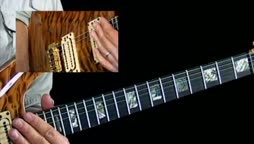
This lesson covers the following progression: F/D to G/D. The accompanying chart can be viewed as follows: column one is the slash chord name, column two is the actual chord name of the harmony, column three is the mode or modes that are applicable, column four is the parent scale for each mode, and column five is the diagram that plots out the information on the fingerboard.Next on this chart is a section entitled horizontal soloing. This is where you can see how to use the minor pentatonic and the blues scale for rock/blues sounds in your soloing.Section three of the chart is titled vertical soloing/arpeggios. As the name implies, this lists the information necessary to define the chord changes in the progression.I will demonstrate how to play over the progression utilizing each of these approaches. We will focus on one area of the fingerboard to allow you to absorb this information more easily. After you have a handle on this material, you can utilize the long fingerboard diagrams to master the entire neck at your own pace.
F/D G/D
This lesson covers the following progression: F/D to G/D. The accompanying chart can be viewed as follows: column one is the slash chord name, column two is the actual chord name of the harmony, column three is the mode or modes that are applicable, column four is the parent scale for each mode, and column five is the diagram that plots out the information on the fingerboard.Next on this chart is a section entitled horizontal soloing. This is where you can see how to use the minor pentatonic and the blues scale for rock/blues sounds in your soloing.Section three of the chart is titled vertical soloing/arpeggios. As the name implies, this lists the information necessary to define the chord changes in the progression.I will demonstrate how to play over the progression utilizing each of these approaches. We will focus on one area of the fingerboard to allow you to absorb this information more easily. After you have a handle on this material, you can utilize the long fingerboard diagrams to master the entire neck at your own pace.
D Bb/D C/D
This lesson covers the following progression: D to Bb/D to C/D. The accompanying chart can be viewed as follows: column one is the slash chord name, column two is the actual chord name of the harmony, column three is the mode or modes that are applicable, column four is the parent scale for each mode, and column five is the diagram that plots out the information on the fingerboard.Next on this chart is a section entitled horizontal soloing. This is where you can see how to use the minor pentatonic and the blues scale for rock/blues sounds in your soloing.Section three of the chart is titled vertical soloing. As the name implies, this lists the information necessary to define the chord changes in the progression using the major pentatonic scale.Section four of the chart is titled arpeggios. This lists various arpeggios starting with triads and moving to more extended harmonies which can be used to solo in a vertical fashion over the progression.I will demonstrate how to play over the progression utilizing each of these approaches. We will focus on one area of the fingerboard to allow you to absorb this information more easily. After you have a handle on this material, you can utilize the long fingerboard diagrams to master the entire neck at your own pace.
D Bb/D C/D
This lesson covers the following progression: D to Bb/D to C/D. The accompanying chart can be viewed as follows: column one is the slash chord name, column two is the actual chord name of the harmony, column three is the mode or modes that are applicable, column four is the parent scale for each mode, and column five is the diagram that plots out the information on the fingerboard.Next on this chart is a section entitled horizontal soloing. This is where you can see how to use the minor pentatonic and the blues scale for rock/blues sounds in your soloing.Section three of the chart is titled vertical soloing. As the name implies, this lists the information necessary to define the chord changes in the progression using the major pentatonic scale.Section four of the chart is titled arpeggios. This lists various arpeggios starting with triads and moving to more extended harmonies which can be used to solo in a vertical fashion over the progression.I will demonstrate how to play over the progression utilizing each of these approaches. We will focus on one area of the fingerboard to allow you to absorb this information more easily. After you have a handle on this material, you can utilize the long fingerboard diagrams to master the entire neck at your own pace.
D Bb/D C/D
This lesson covers the following progression: D to Bb/D to C/D. The accompanying chart can be viewed as follows: column one is the slash chord name, column two is the actual chord name of the harmony, column three is the mode or modes that are applicable, column four is the parent scale for each mode, and column five is the diagram that plots out the information on the fingerboard.Next on this chart is a section entitled horizontal soloing. This is where you can see how to use the minor pentatonic and the blues scale for rock/blues sounds in your soloing.Section three of the chart is titled vertical soloing. As the name implies, this lists the information necessary to define the chord changes in the progression using the major pentatonic scale.Section four of the chart is titled arpeggios. This lists various arpeggios starting with triads and moving to more extended harmonies which can be used to solo in a vertical fashion over the progression.I will demonstrate how to play over the progression utilizing each of these approaches. We will focus on one area of the fingerboard to allow you to absorb this information more easily. After you have a handle on this material, you can utilize the long fingerboard diagrams to master the entire neck at your own pace.
Dm Bb/D C/D
This lesson covers the following progression: Dm to Bb/D to C/D. The accompanying chart can be viewed as follows: column one is the slash chord name, column two is the actual chord name of the harmony, column three is the mode or modes that are applicable, column four is the parent scale for each mode, and column five is the diagram that plots out the information on the fingerboard.Next on this chart is a section entitled horizontal soloing. This is where you can see how to use the minor pentatonic and the blues scale for rock/blues sounds in your soloing.Section three of the chart is titled vertical soloing. As the name implies, this lists the information necessary to define the chord changes in the progression using the major pentatonic scale.Section four of the chart is titled arpeggios. This lists various arpeggios starting with triads and moving to more extended harmonies which can be used to solo in a vertical fashion over the progression.I will demonstrate how to play over the progression utilizing each of these approaches. We will focus on one area of the fingerboard to allow you to absorb this information more easily. After you have a handle on this material, you can utilize the long fingerboard diagrams to master the entire neck at your own pace.

+ 12 more lessons

Start Course

Reviews

3 results

owenerz

Verified buyer

10/03/20

Interesting

There are some lovely ideas in here that will expand your chord playing.

Resojoe

12/02/19

Slash Chords And How To Use Them

I’ve been working with a couple of Brad’s other videos on constructing slash chords and this course put it all together. I wanted to learn how to use slash chords and this course delivers. He starts out simple and builds up to more complicated progressions. Over 4 hours of instruction! I’ll be working with this course for a long time using it as part of my practice routine. Well worth the price!

patrick m.

Verified buyer

11/25/18

I learned a number of new ideas for Understanding cords

Stop searching. Start improving with All Access.

Try 14 days free. Cancel any time.