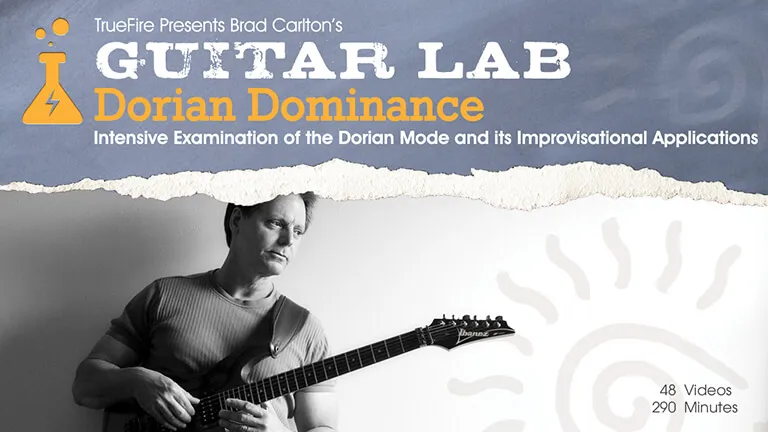
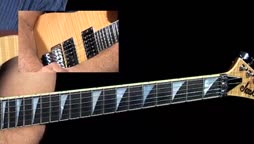
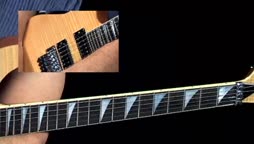
If we had a dollar every time a student asked about the Dorian mode and how to best apply it as a harmonic and improvisational tool, we'd be writing this description from our Tahitian beach palace overlooking the vast blue yonder. Since its doubtful anybody will be funding our Tahitian fantasy anytime soon, we thought we'd unleash Brad Carlton and let him sink his teeth into this intensive Guitar Lab examination covering harmonic, improvisational and comping applications of the Dorian Mode.
As usual, Brad leaves no stone unturned, "We'll explore a wide range of fretboard layouts for the Dorian mode based on various numbers of notes per string. These layouts and the resultant scale forms will provide different avenues of playing this seven-note minor scale, which will break you out of fingering ruts so common among guitarists. You'll also learn the diatonic triads of the Dorian mode so students can start thinking harmonically in a tertiary fashion as opposed to a scalar approach based on intervals of seconds."
Brad steps you through ALL of the 2-note, 3-note and 4-note per string forms across ALL seven traditional position forms of the A Dorian mode. Brad's system of organizing the forms is based upon the lowest available note on the sixth string. Whatever scale degree this starting note is will be the title of that scale form.
"Traditional scale forms reside within a four-fret span with each finger assigned to its respective fret. This allows for a first finger extension and a fourth finger extension enabling you to cover a six fret span. So, for example, the lowest available scale form in the A Dorian mode would be scale form V because the lowest available note on the guitar is a sixth string open which is an E. E is the 5 in A Dorian. This process is repeated with each of the remaining six scale degrees."
In the next section of the course, Carlton covers diatonic seventh chords, heptatonic arpeggios, pentatonic subscales, chords scales, simple intervals ranging from seconds to sevenths, and octaves - ALL relating to the Dorian mode.
In the third section of the course, Brad guides you through compound intervals, root fifth and ninth structures, and various arpeggios and chord voicings all of which are subsets of the Dorian mode. You'll get a grip on arpeggios and voicings for Minor Add9, Minor 7, Minor 9, Minor 11, Minor 13, Minor 7/11, Minor 7/6, Minor 7/6/11, Minor 6, Minor 6/9, Minor 7 sus4, Minor 7/6 sus4, 9 sus4, 13 sus4, sus4, sus2, sus2 sus4, 7 no3, 5 and the A Blues scale.
"The videos will show you how to apply these various groups of notes in both your rhythm guitar and lead guitar playing. You'll receive diagrams showing various layouts of this information on the fingerboard. These diagrams will be written in A Dorian but will be in scale degrees, which allow you to transpose the material into any key."
Brad has also prepared 30 practice rhythm jam tracks to work with throughout the course. The tracks cover a variety of styles and consist of a drum groove and bass line. Each of bass lines will support the A Dorian mode and you'll be working through and exploring the Dorian Mode extensively over these tracks to help you visualize the information on the fingerboard, understand the underlying theory and most importantly, learn how to hear the different colors of the Dorian tonality.
So there you have it; everything you need or want to know about the Dorian mode as a harmonic, improvisational or comping tool. Dig deep!
What you'll learn
Play all four inversions of the minor 6 chord
Create two-part contrapuntal lines using compound intervals as framework
Visualize compound intervals within CAGED/Ed Kegg chord forms
Visualize interval relationships (6 to 1, 6 to 5) across the fretboard
As the title of the course suggests, my goal is to assist you in mastering the Dorian mode. We will accomplish this by viewing various layouts of this scale on the fingerboard based upon the number of notes per string. These layouts and the resultant scale forms will provide different avenues of playing this seven note minor scale which will break you out of fingering ruts so common among guitarists. You'll also receive a lesson presenting the diatonic triads of the Dorian mode. This is where we start thinking harmonically in a tertiary fashion as opposed to a scalar approach based on intervals of seconds.
In this course you will receive 30 jam tracks covering a number of styles. Each jam track consists of a drum groove and a bassline. Each bassline will support the A Dorian mode. You will be encouraged to do a lot of playing along with the jam tracks. This will help you see the information on the fingerboard, understand the theory behind this scale, and learn to hear the different colors of this tonality.
This lesson takes one of the 30 jam tracks which are supplied in this course and presents it for analysis. The bassline on this track consists of the following sequence of notes: G A G A, G A G A C. The A Dorian mode is spelled: A B C D E F# G. The numerical formula for the scale is: 1 2 b3 4 5 6 b7. This means the bassline would be analyzed as: b7 1 b7 1, b7 1 b7 1 b3. As you can see the bassline is a subset of the Dorian mode. By repeating this process with each of the 30 jam tracks you will clearly see how the Dorian mode can be applied over these loops. This will also help you understand how bass lines are constructed using the strong tones of the mode. These strong tones would be the 1, 5, b7, and the b3. These are the four tones which form a minor seven chord. The minor seven chord is the harmonic framework of the Dorian mode.
This lesson presents the seven traditional position forms of the A Dorian mode. My system of organizing these forms is based upon the lowest available note on the sixth string. Whatever scale degree this starting note is will be the title of the scale form. Traditional scale forms reside within a four fret span with each finger assigned to its respective fret. This also allows for a first finger extension and a fourth finger extension enabling you to cover a six fret span. The lowest available scale form in the A Dorian mode would be scale form V because the lowest available note on the guitar is a sixth string open which is an E. E is the 5 in A Dorian. This process is repeated with each of the remaining six scale degrees.As you study the A Dorian mode, you will notice patterns emerging with regard to adjacent notes in the scale. Be sure to memorize the intervallic pattern of this scale. All you need to remember is that the half steps occur between the 2 and b3 and also between the 6 and b7. All the other scale degrees are a whole step apart. This means that if you're viewing groups of three adjacent scale tones, they will fall into the following patterns: whole step half step (1 2 b3 and 5 6 b7), half step whole step (2 b3 4 and 6 b7 1), and whole step whole step (b3 4 5, 4 5 6, b7 1 2).
This lesson will take what you've learned in the previous lesson, the traditional seven scale forms, and turn them into three note per string scale forms. The same system of labeling will be applied and if you've learned the traditional forms, you will have no trouble turning them into three note per string forms. These layouts are one of the most commonly used in modern guitar playing as they are especially useful for triplet scale patterns. Notice how you will be moving in a diagonal line from left to right as you play each scale form.As you study the A Dorian mode, you will notice patterns emerging with regard to adjacent notes in the scale. Be sure to memorize the intervallic pattern of this scale. All you need to remember is that the half steps occur between the 2 and b3 and also between the 6 and b7. All the other scale degrees are a whole step apart. This means that if you're viewing groups of three adjacent scale tones, they will fall into the following patterns: whole step half step (1 2 b3 and 5 6 b7), half step whole step (2 b3 4 and 6 b7 1), and whole step whole step (b3 4 5, 4 5 6, b7 1 2).
This lesson presents a rather unusual layout of the A Dorian mode in that we will only be playing two notes per string. This will create a long diagonal line from right to left on the fingerboard. There are many advantages of learning this layout especially when thinking in terms of arpeggios. There will be seven forms of this two note per string layout; each one being labeled according to the lowest scale degree on the sixth string.
This lesson takes what you learned in your three note per string scale forms and adds one more note on each string. The resultant four note per string scale forms involve duplication. This means that the highest pitched note on each string will be repeated as the lowest pitched note on the next highest string. This is what I term breaking out of “tunnel vision” on the fingerboard. You will be required to stretch beyond what you're accustomed to but if you apply these forms to the higher register of the guitar, you won't feel as challenged. I will also demonstrate how to utilize these forms with legato slides and standard three finger fingerings.As you study the A Dorian mode, you will notice patterns emerging with regard to adjacent notes in the scale. Be sure to memorize the intervallic pattern of this scale. All you need to remember is that the half steps occur between the 2 and b3 and also between the 6 and b7. All the other scale degrees are a whole step apart. This means that if you're viewing groups of four adjacent scale tones, they will fall into the following patterns: whole step half step whole step (1 2 b3 4 and 5 6 b7 1), half step whole step whole step (2 b3 4 5 and 6 b7 1 2), whole step whole step half step (4 5 6 b7, b7 1 2 b3), and whole step whole step whole step (b3 4 5 6).
This lesson involves a four note per string layout of the A Dorian mode without any duplication. What this means is you are going to be covering a lot of fingerboard. Your diagonal line of information will be from left to right and will require you to clearly see the notes. Each scale form is labeled according to the lowest note on the sixth string.As you study the A Dorian mode, you will notice patterns emerging with regard to adjacent notes in the scale. Be sure to memorize the intervallic pattern of this scale. All you need to remember is that the half steps occur between the 2 and b3 and also between the 6 and b7. All the other scale degrees are a whole step apart. This means that if you're viewing groups of four adjacent scale tones, they will fall into the following patterns: whole step half step whole step (1 2 b3 4 and 5 6 b7 1), half step whole step whole step (2 b3 4 5 and 6 b7 1 2), whole step whole step half step (4 5 6 b7, b7 1 2 b3), and whole step whole step whole step (b3 4 5 6).
The Dorian scale is one of the most enjoyable scales to play, and Brad does a fantastic job covering the myriad of ways it can be explored. This course is a great companion piece to his fretboard visualization course, as well as Pat Martino's "Linear Expressions" book for even more Dorian finger work and ideas
S
SoniaMyLove
Verified buyer
11/15/21
Guitar Lab: Dorian Dominance
As always, Brad's view from his experience cannot be over valued.
B
Badabim65
Verified buyer
05/10/21
Very complete and fun to follow.
S
Stephen B.
08/29/19
A Rock In a Moving Universe
I was surprised to find that mine would be the first review of Brad Carlton's dissection of the Dorian Mode. I continually come back to be grounded in the material contained in this course, and I own several hundred Truefire courses. I have linked its A minor nature to the G major (ionian) scale from which it springs, and believe that between the two, I may achieve my dream of knowing the guitar neck in the manner that sets a guitarist free. Never one to spend much time learning songs, I love how the material lets me loose not just on the dorian mode, but also on the natural minor & pentatonic minor (in keys of A, E, & B!) scales, and really, with the G ionian as well. For me, this is a key course, and serves as a springboard to a wider view of music, including Dorian in a multitude of keys. I would very much like to see a following course that might explore the Phrygian Dominant in a similarly microscopic fashion. This would thrill me to no end. Thank you for your hours of work on Dorian Dominance, Brad., and may I say, Well Done!