
Guitar Lab: Big Blues & Beyond

Soloing, Harmony & Technique Tool Kit for Electric Blues Guitar

Marty FriedmanTommy EmmanuelSteve VaiEric GalesEric Johnson

Get this course and 1,000+ more with All Access

Try 14 days free. Cancel any time.

Purchase Individual Course for $5.00
Guitar Lab: Big Blues & Beyond

About this course

Blues players eat, live and breathe off the blues and minor pentatonic scale. At the same time, it's pretty easy to find yourself in the proverbial rut once you've run out of ideas because the harmony is so limited. Brad Carlton to the rescue again with Big Blues and Beyond, an intensive study program focused solely on morphing what you already know into a brand new palette of sounds and textures for electric blues guitar. Big Blues and Beyond will freshen up your vocabulary of single-note and polyphonic moves for both comping and soloing.

The good news is that Carlton will have you working with scales and techniques that are already very familiar to you; blues scale, minor pentatonic scale, blues composite scale, double-stops, triple-stops, pedal tone licks, barres, hammers, bends and slurs. Carlton will show you moves that are already right there under your fingers but just not yet discovered and utilized by you. For example, we all have a solid grip on a few go-to double and triple-stops, but Brad will demonstrate how to employ double and triple-stops across the entire blues, minor pentatonic and blues composite scale forms to produce fresh, great sounding fills, comps and solos.

And because you don't need to learn a lot of new techniques, you'll be able to put these new ideas to work immediately.

As is usual, this Brad Carlton Guitar Lab intensive will open your eyes and ears to some really "Big Blues" ideas by drilling down deep with a singular focus for getting more with what you already know about the blues.

Big Blues and Beyond focuses on the following topics:

>> Blues Scale
>> Minor Pentatonic Scale
>> Blues Composite Scale
>> Barres & Slurs
>> Double Stops
>> Triple Stops
>> Pedal Tones
>> Shuffle Bass Lines
>> Straight Eighth Bass Lines
>> Double Stops
- Root as Upper Voice
- Root as Lower Voice
- 5th as Upper Voice
- 5th as Lower Voice
- b7th as Upper Voice
- b7th as Lower Voice
- b3rd as Upper Voice
- b3rd as Lower Voice
- 4th as Upper Voice
- 4th as Lower Voice
- b5th as Upper Voice
- b5th as Lower Voice
>> Minor Pentatonic
- 6th String Root
- 4th String Root
- 2nd String Root
- 5th String Root
- 3rd String Root
>> Double Stops
- 4th & 5th Strings
- 3rd & 4th Strings
- 2nd & 3rd Strings
- 1st & 2nd Strings
>> Taking It All Further

What you'll learn

  • Apply hybrid picking technique for clean double-stop articulation
  • Create organ-style blues licks using pedal tones
  • Apply double-stop concepts to blues, funk, and rock contexts
  • Understand how different pedal tones create different harmonic colors
  • Develop finger independence for complex double-stop fingerings
Release date: 05/19/2010 • 2h 05m runtime
Start Course
Sample lessons
Double Stops
Double Stops
Root as Upper Voice
Double Stops
Double Stops
Root as Lower Voice
Blues Composite
Blues Composite
Appication
Shuffle Bass Line
Shuffle Bass Line

What's included

31 lessons • 2 charts • 6 Jam Tracks

Big Blues
This course will develop your ability to intergrate polyphonic ideas into your playing which will serve you in both realms of guitar playing: rhythm and lead. I have titled these lessons Big Blues because you will be using the blues scale/minor pentatonic scale as your tonal source in each example. These ideas are not by any means restricted to the blues as you will hear these sounds in rock, funk, country, fusion and jazz.
C Blues Scale
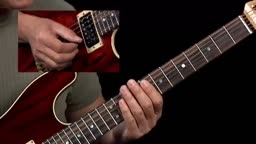
The C blues scale 6th string root form in eighth position is used in this lesson as the tonal framework. Various size barres with the 1st finger are used to play the "low side" of the C blues scale. You then trill (hammer-on and pull-off combinations) the "high side" of the C blues scale. This will help you see the scale on the fingerboard, learn the note names and their respective scale degree labels, and technically you will strengthen your fretting hand.
C Minor Pentatonic
In this lesson we will restrict our tonal frameworks to the C minor pentatonic scale 6th string root form in eighth position.
The minor pentatonic scale degrees: 1, b3, 4, 5, and b7. Notice how it can be viewed as the blues scale without a #4(b5). This scale falls into a two notes-per-string layout which clearly defines a "low" and "high" side (in terms of pitch) border in the 8th fret (low side) and the 10th and 11th frets (the high side).
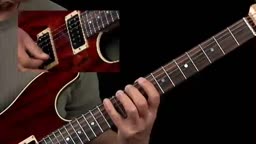
In this lesson you will learn how to play double-stops within this scale form. I'll discuss fingering options and you'll hear some examples of me playing where I blended double-stops with single note soloing. I'll give you tips on vibrato and slurs when playing double-stops.
C Minor Pentatonic
The previous lesson explained the concept of the "low" and "high" sides of the minor pentatonic scale (6th string root form). You were given examples of double-stops on adjacent strings within these two borders of the scale.(Low and high sides)
This lesson applies the same information except we will be playing triple-stops on three adjacent strings. These structures have a more jazzy quality and they lend themselves to a cleaner sound.
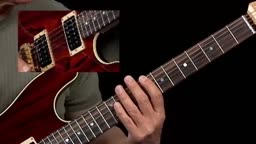
I will explain your fingering options with special emphasis on posture, economy of motion, and of course, those dip joints (the last joint on your finger). You will have to hyperextend these joints which may be uncomfortable but if you want to play well, don't overlook this critical technical issue.
I'll finish this lesson with a recap of the double-stops. I'll also explain the concept of using every other note of the pentatonic scale and how to harmonize a lick with double-stops.
Double Stops
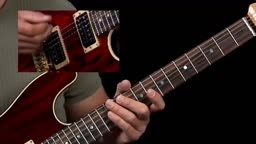
This lesson covers double-stop licks in which the root is the upper voice. The sound produced with this technique will remind you of B3 organ style playing.
We'll begin with the root of the C blues scale 6th string root form in the eighth fret of the 1st string. This will be the upper voice. Then you'll play the C blues scale that exists below it on strings 2 through 4.
This same approach can be used in the lower octave with the root occuring in the tenth fret of the 4th string. You then combine this root with the C blues scale below it.
Double Stops
This lesson covers double-stop licks in which the root is the lower voice. The sound produced with this technique will remind you of B3 organ style playing.
We'll begin with the root of the C blues scale 6th string root form in the eighth fret of the 6th string. This will be the lower voice. Then you'll play the C blues scale that exists above it on strings 5 and 4.
This same approach can be used in the higher octave with the root occuring in the tenth fret of the 4th string. You then combine this root with the C blues scale above it.
Double Stops
This lesson covers double-stop licks in which the 5th is the upper voice. The sound produced with this technique will remind you of B3 organ style playing.
We'll begin with the 5th of the C blues scale 6th string root form in the eighth fret of the 2nd string. This will be the upper voice. Then you'll play the C blues scale that exists below it on strings 3 through 6.

+ 24 more lessons

Start Course

Reviews

3 results

muskymic2

Verified buyer

10/14/24

Excellent as always

Great always Excellent

jeff k.

11/25/22

Amazing!

Brad introduces the 5 position pentatonic system, finds all the strong tones for you and then demonstrates how you can rock out either solo or in a power trio. This guy could make a watermelon sing! It's really amazing how varied his sounds are here. He shows you how, yes, you can use pentatonics for the blues, but also introduces you to funk, hard rock, and jazz atmospherics. You can use this as a wonderful musical warm up or just for fun playing on yr own. The course will grow yr ears!

reslava

02/13/19

Expanding my blues solo sound in awesome new ways

Thanks to amazing guitarist and teacher Brad Carlton I am finding very new ways to improve my skills and knowledge to solo over a blues. Specially if you want to know how you can use double stops this is the course. All Brad's courses I have are awesome and very useful. Thank you very much Brad!

Stop searching. Start improving with All Access.

Try 14 days free. Cancel any time.