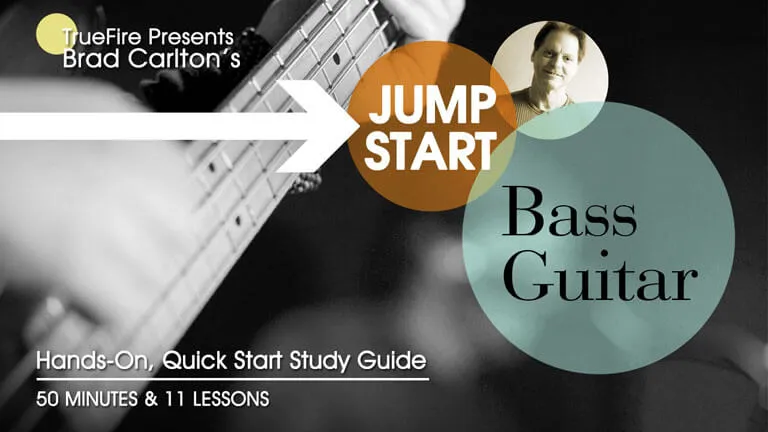
Jump Start Bass Guitar

Hands-on, quick-start guide to bass guitar

Marty FriedmanTommy EmmanuelSteve VaiEric GalesEric Johnson

Get this course and 1,000+ more with All Access

Try 14 days free. Cancel any time.

Purchase Individual Course for $9.99
Jump Start Bass Guitar

About this course

Most beginners believe that they need to know how to read music, understand theory, struggle through boring exercises and learn hundreds of chords to play bass guitar. NOT SO!

Bass guitar is the most popular instrument on the planet because it's also one of the easiest instruments to learn how to play. Thousands of popular bass songs can be played with just a few bass patterns and techniques.

Learn those few patterns and techniques, along with the basics of holding and tuning a bass guitar, and you too will be able to play hundreds of your favorite bass songs. And that's what Jump Start Bass Guitar is all about - a quick, easy, fun and interactive approach for learning how to play bass guitar.

Jump Start Bass starts you off with a series of video lessons showing you how to tune up, hold the pick and position your hands. Next up, you'll start learning the most common picking-hand techniques for bass players. Rhythm patterns and grooves come next with a series of videos showing you a few basic bass lines and rhythmic feels that you would use when playing Rock, Blues, Country, Latin and even a little Jazz. You'll then pull it all together by working with practice rhythm tracks so that you can get comfortable playing with a drummer and keeping the groove!

What you'll learn

  • Play basic blues grooves with swing feel
  • Play latin bass lines with sixteenth note patterns
  • Perform basic jazz walking bass lines
  • Differentiate between straight and swing rhythms
  • Learn how to tune the bass guitar
Release date: 09/12/2011 • 0h 50m runtime
Start Course
Sample lessons
Rhythm 101
Rhythm 101
Straight vs. Swing: the two most important rhythmic feels
Straight Eighth Note Groove
How to create the rhythmic feel for most Rock music

What's included

11 lessons • 6 charts • 5 Jam Tracks

Jump-Start Bass Guitar
Welcome to Jump Start Bass. The purpose of these lessons is to get you up and running playing the bass in the shortest amount of time.

We will accomplish that by covering the basics: how to hold the instrument, tune it, and how to approach each hand in terms of technique and posture. You get practice playing open strings which will allow you to focus exclusively on the picking hand.

This is important because that's the hand that creates your tone. You'll also learn musical principles involving articulation which means how long or short a note is. We will then address the fretting hand with additional emphasis on dampening and articulation.

Next up we will study the basic rhythmic concepts so you'll know how to lock-in with the drums. You will receive 13 jam tracks which you will be playing along with. These are in a number of styles such as: straight eighth rock, slow blues, medium tempo blues shuffles, country grooves, Latin samba, and walking jazz bass. Some of these jam tracks include rhythm guitar which will enable you to experience playing in a trio rhythm section.

Within just a few minutes you will be playing music in a number of styles. You'll also receive a finger board diagram chart labeling all the notes on the bass. Musical examples will be presented in standard notation, bass tablature, and power tab. Everything you need to have a great experience is included in Jump Start Bass Guitar!
Holding and Tuning the Bass
There are two parts to this lesson. In the first half you'll learn how to hold the bass. Since the bass is a rather large instrument with a longer scale length than the guitar, it's important that you hold it in a manner which will allow you access to the notes on the neck.

The video will demonstrate this with many suggestions as to what to avoid so that you are as comfortable as possible.

In the second half of this lesson you will receive some tips on how to tune the bass. It's a good idea to use an electronic tuner which is compatible with the lower frequencies that exist on the bass.
Picking Hand Technique
This lesson focuses exclusively on the picking hand. We will begin with an explanation of an ideal posture which allows maximum tone, dynamic control, and efficiency with a minimal amount of movement. You will learn to alternate your index and middle fingers to provide a foundation for executing higher-speed passages. You'll also learn how to dampen notes for a staccato effect.

Staccato means the note is shortened in duration and is one of the most effective tools for bringing a bass line to life. You will also see how you can move your hand along the string axis for tonal variation.

As a bass player, you always want to have a thick full round tone and it starts with your picking hand. You will learn about rest strokes and their application to produce this tone.
Fretting Hand
Your fretting hand needs to be efficient and strong in order to be able to sustain the constant stream of notes that occur when you're playing the bass. You don't get to bail out and rest when you're a bass player. This lesson will teach you proper hand position to assist you in playing different kinds of bass lines.

You will learn a more relaxed posture utilizing the first and fourth fingers for a three fret span which is especially effective for root-fifth-octave formations. You will also learn a strict one finger per fret approach which allows you to have access to 16 notes in any given position.

It is wise to begin this technique in the higher frets which are closer together and then gradually work your way down the neck as your hand becomes more flexible. A very important secret is to utilize the length of your first finger when you need to execute bigger stretches.
Rhythm 101
This lesson explains some basic rhythmic concepts which are crucial for your success as a bass player. Your job is to lock up with the drums and create a foundation for whatever music you are playing.

The pulse of the music in terms of what makes you want to tap your foot is established with quarter notes. These are the notes that establish the tempo because they receive one beat each. They are counted: one, two, three, four. Many bass lines consist of these quarter notes and you will get practice playing these types of lines.

The next level in rhythm are eighth notes which receive half a beat each. This means they are twice as fast as the quarter notes and can frequently be located in what the drummer is playing on the hi hat and/or ride cymbal. These are counted one and two and three and four and. When you're tapping your foot the numbers occur when your foot is down and the -ands- occur when your foot is up.

It is very important you practice counting while you are tapping your foot so you thoroughly understand what's going on rhythmically. These eighth notes can be played in two different ways: either as straight eighths which are even in rhythm or as swing (shuffle) eighths which are uneven.

These two rhythmic feels define music and you will get a clear definition and demonstration in the video of the these two grooves.
Straight Eighth Note Groove
You get to start playing along with some jam tracks in this lesson and the rhythmic feel will be straight eighth. I will demonstrate a number of variations of quarter note and eighth note combinations. You will also hear various articulations in which I am combining legato and staccato approaches. This means I will play the notes long(legato) or short(staccato). That's where your picking and fretting hand dampening come into play. As I mentioned earlier your jam tracks will be in two formats: drums only and drums with rhythm guitar. This will allow you to practice any note combination on your own with the drum only track.
Swinging Eighth Note Shuffle
This lesson uses the swing(shuffle) eighth note groove as its rhythmic foundation. I will demonstrate a number of variations of quarter note and eighth note combinations against the jam tracks. You will also hear various articulations in which I am combining legato and staccato approaches. This means I will play the notes long(legato) or short(staccato). That's where your picking and fretting hand dampening come into play. Your jam tracks will be in two formats: drums only and drums with rhythm guitar. This will allow you to practice any note combination on your own with the drum only track.

+ 4 more lessons

Start Course

Reviews

6 results

MoSlater

Verified buyer

06/11/25

Jump Start Bass Guitar

Excellent course.
Jsuits

Verified buyer

01/22/21

Starts at the start

True to the truefire way it helps to go from zero to confident in your direction with ease

Jostein A.

07/18/20

A True Jump Start!

I'm a guitar player and I'm mostly self-taught. While that might be a good thing, I also taught myself many bad habits and when I also bought a bass, I decided to avoid the learning mistakes one easily does when one is alone. This course made me up and running in no time and now, some years after, I must say that this course is excellent!

tescot

02/10/20

Bass in Typical Brad Carlton style

I always like the the Jump Start series as they get you up and running with a few short lessons. In this course Brad does his usual style of running though multiple lessons worth of ideas in a single non-stop run. Each lesson could often easily be broken up into 3-5 lessons, but are presented as one combined lesson with multiple skills and skill levels in each lesson. He often explains a track as he is playing new changes from what you just learned and refers to things he taught (presumably you/me) in other courses. While not the simplest method to follow if you read the tab and/or play the sections ahead of time (which is clearly annotated in the tablature) then running though each lesson is a bit easier. Overall, if you keep up with the constant shifting goals provided in each lesson you'll finish the course much more confident about attempting your next more advanced level.

William G.

01/03/20

In the Top Two Beginning Bass Courses and Actually Holds the Key Between Technique and Artistry.

This is an excellent introduction to basic techniques and grooves for bass and will get you up and running immediately. You could complete the first run through of this course in less than 90 minutes. That alone is worth the price of admission. The basic technique is demonstrated as clearly as I've ever seen. On top of that Brad Carleton casually and efficiently shows how technique translates into artistry. For example, check out the section "Straight Eighth Note Groove" to see how he first demonstrates the basic groove but then easily moves into simple variations to keep it interesting. You are shown how to bring 3 notes alive. This is what makes the bass on "Something" by the Beatles (bass by Paul McCartney) or "Desafinado" by Stan Getz (bass by Sebastião Neto) really pop. It defies the cut and paste approach of Pro Tools and defines what makes a live performance memorable. I've never seen that demonstrated quite so quickly, clearly, or offhandedly. Hats off to this educator. If you were just starting, just got your first bass, maybe even don't have the amp yet, I would make this one of the 5 must-have bass lessons from the TrueFire catalogue, if not the top 2 (the other being Stu Hamm's "Bass Basics"). Note: Experienced players will also find something they maybe didn't know, (such as why you tune UP and not DOWN).

Stop searching. Start improving with All Access.

Try 14 days free. Cancel any time.