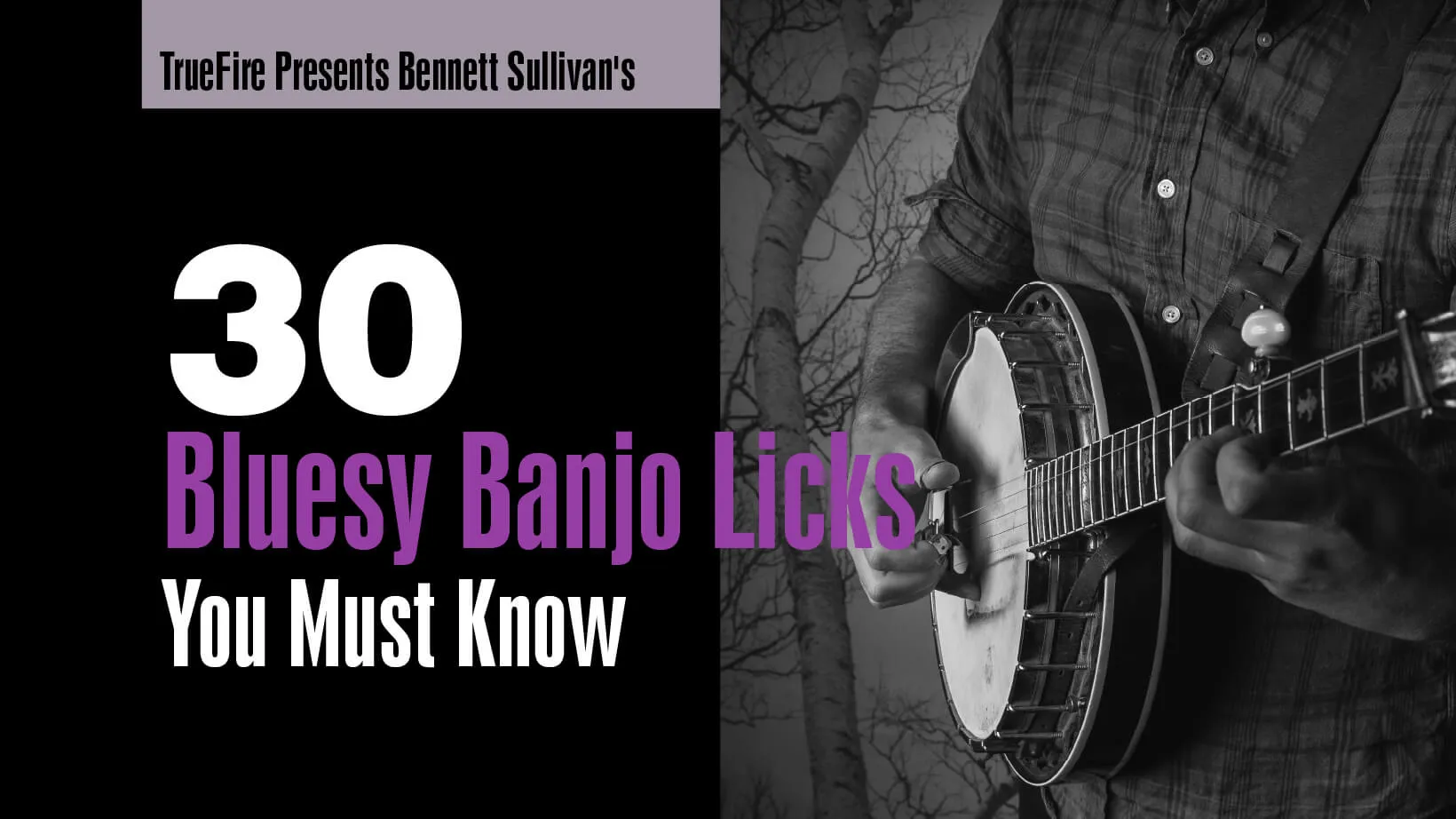
30 Bluesy Banjo Licks

Bluesy Bluegrass Licks, Bends & Phrases

Marty FriedmanTommy EmmanuelSteve VaiEric GalesEric Johnson

Get this course and 1,000+ more with All Access

Try 14 days free. Cancel any time.

Purchase Individual Course for $14.99
30 Bluesy Banjo Licks

About this course

Bennett Sullivan’s collection of 30 Bluesy Banjo Licks will majorly expand your vocabulary of Bluegrass banjo licks, bends and bluesy phrases.

"Whether you’re creating contemporary banjo songs or jamming over traditional bluegrass tunes, tying in some bluesy licks, bends, and phrasing is a great way to add more dimension to your sound and broaden your appeal beyond the scope of traditional bluegrass music.

To help build out your bluesy banjo vocabulary, I’ve put together this collection of 30 licks which you can incorporate into your playing as is, or tweak them and make your own.

In this collection, we’ll explore bluesy banjo lines over backing tracks in G, C, and D – the most common open positions, which can be connected together to create longer lines and can also be easily transposed with a capo.”


You’ll have all of TrueFire’s advanced learning tools at your finger tips to personalize your workspace and learn at your own pace.

You can loop, slow down, or speed up any section of a lesson. Plus, all of the tab and notation is synced to the videos for the optimal learning experience. You’ll also get tab and standard notation files to print out, Guitar Pro files, and all of the backing tracks to practice with.

Grab your banjo, and let’s dig in with Bennett Sullivan!

What you'll learn

  • Use bends on the fourth string effectively
  • Navigate position shifts smoothly from 2nd to 12th fret
  • Navigate position shifts with spider-like finger movements
  • Create tension and resolution through bending and tonic notes
  • Apply ninth chord voicings in bluesy context
Release date: 08/02/2023 • 1h 20m runtime
Start Course
Sample lessons
Rice Repetition: G
Rice Repetition: G
Bluesy Banjo Lick 5
Backwoods Bend: G
Backwoods Bend: G
Bluesy Banjo Lick 8
Down Home Riff: C
Down Home Riff: C
Bluesy Banjo Lick 17
Mountain Vibes: C
Mountain Vibes: C
Bluesy Banjo Lick 19

What's included

32 lessons • 30 charts • 10 Jam Tracks

30 Bluesy Banjo Licks
Hey, I'm Bennett Sullivan. Whether you’re creating contemporary banjo songs or jamming over traditional bluegrass tunes, tying in some bluesy licks, bends, and phrasing is a great way to add more dimension to your sound and broaden your appeal beyond the scope of traditional bluegrass music.

To help build out your bluesy banjo vocabulary, I’ve put together this collection of 30 licks which you can incorporate into your playing as is, or tweak them and make your own.

In this collection, we’ll explore bluesy banjo lines over backing tracks in G, C, and D – the most common open positions which can be connected together to create longer lines and also easily transposed with a capo.

Grab your banjo and let’s dive in.
Chromatic Kickoff: G
In this lesson, you will learn how to play a lick referred to as the "chromatic kickoff" in the key of G. This term refers to a technique involving chromaticism, which starts the lick from a specific position. The lesson provides a step-by-step walkthrough of the process, starting with placing your middle and index fingers on the sixth and fourth frets of the second and first strings, respectively. The 'trickiest' part involves stretching your pinky out to the eighth fret after performing a chromatic sequence. The next part of the lesson instructs you to keep your middle finger on the sixth fret and release your other fingers, followed by a shift of your middle finger to the third fret on the second string, enabling you to transition to the next position for the lick.
Single String Pull-off: G
In this lesson, we will cover the execution of a banjo lick termed the "single string pull-off". This technique gets its name from the initial pull-off action followed by a single string lick to complete the sequence. The lesson begins with a detailed breakdown of the steps involved, starting with a pull-off and placing your ring finger on the fifth fret of the first string. This particular style is reminiscent of Ron Block's nuanced playing, where he often bends a string or pulls it off and replays the same note immediately for a unique effect.

The lesson continues with the introduction of a melodic phrase akin to Bill Keith's style, wherein your ring finger moves up to the sixth fret of the second string and your index finger goes down to the first fret of the same string. This marks the transition into the bluesy or single string lick. In terms of right-hand technique, the lesson emphasizes the importance of string alternating, using the thumb and index finger on the third and fourth strings, respectively. This might feel unusual as it involves crossing the index finger up to the fourth string, a maneuver not frequently used but common in single string playing. The lick concludes with the Block-inspired sequence, followed by the single string part, ending on the third string with your thumb.
Syncopated Single: G
In this lesson, you will learn how to play a banjo lick called "Syncopated Single String," which involves the use of syncopated style influenced by Ron Block. The lick is a variation of a previously discussed one, also ending with a single string phrase, all in the key of G. The lesson starts by demonstrating how the lick sounds before breaking it down into detailed steps.

One of the significant elements of this lick is the syncopated beginning. Similar to the previous lick, this technique extends into a more bluesy note, B flat, found on the first string's eighth fret. This lesson introduces the concept of 'bouncing' on the fifth string between the melody notes. The following part of the lick brings in elements reminiscent of Tony Rice's style, and it involves a single string phrase shifting from the second fret to the first on the second string. This right-hand pattern includes alternating between your index finger and thumb on the third string, followed by your thumb on the fourth string's third fret, and concluding with an open third string. Enjoy practicing this new lick!
Chromatic Tension: G
In this lesson, we will cover the nuances of the fourth bluesy banjo lick, which I refer to as "chromatic tension." The name originates from the lick's structure, which commences with a descending chromatic line and concludes without a resolving note, thus creating a sense of musical tension. After demonstrating the lick, the lesson provides a breakdown of the steps involved in its execution.

The lick begins with a hammer-on using your ring finger on the first string's third fret, followed by a consistent forward roll pattern in your right hand that follows a 5, 2, 1 repeating pattern. An essential aspect of this lick is that each time your index finger hits the second string, the note descends chromatically, not reaching the B note, but ending on a C note.

The lack of resolution at the end of the lick creates tension, leaving room for creativity. You have the choice to resolve it in different ways, such as moving up to G, down to C, or even transitioning to D, thereby adding versatility to this lick. This lesson encourages you to experiment and enjoy playing around with the chromatic tension lick.
Rice Repetition: G
In this lesson, we will cover the fifth bluesy banjo lick known as "Rice Repetition," named so due to its repetitive bluesy style reminiscent of Tony Rice's guitar playing. This lick is in the key of G and demonstrates how the blues scale used frequently by Rice on the guitar transfers seamlessly to the banjo. The structure of this lick is flexible, allowing for extension beyond its basic form if desired.

The lick begins with a pull-off from the second to the first fret on the second string, which is typically played with emphasis to set the rhythm. The entire lick consists of single string playing, akin to flat pick guitar playing. The right-hand technique involves a simple alternating pattern between the index finger and thumb. The complexity increases when the index finger is brought down to the open fourth string, followed by the thumb crossing over to hit the open third string. The beauty of this lick is its extendability—you can keep playing it for as long as you wish. Although this might test your fellow musicians' patience, it's an enjoyable lick to play and offers a great way to conclude. Enjoy practicing this entertaining lick!
Closed Doubles: G
In this lesson, we will learn about the sixth bluesy banjo lick, referred to as "Closed Doubles." This lick, played in the key of G, is named as such due to the closed position it is played in, which allows for transposition anywhere on the neck, and the double stops and double pull-offs featured at the end of the lick.

This lick is especially effective when playing blues, particularly a 12-bar blues progression. Its adaptability allows you to play it over G, C, and D chords, proving useful for maintaining a groove or backing up a solo. The 'doubles' aspect of the lick comes from performing a double stop at the fifth fret, barring like a C chord. After placing your ring finger on the seventh fret of the third string and your middle finger on the sixth fret of the second string, you perform a double pull-off. This technique provides a unique sound rarely heard on the banjo. This lick starts with a hammer-on, which helps establish its groove. It's a versatile and fun lick to incorporate into your banjo playing, so enjoy experimenting with it!

+ 25 more lessons

Start Course

Reviews

2 results

joshmatthews

Verified buyer

01/09/25

Fun Stuff!
ero1965

Verified buyer

12/25/23

Vokabulare

I want to expand my vokabulare. Benneth is clear and precise and this is easy to understand.

Stop searching. Start improving with All Access.

Try 14 days free. Cancel any time.