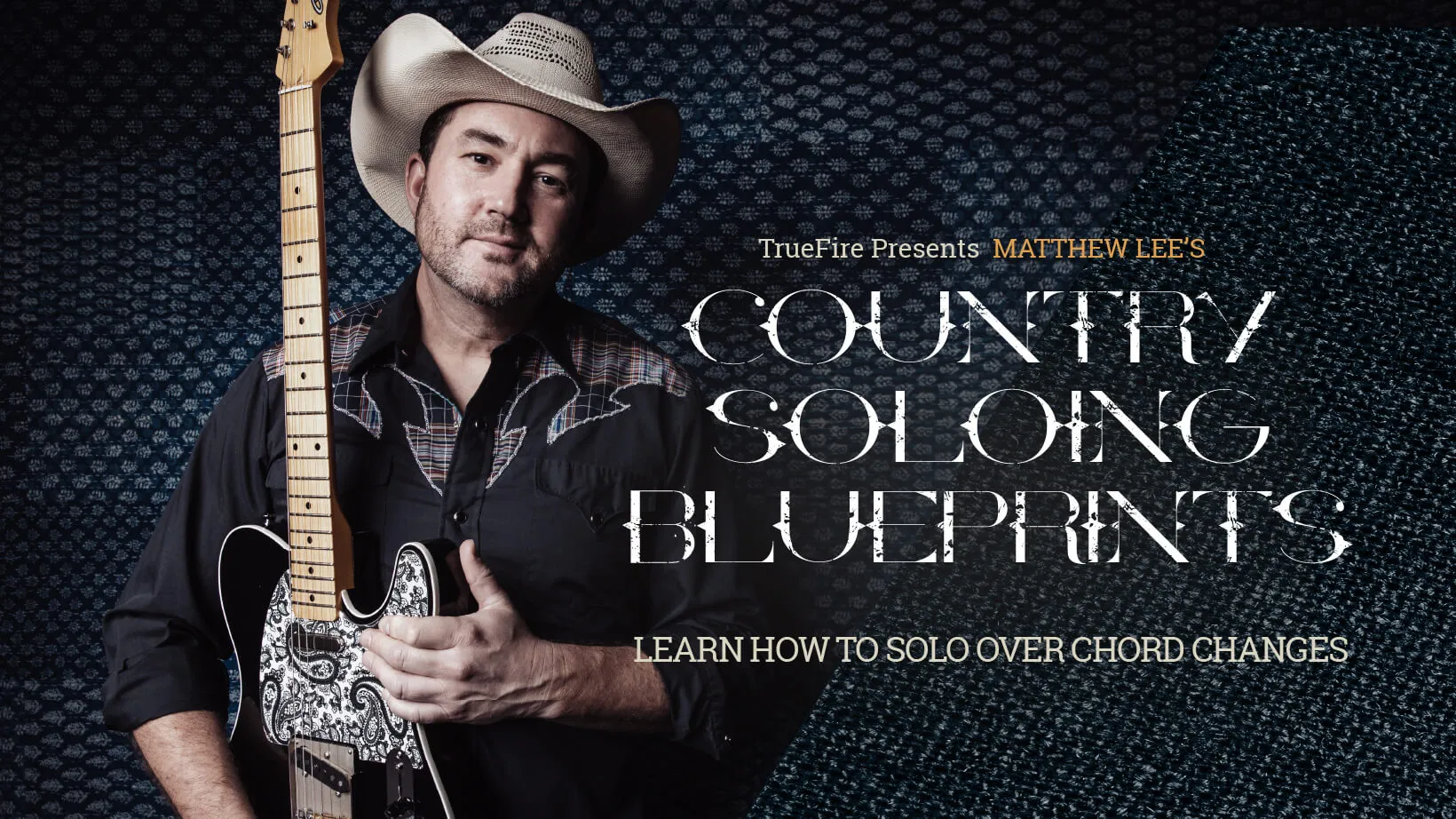

Country Soloing Blueprints

Learn How To Solo Over Chord Changes

Marty FriedmanTommy EmmanuelSteve VaiEric GalesEric Johnson

Get this course and 1,000+ more with All Access

Try 14 days free. Cancel any time.

Purchase Individual Course for $19.99
Country Soloing Blueprints

About this course

Learning how to solo over chord changes is a critical milestone for country guitarists and the key to crafting more melodic, interesting solos and improvisations. There are many approaches for learning how to “play the changes” but selecting which approach is best for a player can be a confusing and challenging undertaking for most players.

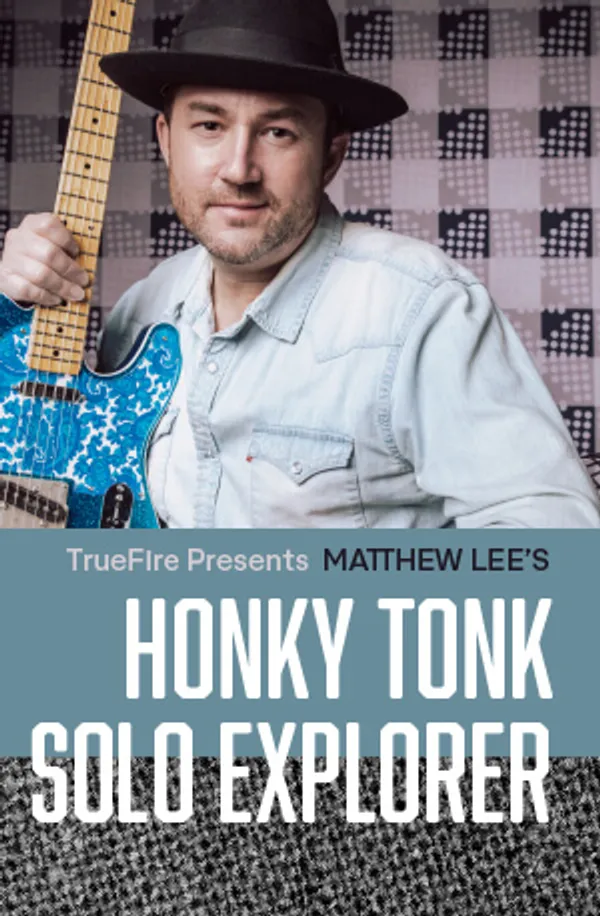
Matthew Lee’s Country Soloing Blueprints reveals an approach that many professional players embrace because of its simplicity and how quickly players are able to analyze any song or chord progression and start soloing over all of the chord changes.

”I’ve found that the easiest and quickest way to learn how to “play the changes” is to follow a simple, step-by-step “blueprint”, which I’ll share with you in this course.

We’ll work with four commonly encountered progressions and start by developing a vocabulary of phrases for each individual chord. We then connect our phrases, over the entire progression, to craft a seamless solo across all of the chord changes.”


Matthew will explain and demonstrate all of the key concepts and approaches along the way. You’ll get standard notation and tabs for all of the licks. Plus, you’ll be able to use TrueFire’s learning tools to sync the tab and notation to the video lesson.

You can also loop or slow down the videos so that you can work with the lessons at your own pace. All of the backing tracks are also included to work with on your own.

Grab your guitar, and let's dig in with Matthew Lee!

What you'll learn

  • Combine rock and roll playing with country chicken picking techniques
  • Apply different licks over individual chords in a progression
  • Construct two-bar phrases over a four on the floor groove
  • Build a complete solo incorporating multiple stylistic elements
  • Develop phrasing skills by incorporating two-bar breaks between licks
Release date: 06/16/2022 • 2h 45m runtime
Start Course
Sample lessons
SECTION 3: Rockin' Country
Overview
Licks for the 1 Chord
Demonstration
1 Chord Workout
1 Chord Workout
Practice Session
Rockin' Country Solo
Performance

What's included

44 lessons • 30 charts • 17 Jam Tracks

Country Soloing Blueprints
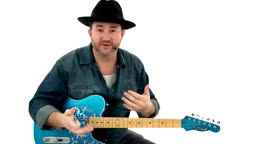
Hey, Matthew Lee here!

Learning how to solo over chord changes is an important milestone for country guitarists and the key to crafting more melodic, interesting solos and improvisations.

I’ve found that the easiest and quickest way to learn how to “play the changes” is to follow a simple, step-by-step “blueprint”, which I’ll share with you in this course.

We’ll work with four commonly encountered progressions and start by developing a vocabulary of phrases for each individual chord. We’ll then connect our phrases, over the entire progression. Simple and very effective!

Everything is tabbed and synced to the video. You can slow down or loop any video to learn at your own pace.

Grab your guitar and let’s go!
SECTION 1: Straight Tropical
In this first progression over a tropical feel ( think Zach Brown, Kenny Chesney, Jimmy Buffet) I'll show you how to construct licks based on thinking about one chord at a time. We will work with thinking in portions of the neck in box patterns, ascending and descending lines.
Licks for the 1 Chord
We start with the first chord in this progression using box and ascending and descending lick ideas. Each lick will have different themes and techniques used. All examples in this first section are diatonic to the key of C.
1 Chord Workout
We start with the first chord in this progression using box and ascending and descending lick ideas. Each lick will have different themes and techniques used. All examples in this first section are diatonic to the key of C.
Licks for the 4 Chord
We now move to the second chord in this progression working through the same concept of box, ascending and descending lines. Still within the diatonic key of C . The ideas are borrowed from the Lydian Scale or fourth degree of C major.
4 Chord Workout
We now move to the second chord in this progression working through the same concept of box, ascending and descending lines. Still within the diatonic key of C . The ideas are borrowed from the Lydian Scale or fourth degree of C major.
Licks for the 5 Chord
The third and final chord will have a Mixolydian sound as its a C major scale starting on G. Note the use of the tritone in this example.

+ 37 more lessons

Start Course

Reviews

6 results

arpeggio5

Verified buyer

02/03/26

very well explained and clear

fogerty

Verified buyer

01/09/23

Hi everybody! Excellent licks and perfect explanations. Although I can understand English, I would also be good in Spanish. Extraordinary teacher and incredible guitarist who encourages you to continue. Thanks for the good work.

dspoling

Verified buyer

11/04/22

Country Soling Blueprints Review

This is an excellent course. Mathew Lee is a clear and effective instructor. I very much enjoy his solo building approach - the Blueprint - of applying box shaped, ascending and descending licks to song chord progressions. Matthew reviews and evaluates each song's structure before diving into the licks. This is very helpful in applying licks to build solos for real world songs (rather than just learning stand-alone licks).

dbeuttner

Verified buyer

08/31/22

Country Soloing Blueprints

This course will help you to start putting your country chops together and start thinking about the chords you're playing over. Definitely helped my playing.

NowhereRoad

08/01/22

This is how you teach!!!!

Matthew lays out these lessons so perfectly. As we listen to the track, he explains what you're hearing with the beat and chord changes, etc. and explains his approach very well. I love the way the lessons are divided into multiple I chord/ IV chord, etc. licks in position, descending, and ascending. You learn multiple licks to play over each chord and even ways to connect the changes. Then you learn how to put it all together and wrap it all up with a complete solo. In my opinion, Truefire should try to use this layout for as many lessons as possible. This layout very efficiently fills in the blanks that are missing in so many courses. Outstanding job by Matthew and the entire Truefire team.

Stop searching. Start improving with All Access.

Try 14 days free. Cancel any time.