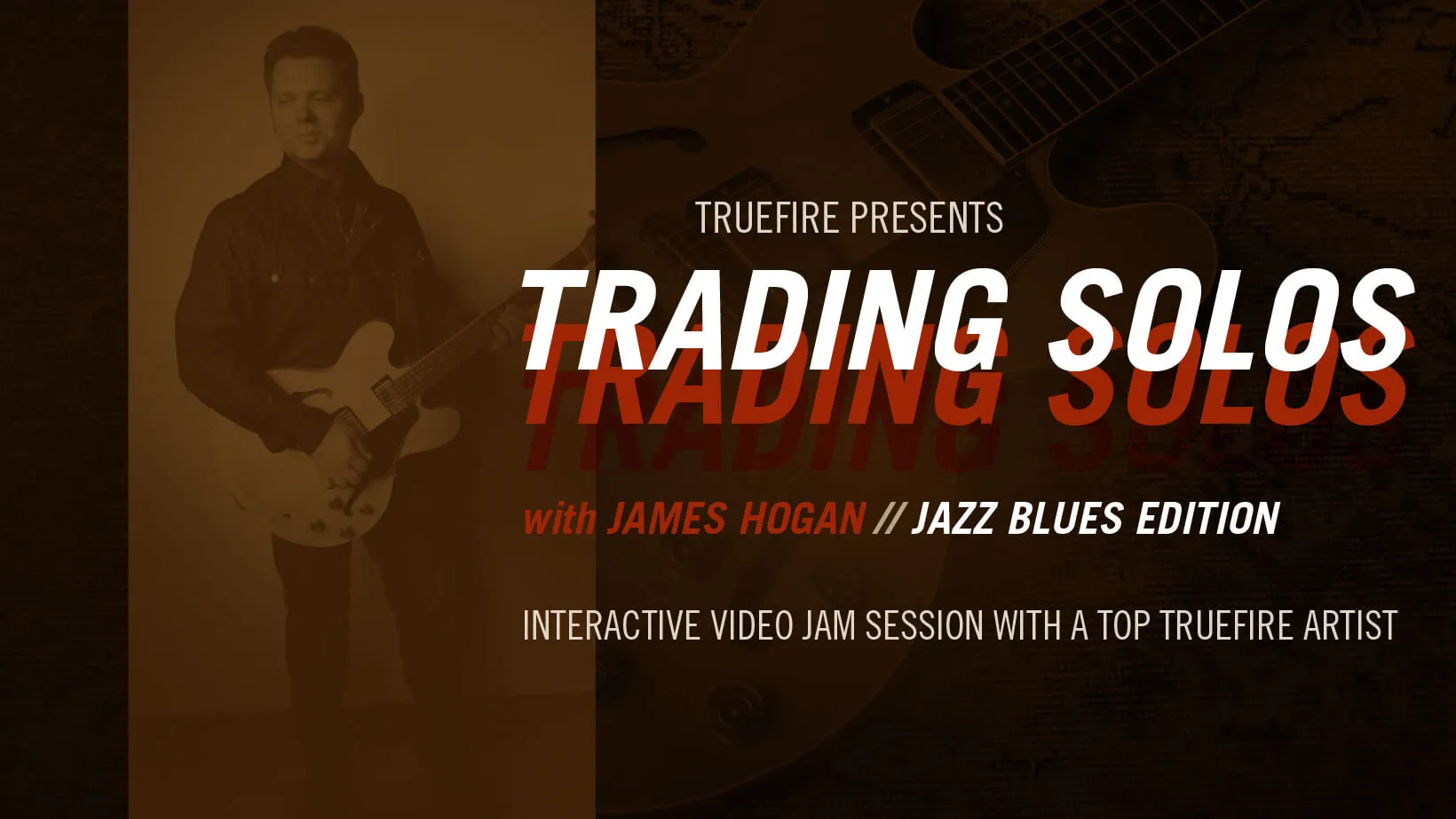
Trading Solos: Jazz Blues Vol. 2

Interactive Video Jam Session with a Top TrueFire Artist

Marty FriedmanTommy EmmanuelSteve VaiEric GalesEric Johnson

Get this course and 1,000+ more with All Access

Try 14 days free. Cancel any time.

Purchase Individual Course for $9.99
Trading Solos: Jazz Blues Vol. 2

About this course

No one would argue that one of the most effective ways you can become a better guitarist is to play with other musicians. That's where the real learning happens. By sitting in at jam sessions, interacting with the rhythm section, and playing behind soloists, you can hone your comping chops and learn how to improvise compelling solos yourself.

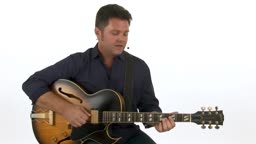
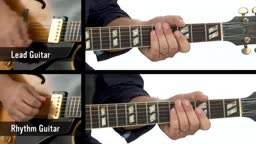
In James Hogan’s Jazz Blues edition of Trading Solos, you’ll jam with James over five popular jazz blues grooves, in a variety of keys and feels. James kicks off the course sharing some tone tips to help you get a great ‘jazz blues’ sound. And then for each of the five grooves, James shows you a handful of moves and comping approaches. You’ll then take turns applying those ideas, trading solos, and comping for each other over the tracks.

”We’ll jam together over five killer jazz-blues grooves in a variety of keys, tempos , and feels. We’ll play over a killer organ trio shuffle in B flat, a classic jazz blues in F with some altered chords and two fives, a modal waltz inspired by the great Miles Davis, a swingin’ jazz minor blues, and finally a :"bird" blues in F inspired by jazz genius Charlie Parker. You'll be able to jam along together on screen, checkout the tabs and chord charts, and follow along with video synced tab, too. This is gonna be fun!”

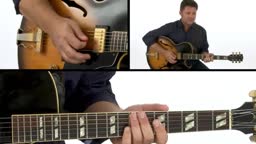
James will explain and demonstrate all of the key concepts and approaches along the way. You’ll get standard notation and tabs for all of the key examples and performance studies. Plus, you’ll be able to use TrueFire’s learning tools to sync the tab and notation to the video lesson. You can also loop or slow down the videos so that you can work with the lessons at your own pace. All of the backing tracks are included to work with on your own as well.

Grab your guitar and let’s trade solos with James Hogan!

What you'll learn

  • Practice trading solos with another musician in a structured format
  • Practice switching between soloist and accompanist roles
  • Understand the structure of chorus-based improvisation
  • Develop listening skills and musical conversation abilities
  • Develop comping skills while another musician solos
Release date: 02/13/2020 • 1h 47m runtime
Start Course
Sample lessons
Track 3: Modal Waltz
Track Overview
Track 3: Modal Waltz
Three Rhythm Ideas: Demo
Track 3: Modal Waltz
Three Soloing Ideas: Demo
Track 3: Modal Waltz
Playalong Preview

What's included

28 lessons • 15 charts • 5 Jam Tracks

Trading Solos: Jazz Blues
Hi, I'm James Hogan. Welcome to this Jazz Blues edition of Trading Solos! In this course, we'll jam together over five killer jazz blues grooves in a variety of keys, tempos and feels. Swing 1/8th's, shuffle grooves, modal waltzes, minor blues grooves and uptempo bebop will all be covered in this gem of a course. For each of the five examples, I'll teach you a handful of great licks and comping ideas that you both can use when trading solos and comping for one another. You'll be able to jam along on screen, checkout the tabs and chord charts provided, and follow along with synced tab, too. In addition, I'll offer insight on gear and how to get a great jazz blues tone!

I'm really excited about this course! If you aspire to play jazz and work with other musicians, it's vital to know how to listen, get a great sound, play the changes, solo with intent, comp to support soloists, play with dynamics and most importantly swing! Along with some of my own licks and tricks, I'll show you how the jazz greats have inspired my playing in this style, and Look forward to jamming along! This is gonna be fun!
Jazz Blues Style Tips
If you're looking for a more traditional sound like the recordings from the 1950's-60's, I'd recommend an archtop guitar and an amp with at least 35 watts. A lot of the classic albums were cut using Gibson L5's, ES 150's, ES-175's, ES-330's, ES-335's and Super 400's, along with Epiphone variants, though there are many derivatives of those guitars out there nowadays. Often those classic Gibson guitars were paired with tweed & blackface Fender tube amps along with Ampegs, Gibsons and others, which is why there's often a little bit of grit in the guitar sound on those old Grant Green, Wes Montgomery and George Benson records, especially in an organ trio setting! Players had to dime those small amps to keep up with the B3's so there was often some crust in the sound. That being said, there are clips of Joe Pass killing it on a Fender Jaguar, Les Paul, Pat Martino, George Benson and others swinging out on Les Pauls, Ed Bickert, and others on Teles, etc.

Solid state amps like Standels, Polytones and Roland JC120's were the go to amps in the 70's & 80's. Anything goes though, especially nowadays. Many modern players use solid body guitars and pedals to get their sound. The main objective is to get a big fat sound that blends in with other instruments. You also want to be inspired when you play! Portability is a concern for a lot of people too, so that may affect your purchase decision. Fortunately, we are in a Golden Age for guitar gear so there are many options out there for you in many sizes & price points. For me, it all depends on the gig. I typically bring out a 335 or Tele with my '64 Bandmaster and pedalboard. Since the Bandmaster lacks reverb, I use a pedal for that, along with a clean boost to fatten up the tone. I keep things fairly traditional, though I sometimes like to use an overdrive when following a B3 player, or tenor player who's playing at 400db and hitting splits!
Track 1: Bb Shuffle
For our first example we'll dig into a killer blues shuffle in Bb. You can't have a blues course without a shuffle! The track we'll be playing over is a really fun, mid-tempo groove that's a staple in jazz blues. You'll hear this type of shuffle a lot in organ trio settings and it's a great groove for us to get started on. This is basically a traditional 12-bar blues in Bb with a hip turnaround. We'll start with this straight-forward progression, develop some ideas, and then ramp things up as we go through the course!

Why blues in Bb? Keys like F, Bb, Eb, Ab, Db, etc. are very common in jazz. This is largely due to the transposition of instruments like tenor saxophone and Bb trumpet. For example, if concert instruments (guitar, piano, flute, etc.) are in Bb, then tenor sax and trumpet will be in C. Nice for them! Also, jazz singers tend to prefer flat keys so keep that in mind.

The biggest thing to take away from this 1st example is the feel. It's really important to lock into the groove and swing! Dig into those 1/4 notes and swing the 1/8th notes. We'll be trading some solos and comping for each other so it'll definitely be a lot of fun! Also, before we jam on this I'll show you some nice chord moves and a few classic licks we can use when trading solos. For reference, check out any Jimmy Smith, Jack McDuff or Don Patterson record! I also recommend listening to organ trio records from Wes Montgomery, Pat Martino, George Benson, Grant Green, Kenny Burrell, Joey DeFrancesco, Dr. Lonnie Smith, Larry Goldings and others. Dig it!
Track 1: Bb Shuffle
For our first example we'll dig into a killer blues shuffle in Bb. You can't have a blues course without a shuffle! The track we'll be playing over is a really fun, mid-tempo groove that's a staple in jazz blues. You'll hear this type of shuffle a lot in organ trio settings and it's a great groove for us to get started on. This is basically a traditional 12-bar blues in Bb with a hip turnaround. We'll start with this straight-forward progression, develop some ideas, and then ramp things up as we go through the course!

Why blues in Bb? Keys like F, Bb, Eb, Ab, Db, etc. are very common in jazz. This is largely due to the transposition of instruments like tenor saxophone and Bb trumpet. For example, if concert instruments (guitar, piano, flute, etc.) are in Bb, then tenor sax and trumpet will be in C. Nice for them! Also, jazz singers tend to prefer flat keys so keep that in mind.

The biggest thing to take away from this 1st example is the feel. It's really important to lock into the groove and swing! Dig into those 1/4 notes and swing the 1/8th notes. We'll be trading some solos and comping for each other so it'll definitely be a lot of fun! Also, before we jam on this I'll show you some nice chord moves and a few classic licks we can use when trading solos. For reference, check out any Jimmy Smith, Jack McDuff or Don Patterson record! I also recommend listening to organ trio records from Wes Montgomery, Pat Martino, George Benson, Grant Green, Kenny Burrell, Joey DeFrancesco, Dr. Lonnie Smith, Larry Goldings and others. Dig it!
Track 1: Bb Shuffle
For our first example we'll dig into a killer blues shuffle in Bb. You can't have a blues course without a shuffle! The track we'll be playing over is a really fun, mid-tempo groove that's a staple in jazz blues. You'll hear this type of shuffle a lot in organ trio settings and it's a great groove for us to get started on. This is basically a traditional 12-bar blues in Bb with a hip turnaround. We'll start with this straight-forward progression, develop some ideas, and then ramp things up as we go through the course!

Why blues in Bb? Keys like F, Bb, Eb, Ab, Db, etc. are very common in jazz. This is largely due to the transposition of instruments like tenor saxophone and Bb trumpet. For example, if concert instruments (guitar, piano, flute, etc.) are in Bb, then tenor sax and trumpet will be in C. Nice for them! Also, jazz singers tend to prefer flat keys so keep that in mind.

The biggest thing to take away from this 1st example is the feel. It's really important to lock into the groove and swing! Dig into those 1/4 notes and swing the 1/8th notes. We'll be trading some solos and comping for each other so it'll definitely be a lot of fun! Also, before we jam on this I'll show you some nice chord moves and a few classic licks we can use when trading solos. For reference, check out any Jimmy Smith, Jack McDuff or Don Patterson record! I also recommend listening to organ trio records from Wes Montgomery, Pat Martino, George Benson, Grant Green, Kenny Burrell, Joey DeFrancesco, Dr. Lonnie Smith, Larry Goldings and others. Dig it!
Track 1: Bb Shuffle
For our first example we'll dig into a killer blues shuffle in Bb. You can't have a blues course without a shuffle! The track we'll be playing over is a really fun, mid-tempo groove that's a staple in jazz blues. You'll hear this type of shuffle a lot in organ trio settings and it's a great groove for us to get started on. This is basically a traditional 12-bar blues in Bb with a hip turnaround. We'll start with this straight-forward progression, develop some ideas, and then ramp things up as we go through the course!

Why blues in Bb? Keys like F, Bb, Eb, Ab, Db, etc. are very common in jazz. This is largely due to the transposition of instruments like tenor saxophone and Bb trumpet. For example, if concert instruments (guitar, piano, flute, etc.) are in Bb, then tenor sax and trumpet will be in C. Nice for them! Also, jazz singers tend to prefer flat keys so keep that in mind.

The biggest thing to take away from this 1st example is the feel. It's really important to lock into the groove and swing! Dig into those 1/4 notes and swing the 1/8th notes. We'll be trading some solos and comping for each other so it'll definitely be a lot of fun! Also, before we jam on this I'll show you some nice chord moves and a few classic licks we can use when trading solos. For reference, check out any Jimmy Smith, Jack McDuff or Don Patterson record! I also recommend listening to organ trio records from Wes Montgomery, Pat Martino, George Benson, Grant Green, Kenny Burrell, Joey DeFrancesco, Dr. Lonnie Smith, Larry Goldings and others. Dig it!
Let's Trade Solos
For our first example we'll dig into a killer blues shuffle in Bb. You can't have a blues course without a shuffle! The track we'll be playing over is a really fun, mid-tempo groove that's a staple in jazz blues. You'll hear this type of shuffle a lot in organ trio settings and it's a great groove for us to get started on. This is basically a traditional 12-bar blues in Bb with a hip turnaround. We'll start with this straight-forward progression, develop some ideas, and then ramp things up as we go through the course!

Why blues in Bb? Keys like F, Bb, Eb, Ab, Db, etc. are very common in jazz. This is largely due to the transposition of instruments like tenor saxophone and Bb trumpet. For example, if concert instruments (guitar, piano, flute, etc.) are in Bb, then tenor sax and trumpet will be in C. Nice for them! Also, jazz singers tend to prefer flat keys so keep that in mind.

The biggest thing to take away from this 1st example is the feel. It's really important to lock into the groove and swing! Dig into those 1/4 notes and swing the 1/8th notes. We'll be trading some solos and comping for each other so it'll definitely be a lot of fun! Also, before we jam on this I'll show you some nice chord moves and a few classic licks we can use when trading solos. For reference, check out any Jimmy Smith, Jack McDuff or Don Patterson record! I also recommend listening to organ trio records from Wes Montgomery, Pat Martino, George Benson, Grant Green, Kenny Burrell, Joey DeFrancesco, Dr. Lonnie Smith, Larry Goldings and others. Dig it!

+ 21 more lessons

Start Course

Reviews

7 results

Frank

01/08/21

Outstanding! Why?

James Hogan not only shows and explains the solos like the others. He also explicitly goes into the rhythm. Very good!
tjgqbyron

Verified buyer

07/09/20

Great Course

Classic jazz blues vocabulary and more.

Joël J.

04/06/20

Real Jazz language

Although this is a jazz blues lesson, the vocabulary (lines and chords) tought here can be applied to most of jazz tunes. A "must have" method.

nottebaertmarc589

Verified buyer

04/03/20

jazz blues

A vey nice approach to the four basic jazz blues patterns with elegant solo phrases.

znguitar

Verified buyer

03/22/20

A little escape with a smile!

Like many I've been recently confined at home with family due to this COVID-19 epidemic. In between trying to make the most of quality time with my wife and kids I've been sneaking in a bit of me time when I can. Thought I'd focus on my recent purchase TRADING SOLOS: JAZZ BLUES VOL. 2 by James Hogan. I must admit this one has provided a great little escape that puts a smile on my face. The backing tracks sound so pro its easy to bury myself in the tracks all by myself! That said, his rhythm suggestions and added licks are VERY HIGH on The Tasty Richter Scale! Ideas well worth stealing! Lastly, I must say I'm pretty impressed with Mr. Hogan's versatility. I play in a situation requiring versatility and have always admired the chameleon-like guitarists. This dude seems to nail many styles with conviction and taste. I'll be keeping a close eye on this dude when I visit Truefire in the future.

Stop searching. Start improving with All Access.

Try 14 days free. Cancel any time.