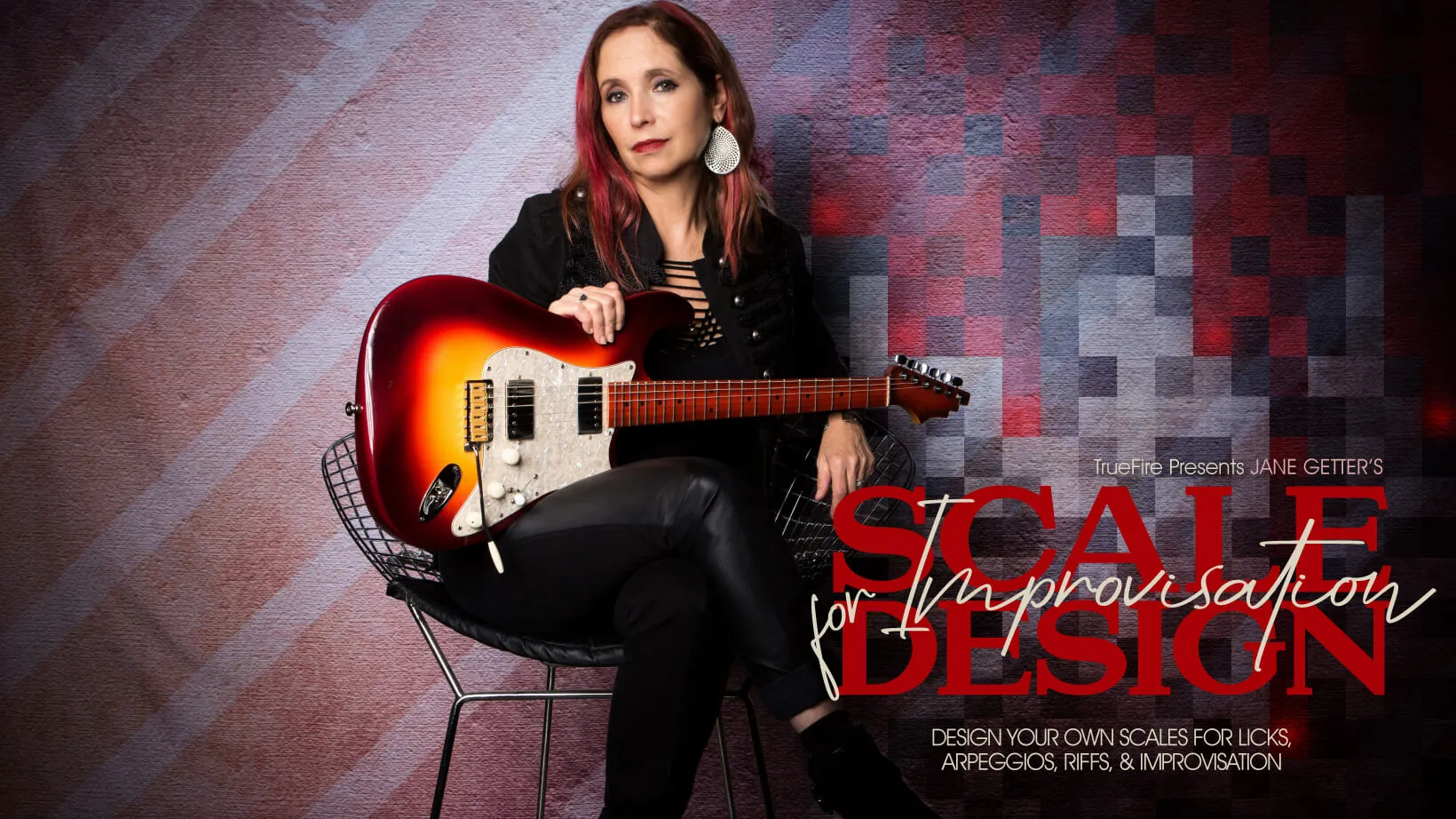
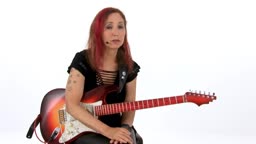
It’s not unusual to find that your vocabulary of traditional jazz scales and arpeggios do not serve the improvisational colors and textures that you hear in your head for a particular situation. Easy fix — design your own!
Jane Getter’s Scale Design for Improvisation presents three core concepts for designing your own scales and arpeggios. By way of example, Jane will demonstrate the approaches using nine scales of her own design: Minor Pentatonic 6, Minor Pentatonic 6 Flat 9, Chennai, Snake Charmer, Altered Pentatonic, Over the Edge, 2 Major Triads, 2 Minor Triads, and Mixed Bag Triads.
"Getter is a superb, genre-bending guitarist equally at home in the jazz-rock, progressive and singer-songwriter realms!" Jane has played with many jazz and rock greats while garnering increasing recognition as a gifted writer, bandleader, instrumentalist, and vocalist. She has performed and recorded with many music icons, including Brother Jack McDuff, Return To Forever drummer Lenny White, vocalist Ursala Dudziak, as well as Jaimoe (of the Allman Brothers), Michal Urbaniak, Kenny Garrett, The Roots the jam, Headhunters drummer Mike Clark, and many others. We’re thrilled to welcome Jane to the family with her first TrueFire course, Scale Design for Improvisation!
"I started designing my own scales because I wanted a different type of sound in certain situations that I was getting from the conventional scales that I already knew. Out of each new scale, I also created an arpeggio that I’ll show you. The point of this course is to introduce you to the concepts behind designing your own scales and hopefully these approaches will inspire you to create your own. This is a great way to develop your own unique individual sound and voice when improvising. I'll also show you fingerings and harmonic applications for my scales and arpeggios.”
Scale Design for Improvisation has 5 different fingerings for each of the 9 scales and arpeggios. There are tabs, notation, and diagrams for each of the fingerings along with demonstrations and backing tracks for you to play along with.
Jane will explain and demonstrate all of the key concepts and approaches along the way. You’ll get standard notation and tabs for all of the key demonstrations and performance studies. Plus, you’ll be able to use TrueFire’s learning tool to sync the tab and notation to the video lesson. You can also loop or slow down the videos so that you can work with the lessons at your own pace. All the backing tracks are included to work with on your own as well.
Grab your guitar and let's design our own scales with Jane Getter!
What you'll learn
Create custom arpeggios from combined triads
Use melodic and rhythmic patterns to practice scales
Improvise using the scale over a 12-bar blues
Connect scale positions across the entire fretboard
Understand how to create tensions with major and minor thirds
Hey folks - Jane Getter here. I'm so excited to present to you my course Scale Design for Improvisation! In this course, I will show you the scales and arpeggios I've created and how I created them. The point of this course is to introduce you to the concepts behind designing your own scales and hopefully inspire you to create your own. This is a great way to develop your own unique individual sound and voice when improvising. I'll also show you fingerings and harmonic applications for my scales and arpeggios.
I've been creating scales and arpeggios for over 15 years. I started designing my own scales because I wanted a different type of sound in certain situations that I was getting from the conventional scales that I already knew. Out of each new scale, I also created an arpeggio that I will take you through.
This course will show you 3 basic concepts for designing your own scales and arpeggios that I used for these particular 9 scales. You will see that the application of each of these concepts may vary depending on what you are looking for.
Scale Design for Improvisation has 5 different fingerings for each of the scales and arpeggios. There are tabs, notation and diagrams for each of the fingerings along with demonstrations and backing tracks for you to play along with.
I hope this course inspires you to run with some of these concepts and start designing your own scales and arpeggios. It's a great way to create your own unique voice and sound!
Thank you and have fun with the course! Jane
This is my "minor pentatonic 6" scale. It's the first scale I ever created and inspired me to continue down this path of creating my own scales. It consists of a minor pentatonic scale with a natural 6 instead of the b7. The scale degrees are 1, b3, 4, 5, 6. I created this scale because I wanted a slightly different sound when using the pentatonic scale. but also wanted it to still be a pentatonic (5 note) scale. After experimenting with adding and subtracting notes from the scale, I came up with replacing the b7 with a natural 6. I'll also compare the "minor pentatonic 6" scale to a normal minor pentatonic scale 1, b3, 4, 5, b7 and show you how you can do the same with any scale to make it your own.
The arpeggio for this scale consists of the 1, b3, 5, 6. When creating your arpeggio, you can choose any notes from the scale and order them in any way that sounds good to you. You don't have to follow the conventional way of spelling out a chord in an arpeggio. For examples of unusual note choices and their order in arpeggios, check out the arpeggios for the other scales in this course, especially the Chennai and Altered Pentatonic scales.
You can use this fun and easy concept with any scale that you already know to create your own sound. There are no right or wrong notes, as long as it sounds good to you, it's right. The sound is always the determining factor.
In this video, I demonstrate the 5 different fingerings for the "minor pentatonic 6" scale that I've mapped out with diagrams, tabs and notation. Once you've played the 5 fingerings, keep going up the neck by repeating the first couple of fingerings up an octave. Then, turn around and go down the neck in reverse order. Challenge yourself by playing them without stopping, connecting all of the fingerings without pausing. Also, practicing them in different rhythmic and melodic patterns is a good way to learn your scales.
The "minor pentatonic 6" scale can be used over any minor chord or minor chord progression that you would use a Dorian scale to improvise with. The Dorian scale is composed of a 1, 2, b3, 4, 5, 6, b7. The "minor pentatonic 6" scale's degrees are 1, b3, 4, 5, 6. You wouldn't use this in a chord progression that also has a b6 in the progression, like "All Along the Watchtower" - Cmin, Bb, Ab, with Ab being the b6 of C minor. Or the solo section in "Stairway To Heaven" - Ami, G, F, with F being the b6 of A minor.
This scale also works on the 1 chord of a minor blues (C minor in the key of C minor). However, it wouldn't work on the whole blues progression like a natural minor scale does. The natural minor scale has a b6 (Ab) which is in the key of C minor whereas the natural 6 (A natural) is not. You can also use it over a dominant 7th chord a 4th away from the root, like D7 for the A minor pentatonic 6 scale.
In all of these scales, you may find other applications for them and it's fun to experiment with them. When you design your own scales, experiment with them over a variety of chords and see what you can come with.
In this video, I explain how I will demonstrate using the minor pentatonic 6 scale over this chord progression - A minor for 8 bars, then D/F#, C, D/F#, Emin, D/F#, E. In the first video, I'll play just the scale up and down with only rhythmic variations to show how it sounds but itself in the progression. In the second video, I'll play a solo, nixing the scale up with other scales and articulations to show how it can be used in a real solo.
In this video, I play the minor pentatonic 6 scale by itself in different rhythms to show how it sounds over the A minor section of the progression. I start out playing it slowly with quarter notes and then vary the rhythms.
In this video, I play a solo over the chord progression, mixing the minor pentatonic 6 scale with other scales and articulations.
This is a must do! You will be learning several scales she developed under certain chords and then you will learn the contex on where and how to use them. Then you will improve useing that scale. So, if you want to get out of a rout, or out of the caged and at the same time get a deeper understanding of what scales are, definitely do this course. Even if you do not like the sound of this particular inventions you will be inspired to a grater flexibility in your scales and you sound.
F
Firefighter
Verified buyer
08/26/21
Good quick inspiration to to youtrown thing.
Concise and to the point. Reinforced things I already do, and added some motivation to more of this.
B
Blackguitars
Verified buyer
08/24/21
CONCEPTUAL
Brings up interesting concepts (hence why I bought it) so gives you a different way of looking at scales rather than 'staying within the lines'.
G
Gil B.
05/23/21
pleasure of inprovisation
how to enjoy yourself by taking a new step in improvisation with this course by Jane Getter - all the tools to advance to your level by creating your own sentences according to your game and feeling and by discovering the sounds and climates that will make you forget the usual pentatonic scale
J
joseph
05/18/21
just magic
thanks Jane for offering the oportunity of this course on improvisation starting from the simple min.6 - I hastened to test the first 2 ranges of work on "scarlet woman" of Zawinul Syndicate and it’s just magic - thanks again