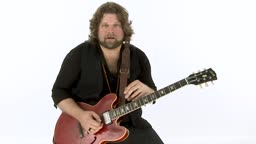
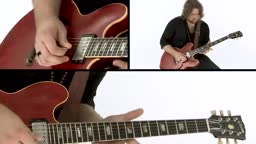
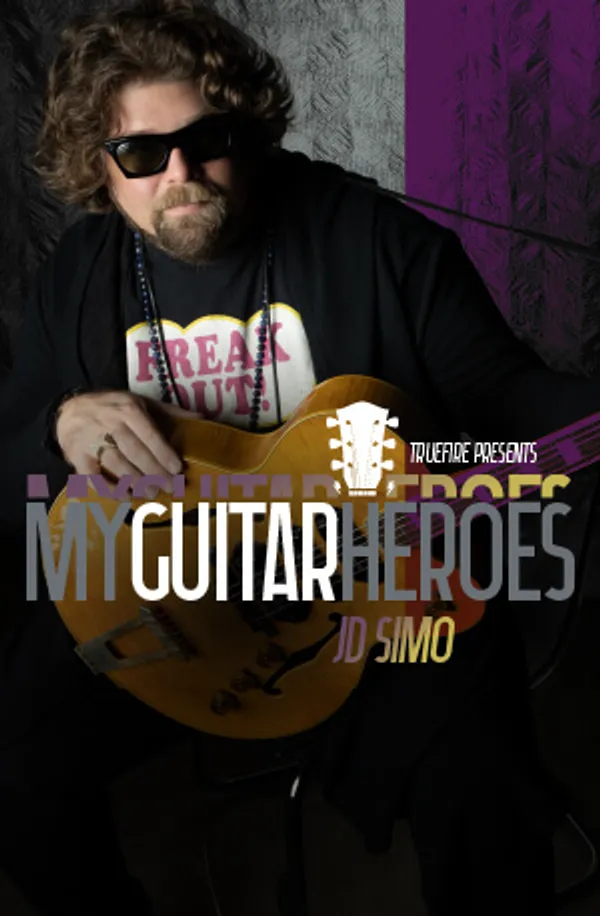
Recording artist, composer, bandleader, and gifted guitarist, JD Simo blends acid rock, traditional blues, folk, soul, and free-form jazz, to create a “mind-bending, kaleidoscope of sound, energy, and vibe.” NPR said, “Nashville blues trio SIMO sounds as if it comes to us straight from 1968.” Rolling Stone lauded, “J. D. Simo spins soulful psychedelic blues rock with an improvisational bent reminiscent of the Grateful Dead and Stevie Ray Vaughan.”
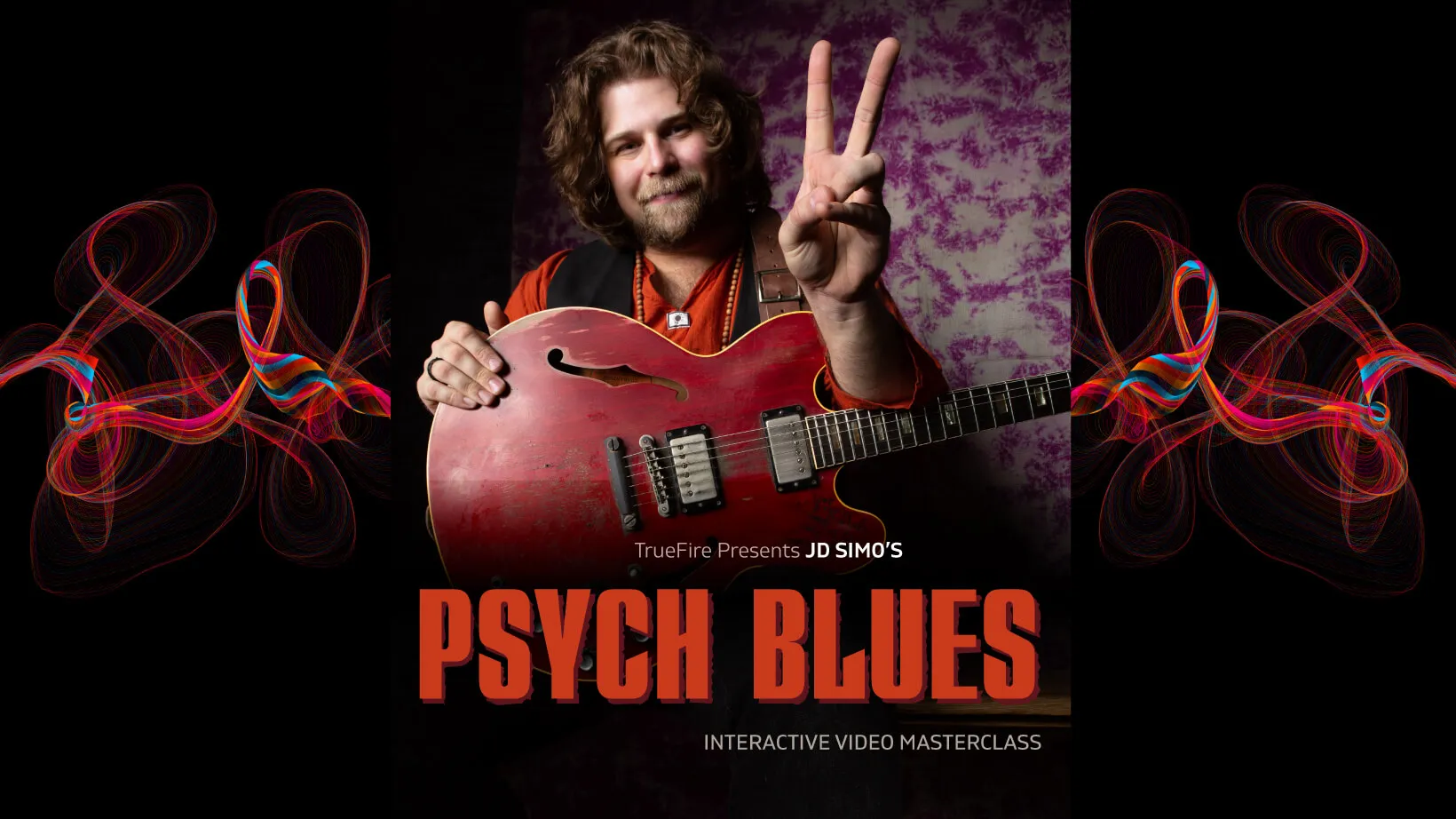
We’re thrilled to welcome JD to the family with his first TrueFire course, Psych Blues! We guarantee that you will likewise be thrilled when you dig into this ‘mind-bending’ educational experience that transcends learning some very cool techniques and fretboard moves — JD will also ignite your music spirit!
”I’ve been steeped in both the disciplines of traditional forms of American music; blues, folk, bluegrass, rock and roll, and jazz - since I was a little boy. The art of free-form improvisation is the totem, if you will, that these forms of music all share and that I’m most enamored with. In this course, I’m going to share with you many of my insights, techniques and most importantly...the inner – sometimes psychological – and mostly spiritual aspects that fuel my musicianship and my life.”
JD organized the course into two sections, in the first half, he covers 15 key creative approaches, techniques, and philosophies that are signature to his innovative style: Building Hand Strength, Right Hand & Dynamics, Vibrato: Your Statement, Blues Roots & Evolution, Out of the Box Approaches, Keeping it Simple, The Importance of Listening, Getting Started on Slide, More Slide Techniques, Accompaniment, Singing & Your Voice, Gear & Tone Talk, Using a Wah-Wah Pedal, A Hippie Plays Country, and The Why. JD performs a series of soloing studies, over backing tracks, to illustrate many of the concepts and techniques presented in the first section including:
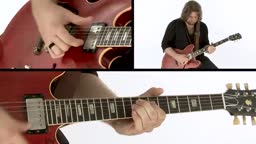
JD will explain and demonstrate all of the key concepts and approaches along the way. You’ll get standard notation and tabs for all of the key performance examples, in the first section (please note that the bonus second section of solo performances is not tabbed -- solo video performances included just for viewing and listening pleasure!). Plus, JD includes all of the rhythm tracks for you to work with on your own. In addition, you’ll be able to loop or slow down any of the videos so that you can work with the lessons at your own pace.
Grab your guitar and let’s get psyched with JD Simo!
What you'll learn
Learn to improvise freely using slide guitar with an open palette approach
Seeing how to translate ensemble playing concepts to solo guitar
Develop ability to seamlessly switch between slide and non-slide playing during improvisation
Understanding the philosophy behind solo guitar performance
Develop multiple vibrato styles for different musical contexts
Hey there, I'm JD Simo and welcome to Psych Blues. I've been steeped in the traditional forms of American music (blues, folk, bluegrass, rock 'n' roll, jazz) since I was just a little boy. The art of free form improvisation is the "totem" that these forms of music all share, and that I'm most enamored with. In this course, I'm going to share with you many of my insights, techniques and most importantly the "inner" psychological and spiritual aspects that fuel my musicianship and my life.
I've organized the course into two sections. In the first section, we'll cover techniques like hand strength, vibrato, slide guitar and I'll also share my approaches for accompaniment and some out-of-the-box improvising. Then in the second section, I'll perform four of my songs solo.
All the key playing examples are tabbed and notated, and you'll also have the backing tracks to work with on your own. You can loop and slow down any of the videos so you can work with the lessons at your own pace. So, grab your guitar, get in tune, center yourself and let's have some fun.
In this first section, we're going to dive into a bunch of relatively broad concepts that make up the nucleus of me as a musician. These are the nuts and bolts of guitar playing. Tune up your guitar and let's get ready!
So, let's talk a little bit about hand strength. What I mean when I say that is not dexterity, or being able to play quickly around the neck, but rather playing with enough strength to get the proper tone out of the instrument. The old-timers who became musicians before all of the technology that props us up today such as gain, compression and distortion had to rely on their hands in order to get the tone that they wanted. Now, I see this as a skill that's lacking among modern guitar players and something that needs to be worked on.
Something you can do when you're just watching TV, and a good way to practice in order to strengthen your fretting hand is to play the instrument unamplified while bending to the next note up. Try doing this in as many positions and on as many strings as you can. Again, the old-timers did this all the time: They often times were practicing in hotel rooms, which meant that you had to make it sound right unamplified first. It's a good practice habit to pick up, as if you can get it to sound good then, it will sound even better when you do amplify it.
Practice it enough times that it becomes a reflex, and in a month's time you'll find that you've made great progress on getting this skill down. Next, let's look at some right hand techniques in order to improve your playing.
Now let's talk about the right hand. I find that the guitar is a lot like a drum in that the harder you hit, the more attack you get. However, with both these instruments, or even with a piano, there's only so much vibration that can translate into tone, and at a certain point it ends up choking itself.
How hard you hit the strings is controlled by your right hand, so let's look at some things you can do to change the dynamics of your playing with it. When I dig in to the string, you can hear that it's sharper yet thinner sounding. With a lighter attack, you'll hear that it's a bit sweeter and rounder sounding. It's important to learn how to vary your approach in order to play dynamically. You should try to make your guitar parts sound conversational, with "punctuation" within your phrases, containing both heavy and light attack.
There are a few other ways we can change the tone of the guitar with our right hand, one of which is decided by the thickness of the pick. If you're playing with a heavier pick, you're bearing down harder on the strings, and may find yourself having to overcompensate in other areas in order to make your playing sound dynamic. For example, I used to bear down too hard with my right hand, and used lighter strings in order to balance it out. You have to make a decision about where to play on the guitar as well - whether it's back by the bridge or closer to the neck. The bridge gives us a staccato, almost "thuddy" sound, with the neck having a sweeter and rounder tone.
Try experimenting with playing with dynamics, the thickness of your pick, and playing close to the bridge or neck in order to get the tone that suits you best. Remember! Your tone is in your hands.
Vibrato is the achilles heel of every good musician out there. It's the last piece of the puzzle to figuring out your tone, as vibrato is your "fingerprint". Everyone's vibrato is personal, just as everyone's voice is different.
This is by far the most important element of playing, going back to the generation of players I admire the most. It's the most fundamental strength for being a great guitar player. If they don't have good vibrato or phrasing, it doesn't matter what you can do or how much harmonic knowledge you have, it's never going to sound like music. And it's more common than you'd think! There's no shortcut to it, it can take months or years. As we age, so does our vibrato, mellowing out like a fine wine.
Since everyone's vibrato is unique, here we're just going to talk about the basics of what makes a good vibrato. We'll look at some of the innovators of the technique such as B.B. King and other blues greats.
Blues is what I fell in love with when I was a little boy growing up in Chicago, listening to people like B.B. King, Lightnin' Hopkins, Earl Hooker, and Muddy Waters. In this lesson, rather than giving you a bunch of sampling of different eras of blues, here I'll give you the history of what I interpret as "real blues" playing. And by that, I mean the original blues players that inspired the next generations.
There's the later rock interpretation that happened in the 60's and 70's, and what made that so great is that they had a firm understanding of the original source. The more generations we go into the future, the less the connection to the source is prevalent. So, let's go through and look at what the source looks like in order to place where we are today.
Let's look at a track of me and my band playing a slow blues in the style of B.B. King in C#, which is the key the blues were originally played in. This is the traditional 50's and 60's style of playing blues, with my right hand close to the bridge and B.B.'s approach to vibrato. Let's check it out.
great lessons!! would recommend to anyone into the style. JD Simo kicks b#tches in the teeth one of my favorite guitar players thank you for this most excellent video!!!
G
gregory123
Verified buyer
04/21/25
Psych Blues
Excellent course!
T
tim1985
02/27/21
JD Simo's Psych Blues
Awesome!
A
Andrew
01/11/21
Absolutely Outstanding
Super inspirational and informative
I
ImenesGuitar
09/19/20
A True Master
One Of The Best Truefire Course of all Time. The "Real Deal" All The information comes so organic and real.JD is a true Guitar Hero.In fact, a Classic!! Waiting For other Lessons from Him!!