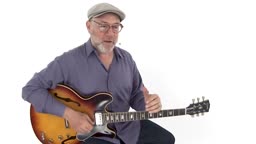
Before we get into the five solos in this course, I just want to talk a little bit about what lyricism means as it relates to the guitar. Quite often when we practice the guitar, we practice in positions and scales, going across the six strings. And, if you think about how the human voice works, it's really nothing like that at all - certainly no strings and pick involved.
We'll be talking about some of the things that we can do to bring out the lyrical quality in a technical way, but also in a conceptual way, as that's really as much of a part of it as well.
On the technical side of it, one thing that we're going to do is minimize vibrato. Which is not because singers don't use vibrato — they do, and the reason we use vibrato on the guitar in the first place is probably to sound more vocal. But, as the years have gone on, and the strings have got thinner, and rock music happened, vibrato has gotten wider and wild, which isn't so much related to the sound of human voices. I would recommend that you take it down a notch or two (or three), and think of vibrato differently. Really listen to some singers that you like, and check out how and when they use their vibrato to get into that mindset.
Another thing that can help give your playing a lyrical quality is limiting the range of what you're doing. Try taking a solo that's just within one octave. Try finding all the music there without moving to another octave. We can also repeat a note ‐ something that we don't often do when playing guitar, but it's always possible. Why not?
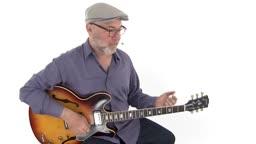
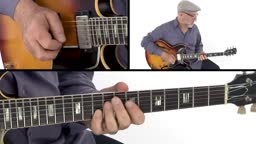
I also wanted to talk a little bit about getting the tone down for this course. Right now I'm in the middle position, with both humbucking pick-ups on. I'm using a mild overdrive pedal here as well. You want it where when you dig in, you get a bit of grit, but when you use a light touch it goes away. This is similar to a singer's voice — when a singer sings louder the quality of their voice changes (because they're pushing harder), and when they sing quietly, they sound mellower. This can happen all within a phrase, so you want to be able to move quickly like that.
Muting is another technique that we'll be using here. Now, if you have this overdrive sound, your guitar is going to be pretty lively. It's going to be easy to get a string to sound even if you just barely touch it. So, you have to be a little more "judicious" with your muting, with it coming from either hand.
In this course, you'll see that each solo is built around one of two techniques, or using a specific conceptual technique to build the solo. We'll be using things like hammer-ons and pull-offs, slides, bends, etc. as well. Let's get started.