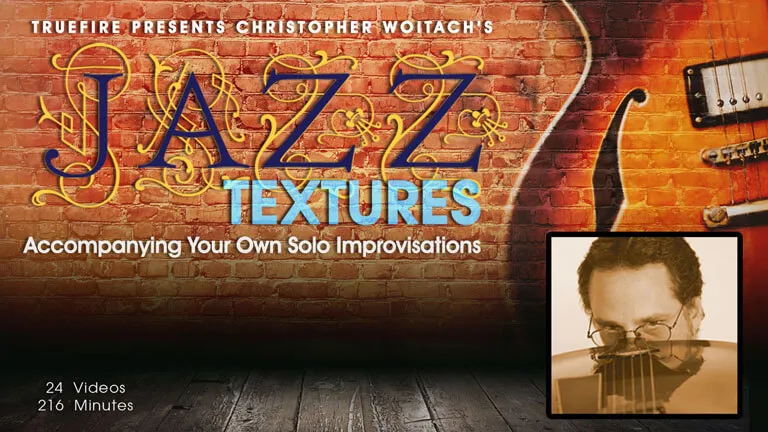
Jazz Textures

Accompanying your own solo improvisations

Marty FriedmanTommy EmmanuelSteve VaiEric GalesEric Johnson

Get this course and 1,000+ more with All Access

Try 14 days free. Cancel any time.

Purchase Individual Course for $5.00
Jazz Textures

About this course

More so than other styles, jazz guitarists find themselves performing in a wide variety of musical configurations; solo, duo, trio, quartet, big band and everything in between. Sometimes the jazz guitarist gets to play with another chordal player, such as a pianist, but more often than not the jazz guitarist is the only chordal instrument and is expected to support the vocalist or soloist accordingly. But what happens when it's time for the guitar solo? The entire dynamic changes without chords to play off of!

Sure, a good player will keep their lines clear, make all the changes and swing hard BUT there's still something missing. On the other hand, a great player knows how to accompany themselves during an improvisation in a band setting and during a solo performance. For those of you eager to graduate from just good to great, Christopher Woitach's Jazz Textures guitar lessons will take you there in a hurry.

Christopher Woitach is a performing jazz guitarist and composer hailing out of Portland, Oregon where he is also an adjunct professor of jazz guitar at Western Oregon University. He performs a wide range of jazz styles, from Dixieland to Free jazz, Ragtime to Bebop and has worked with the likes of Bernadette Peters, Rich Little, Hank Roberts, Bob Mover, Tony Monaco, Mel Brown and John Stowell (who by the way highly recommended Christopher for this particular course of study). Jazz Improv Magazine recognizes "Woitach's honed skills as a composer, his command of the guitar - all bolstered by his imaginative ideas as a soloist."

In Jazz Textures, you'll learn how to increase your chord vocabulary, turning the simplest voicings into multiple voicings that span the entire fretboard, ready for you to use in your improvisations, no matter where you are on the neck. You'll also learn how to think about chords in an entirely new way, as representations, giving you a flexible, supple harmonic palette to work with.

Christopher covers a variety of ways for you to accompany single note lines with chords you'll create, as well as chords already in your arsenal. There are examples, exercises, and improvisations throughout these video jazz guitar lessons that will help make all the concepts clear and quickly accessible to you.

"Texture is a term used to describe the varying amount of voices played simultaneously - single notes are one texture, chord melody another. In Jazz Textures, you'll learn how to fill in all the "textural" gaps between the two by harmonizing your lines with dyads of various intervals, dyads in various ratios, how to move chords horizontally and even how to use counterpoint in your improvisations."

Jazz Textures Curriculum

1. Right-Hand Technique
2. Representational Harmony
3. Building a Personal Chord Vocabulary
4. Moving Horizontally
5. C Major Chords
6. G Dominant Chords
7. G Altered Dominant Chords
8. Chord Types Combined
9. Using 3rds and 7ths
10. Accompanying the Improvised Line
11. Single Lines with Comped Chords
12. Single Lines with Embedded Chords
13. Embedded Chords: Exercise
14. Dyads: Octaves
15. Dyads: Intervals
16. Dyads: Contrary Motion
17. Dyads: Linear Intervallic
18. Dyads: 2.1
19. Dyads: Counterpoint

Jazz Textures includes a vast reference of textural material - dyads, triads, chord forms with scalar areas mapped out, exercises, examples of contrary motion and inner voice movement, horizontal essential scale charts, non-adjacent dyads and triads, dyads of various ratios - everything covered in the video and more.

The Jazz Textures guitar lessons will deliver the knowledge, technique and harmonic freedom to accompany your improvised solos and produce that big sound all great players possess. Texturize now!

What you'll learn

  • Create open, spacious comping textures
  • Voice lead through ii-V-I progressions with shell voicings
  • Learn to comp chords while improvising
  • Comp for other soloists using minimal voicings
  • Build chord voicings using only 3rds and 7ths
Release date: 09/29/2010 • 3h 36m runtime
Start Course
Sample lessons
Chord Types Combined
Using 3rds and 7ths
Using 3rds and 7ths
Single Lines with
Single Lines with
Embedded Chords
Dyads
Dyads
Linear Intervallic

What's included

24 lessons • 19 charts

Jazz Textures
In this video, we'll explore an exciting and often neglected area of jazz guitar playing, the textural ground that lies in between single notes and classic chord melody. We're going to learn about various ways to create your own chord vocabulary, different approaches to using these chords, and techniques for incorporating them into your improvisations. There are sections on harmonizing jazz lines with dyads, moving chords horizontally, and even some examples of using counterpoint in improvisation. I play lots of examples, and perform several improvisations using all the techniques discussed in the video.

Included with this video are many pages of textural material to help you expand your skills and fretboard knowledge. To get the most out of the material, I suggest you play the examples in all twelve keys, using all scales. The most important thing you can do, however, is to apply what you learn from the material and this video to the songs you know, and new ones you're working on. All the information in the world won't help you grow musically unless you apply it, so be sure to use anything you learn in your own improvisations and arrangements. And just as important, have fun!
Right-Hand Technique
Before we start in on learning jazz textures, I'm going to talk about right hand technique. The guitar has an incredible variety of tones and textures, largely because of the many ways you can produce sound with the right hand. You can strike it with a flatpick, pick it with your fingers, use a hybrid combination of pick and fingers, mute it with your palm, bang on it with the heel of your hand, use two-hand tapping, throw pennies at it, play it with an ebow, play it with a violin bow... A truly amazing instrument, with enormous possibility.

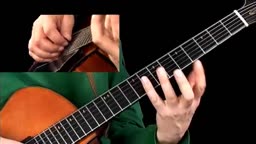
For the purposes of playing texturally, our best choices are either hybrid pick and fingers or pure fingerstyle. Although two-hand tapping can be an interesting textural device, it's outside the scope of this course. I prefer hybrid picking, myself - the combination of control over the voices and the energy that a pick can provide works best for my style. I'll play some examples using hybrid picking so you can see how I use it to highlight the textures I'm using.
Representational
The first section of Jazz Textures is about Representational Harmony. This concept is a more generalized way of looking at chords. Instead of thinking about specific voicings, we'll learn about ways to represent chords, which will give you a much wider chordal palette to draw from. When we're improvising, we need to be flexible, harmonically. Using representations of chords allows us freedom to make chord choices that can fit in with our improvisations any way we wish.

I'll show you some basic substitution concepts, and how that might relate to a typical jazz chart. You'll get a taste of how many chord choices there are, and some ways to make them.
Representational
In Part 2 of Representational Harmony, we take a typical ii V I VI chord progression and explore some ways to use chord substitutions to "color" the progression. This a great way to try out some new chords to get an idea of how they sound in context. A great next step is to try them out over tunes, ultimately, that's the goal, to play music. Once you have a few new voicings that work over one tune, you'll be able to use them in several more tunes.

I play an improvisation over the progression and show you some ways that I would use substitute chords, in context. I play a lot of examples in this course, and although there is a lot of written material, including the specific examples from each segment, my improvisations aren't transcribed, they're to provide examples of how I would approach the material being discussed when improvising. The textural material I use when improvising is included with this video, make sure to check it out, and see how it relates to the improvisations.
Building a Personal
Often, the first step in expanding our chord vocabulary is to look for sources of chords, books, videos, the Internet. This is a good and useful step, as there are many great resources out there.

Here are some of my favorites:

"Chord Chemistry", Ted Greene. Every jazz guitarist must own this. Period.

"Modern Chord Progressions", Ted Greene. See above.

"The Advancing Guitarist", Mick Goodrick. This book covers all kinds of ground, very useful, very mind expanding - must have.

"Mr. Good Chords Almanac of Voice Leading", Mick Goodrick. Multiple volumes, great stuff.

"Exploring Jazz Guitar", Jim Hall. This book covers many aspects of jazz guitar, excellent. I took lessons for about a year from Jim Hall, great teacher, wonderful, smart person. One of my heroes, for sure.

I also suggest www.tedgreene.com - Ted's longtime partner, Barbara Franklin, has put together a wonderful site dedicated to his memory that includes pages and pages of his amazing lessons, you could spend years working on all this great stuff!
Building a Personal
In Part 2 of this segment, I'll explain some reasons why you want to expand your chord vocabulary, and give you some examples. Then I'll show you how to use scales to create multiple voicings from one basic voicing. We'll see how all of the voicings we create represent the chord, a technique we're going to use all through this course.
Moving Horizontally
Why does horizontal movement matter? In this segment, I'll explain why, and improvise using a horizontal concept to demonstrate. We'll learn how to take the voicing we created in the previous segment, and move it up and down the neck horizontally. This expands the original three note voicing we started from exponentially. When you consider that we're only dealing with one set of three adjacent strings here, the possible number of chords that can be created using all the other string sets, including the non-adjacent strings, is huge. Here's another reason for playing all the exercises in all keys, all positions, all string sets.

+ 17 more lessons

Start Course

Reviews

12 results

RhythmRob

Verified buyer

10/07/25

Great ideas, good practical performance based tips.

Jordu

Verified buyer

12/11/24

Buen curso , en efecto

Jeff K.

11/22/22

simple concepts but

Simple concept, move up one note up or down on each string while holding the guts of the chord in place; it works, so long as you are in key, BUT.... without a sense of the cycle of 5ths or a really strong ear, you might flounder. The examples are very beautiful; as other have noted, the course lacks full transcriptions. If you have an innate musical sense, this would really add to yr voicings.

Wessel07

Verified buyer

08/15/22

I have only completed the first lesson and I am already using the skill shown herey. The rest will be just as good and looking forward to chord studies and the melodic exercises as well as the other studies experimenting in all the keys. So thankful I could get this!

Osokin

Verified buyer

07/24/22

Expand Your Jazz Palette!

Christopher Woitach is a talented and knowledgeable guitar player and in this course he relays a tremendous amount of useful and stimulating information, some of which is quite advanced. As this is an older course (2010) there is no tab sync, but there are plenty of charts and transcriptions. Lots to learn and enjoy, and guaranteed to expand your palette of ideas!

Stop searching. Start improving with All Access.

Try 14 days free. Cancel any time.