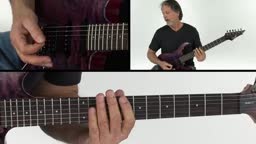
Guitar Lab: Scale Form Logic Vol. 1

Marty FriedmanTommy EmmanuelSteve VaiEric GalesEric Johnson

Get this course and 1,000+ more with All Access

Try 14 days free. Cancel any time.

Purchase Individual Course for $5.00
Guitar Lab: Scale Form Logic Vol. 1

About this course

Hi, I'm Brad Carlton, and welcome to the first edition of Guitar Lab: Scale Form Logic.The guitar is not like the piano in terms of note location: There is redundancy, as the same pitch can be located in several places on the guitar fingerboard. This necessitates a system of organizing fingerings for chords, scales, and arpeggios. This course is designed to assist the guitarist in systematically studying this redundancy, which will allow access to the entire fingerboard in any key. In this volume, we'll deal with the pentatonic scale and you'll learn how to locate each form based on the root which will always reside on a particular string. Another point of reference for each scale form will be the chord forms out of the CAGED and EDCAG system. You'll be provided jam tracks which are modal in nature that will allow you to saturate your ears, eyes, and head with one tonality throughout the full range of the fingerboard. You'll also receive jam tracks with chord changes that are changing keys. To accommodate these key changes, you'll learn how to utilize different scale forms while keeping your hand in the same general area of the fingerboard.

What you'll learn

  • Applying pentatonic scales across different chord progressions
  • Ability to navigate five different pentatonic scale positions
  • Multiple ways to play and practice pentatonic scales
  • Fretboard visualization techniques
  • Learning to shift scale perspective based on chord root
Release date: 04/01/2017 • 1h 30m runtime
Start Course
Sample lessons
C Minor Pentatonic
C Minor Pentatonic
6th String Root Form
C Minor Pentatonic
C Minor Pentatonic
4th String Root Form
C Minor Pentatonic
C Minor Pentatonic
2nd String Root Form

What's included

14 lessons • 13 charts • 4 Jam Tracks

Scale Form Logic Vol. 1
Hi, I'm Brad Carlton, and welcome to the first edition of Guitar Lab: Scale Form Logic.

The guitar is not like the piano in terms of note location: There is redundancy, as the same pitch can be located in several places on the guitar fingerboard. This necessitates a system of organizing fingerings for chords, scales, and arpeggios.

This course is designed to assist the guitarist in systematically studying this redundancy, which will allow access to the entire fingerboard in any key. In this volume, we'll deal with the pentatonic scale and you'll learn how to locate each form based on the root which will always reside on a particular string. Another point of reference for each scale form will be the chord forms out of the CAGED and EDCAG system.

You'll be provided jam tracks which are modal in nature that will allow you to saturate your ears, eyes, and head with one tonality throughout the full range of the fingerboard. You'll also receive jam tracks with chord changes that are changing keys. To accommodate these key changes, you'll learn how to utilize different scale forms while keeping your hand in the same general area of the fingerboard.
C Minor Pentatonic
The sixth string root pentatonic scale form is the most common scale form. This is the one that everybody learns within the first few months of playing guitar. In my system of labeling pentatonic scale forms, I do not use the first string. This two note per string scale form will always have the root on the six string, and if you consider the root with your index finger, you'll be playing minor pentatonic. If you consider the root with your fourth finger, you'll be playing major pentatonic.
C Minor Pentatonic
The five forms of the pentatonic scale move up the neck via the octaves of the root of each form. In the previous lesson, we dealt with the sixth string root form. The octave of any note on the six string is always two frets higher in two strings over (which would be the the fourth string). Another important consideration is how the pentatonic scales fit together like puzzle pieces as you move up or down the neck. This introduces the concept of the "sides" of each pentatonic scale form. Thus, the high side of the sixth string root pentatonic is the same as the low side of the fourth string root pentatonic.
C Minor Pentatonic
This lesson presents the next scale form up the neck, which is the second string pentatonic.
C Minor Pentatonic
This lesson presents the next scale form up the neck, which is the fifth string pentatonic.
C Minor Pentatonic
The final pentatonic scale is the third string root form.
Harmonic Preparation
For the next few lessons, we're going to change gears and play through chord changes. Before you start soloing, it's important to be able to play the actual chord voicings. This lesson will get you up and running playing rhythm guitar through this pentatonic workout.

+ 7 more lessons

Start Course

Reviews

5 results

Flip

05/26/25

Evolving pentatonics and a refresher

The Scale Form Logic that Brad demonstrates is a slightly different vantage point from the CAGED shapes, focusing on the root position on each string, and how the scale boxes evolve with the progression while staying in one position. For a beginner, it's a good start to see how the scales evolve with chord changes, and it's a good companion course to Brad's "Vertical Soloing" course which will keep things further grounded on chord tones. For intermediate players, you'll enjoy the more exotic harmonies, and towards the end of the course, how the same minor scale shapes relate to a major progression when built of the 3rd and 5th of a chord.
Kyle W.

02/04/25

Very useful Class

This class was very helpful for me puling together different scale forms into a system

bluesguit

07/13/24

Brad Carlton's Guitar Lab: Scale Form Logic Vol. 1

Found it eye opening. Thought I "knew" my forms. :) You have to go over the lessons several times to absorb it all because at times it moves at a clip and if you blink you miss it. I wish I could print out the carts at one go because 1) The individual PDFs have repeats in them (and Chart #1 is in every lesson Brad has ever done :) ) 2) The saved PDFs and files in general have random names with no clue as to content 3) A lesson sometimes refers to diagrams not available to the lesson in the app Did find an error though "Dia. 10 8th String Root" ... or I'm short 2 strings.

Fabio

02/27/24

Interesting, but rushed

In my opinion, a missed opportunity. While the concepts of the course are really interesting, and definitely worth working on, the lessons were unsatisfactory for me, "rushed" I dare say. I was left with the unpleasant sensation that the (very well-prepared) Brad Carlton always had one eye on the clock - but it is likely that musicians more capable than me are perfectly comfortable with this speed.

Jeffochka

10/25/18

More From The Master of Cool!

Brad Carlton's classes always hit home with me. His approach to the CAGED system is fresh and insightful. He gets you up to speed, always straight to the point and without clutter, on playing the major and minor Pentatonics. While it may seem "too foundational" to someone impatient to blaze through all the modes, don't be fooled; you need to have a solid foundation before you can build upon it. Brad knows this and guides you through building one heck of a solid foundation. Rather than fumbling across the fingerboard, you learn each position and can move across the fingerboard masterfully because you want to and know what you are doing. For me, the best part of this course are the jam tracks that change keys. This really challenges you to put into practice what you've learned and to prove whether or not you have mastered it. Great thinking, Brad!!

Stop searching. Start improving with All Access.

Try 14 days free. Cancel any time.