Play Acoustic Guitar 9: Advanced Style Variations

Diversify Your Acoustic Guitar Chops with this Acoustic Learning Path Core Course

Marty FriedmanTommy EmmanuelSteve VaiEric GalesEric Johnson

Get this course and 1,000+ more with All Access

Try 14 days free. Cancel any time.

Purchase Individual Course for $5.00
Play Acoustic Guitar 9: Advanced Style Variations

About this course

Welcome to Play Acoustic Guitar 9: Advanced Style Variations for late intermediate to advanced students of Acoustic guitar.

This Acoustic Learning Path core course is presented by 4 top TrueFire educators: Tony McManus, Fareed Haque, Alonzo Pennington, and Renier Voet.

The Advanced Style Variations curriculum is comprised of select Acoustic guitar lessons from the educators’ existing TrueFire course libraries.

One of the qualities that attracts all of us to the guitar is the virtually infinite range of styles and techniques that are possible on the instrument. Having a grasp on a wide variety of styles and techniques not only broadens your musicality, it opens the door to many more playing opportunities with other musicians. You’ll gain more clarity on the instrument overall and expressing yourself on it will become a richer experience. The video guitar lessons in this core course will diversify your skill set and help take your playing to the next level.

Play Acoustic Guitar 9: Advanced Style Variations is organized into 4 sections. In the first section, Fareed Haque presents bossa nova rhythm patterns and etudes. In the second section, Tony McManus presents key techniques and harmonic considerations for performing Celtic music on guitar. Renier Voet passes on essential gypsy jazz techniques and vocabulary in Section 3, and Alonzo Pennington wraps things up in the fourth and final section with some good ole Kentucky thumbpicking.

When you’ve completed the lessons here in Advanced Style Variations, you’ll find more lessons focused on variations in Advanced Style Diversity, also a Play Acoustic Guitar 9 core course.

The educators demonstrate all of the key examples over jam tracks (where and when applicable) to simulate a real-world application, in a musical context. All of the key examples are also tabbed and notated for your practice, reference and study purposes.

You’ll also get Guitar Pro files so that you can play, loop or slow down the tab and notation as you work through the lessons. Plus, you’ll have all of the available jam tracks to work with on your own.

Take as much time as you need to work through each video guitar lesson before moving on to the next lesson. If you want to dig deeper or wider into any of the topics covered in this core course, check out the recommended supplementary courses in your learning path where you’ll find more examples, techniques and insight from top TrueFire educators.

Grab your guitar and let’s get started!

What you'll learn

  • Master Kentucky thumb picking technique
  • Use arpeggiation to support a melody
  • Arrange a melody with chord accompaniment
  • Learn rhythmic variations in traditional Celtic music
  • Learn tone matching skills
Release date: 09/14/2016 • 3h 17m runtime
Start Course
Sample lessons
Bossa Nova
Bossa Nova
SECTION 1: Overview
Bossa Rhythm Patterns
Overview
Rhythm Pattern #1
Rhythm Pattern #1
Demonstration
Rhythm Pattern #1
Rhythm Pattern #1
Slow Playalong

What's included

54 lessons • 32 charts • 17 Jam Tracks

Play Acoustic Guitar 9: Advanced Style Variations
Welcome to Play Acoustic Guitar 9: Advanced Style Variations for late intermediate to advanced students of Acoustic guitar.

This Acoustic Learning Path core course is presented by 4 top TrueFire educators: Tony McManus, Fareed Haque, Alonzo Pennington, and Renier Voet.

The Advanced Style Variations curriculum is comprised of select Acoustic guitar lessons from the educators' existing TrueFire course libraries.

One of the qualities that attracts all of us to the guitar is the virtually infinite range of styles and techniques that are possible on the instrument. Having a grasp on a wide variety of styles and techniques not only broadens your musicality, it opens the door to many more playing opportunities with other musicians. You'll gain more clarity on the instrument overall and expressing yourself on it will become a richer experience. The video guitar lessons in this core course will diversify your skill set and help take your playing to the next level.

Play Acoustic Guitar 9: Advanced Style Variations is organized into 4 sections. In the first section, Fareed Haque presents bossa nova rhythm patterns and etudes. In the second section, Tony McManus presents key techniques and harmonic considerations for performing Celtic music on guitar. Renier Voet passes on essential gypsy jazz techniques and vocabulary in Section 3, and Alonzo Pennington wraps things up in the fourth and final section with some good ole Kentucky thumbpicking.

When you've completed the lessons here in Advanced Style Variations, you'll find more lessons focused on variations in Advanced Style Diversity, also a Play Acoustic Guitar 9 core course.

The educators demonstrate all of the key examples over jam tracks (where and when applicable) to simulate a real-world application, in a musical context. All of the key examples are also tabbed and notated for your practice, reference and study purposes.

You'll also get Guitar Pro files so that you can play, loop or slow down the tab and notation as you work through the lessons. Plus, you'll have all of the available jam tracks to work with on your own.

Take as much time as you need to work through each video guitar lesson before moving on to the next lesson. If you want to dig deeper or wider into any of the topics covered in this core course, check out the recommended supplementary courses in your learning path where you'll find more examples, techniques and insight from top TrueFire educators.

Grab your guitar and let's get started!
Bossa Nova
In this first section, you'll learn 3 bossa nova rhythm patterns from Fareed Haque. Fareed will first demonstrate the pattern and then guide you through playalongs to help you work the patterns up to tempo. Nail these 3 patterns and you'll be able to take on the entire bossa nova songbook. Fareed also guides you through 3 bossa nova performance studies.

TIP! Being a good rhythm guitarist starts with having a good sense of timing and being able to play in the pocket. But once you have a good handle on that, then you need to expand your options - both rhythmically and harmonically.

A great way to do this is by listening to other players who are great rhythm guitarists. Hear how they apply different variations and make note of what their choices are.

It helps to break your rhythm practice into those two areas - work on rhythm variations and different feels and grooves. Then work on using other harmonic options, different chord inversions and voicings. If you systematically experiment with testing out other options you will naturally gravitate towards the ones that are YOUR style, and you can further develop those, and then you will become that hip rhythm player that other people listen to!
Bossa Rhythm Patterns
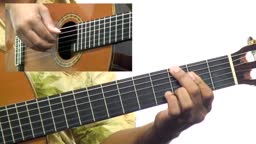
Bossa Rhythm Patterns - Overview is a video guitar lesson presented by Fareed Haque and is sourced from 1-2-3 Bossa Nova.

In this section we will take the basic bossa right hand pattern and break it down into 3 simple parts. But first! A few words about right hand technique. Classical guitar technique is basically the same as Brazilian guitar technique - which would explain why so many great classical guitarists come from Brazil! Here are some general principles: 1) To articulate or "pluck" strings we use thumb, index, middle and ring finger. Usually these are identified by the letters p for thumb (Actually Spanish for thumb - PULGAR), i for index finger, m for middle finger, a for ring (Spanish for ring finger - ANULAR). "Pinky" or "e" is rarely used. 2) Flesh and Nail: The basic contact with string is with flesh. Later on we will add nail to give brightness and possibilities for different tone colors. 3) Hand position: Right arm touches guitar roughly at top of guitar where bridge points to upper bout. Wrist remains relatively straight with a slight arch away from top. Touch strings with left side of fingertip. Fingers move in towards palm, and thumb moves away from fingers and away from top of guitar. Fingers and thumb make a little cross as they move away from each other. That's the basics. Check out Vladimir Bobri's "The Segovia Technique" as well as Christopher Parkening's method as they are both excellent and clear. But by far the best book is Pepe Romero's "La Guitarra: A Comprehensive Study of Classical Guitar Technique and Guide to Performing". It has been rereleased by Guitar Salon International and is amazing!

Rhythm Pattern #1
Rhythm Pattern #1 - Demonstration is a video guitar lesson presented by Fareed Haque and is sourced from 1-2-3 Bossa Nova.

This rhythm is used commonly in slow, mellow bossa novas. Just keep the bass notes coming straight on the beat. The most common error made by beginners is to try and syncopate the bass notes. The key to the bossa nova is that like jazz it is felt in 4/4 time. It's really a slow, sexy march, but a march nonetheless, just like jazz. And the walking bass in jazz is that steady pulsing quarter note bass in bossa nova. Keep da beat!
Rhythm Pattern #1
Rhythm Pattern #1 - Slow Playalong is a video guitar lesson presented by Fareed Haque and is sourced from 1-2-3 Bossa Nova.

A slow play-along over G 6/9. Keep the bass note steady. Keep all notes sustaining and clear. Don't stop or cut bass notes short - let them ring!
Rhythm Pattern #1
Rhythm Pattern #1 - Fast Playalong is a video guitar lesson presented by Fareed Haque and is sourced from 1-2-3 Bossa Nova.

Fast play-along. Don't tense up, keep the fingers moving to the palm, and the thumb moving away from the guitar. Bring the thumb up, around and back in a small circle.
Rhythm Pattern #2
Rhythm Pattern #2 - Demonstration is a video guitar lesson presented by Fareed Haque and is sourced from 1-2-3 Bossa Nova.

This is the most typical basic bossa pattern. Note that pattern #1 is the first 1/2 of pattern #2 so all you have to do is add the second 1/2. Notice that when all four parts of Rhythm # 2 are put together you have 4 steady quarter notes in bass. On top you have the rhythm (in eighth notes) 2-3, 2-2-3, 2-2.

+ 47 more lessons

Start Course

Reviews

1 result

Herrenknecht

Verified buyer

11/11/21

Great course for advanced players

This is a great course for the advanced player covering different styles and providing lots of inspirations. If you are not focused on one style only than this may be your course to broaden your skills and diversity.

Stop searching. Start improving with All Access.

Try 14 days free. Cancel any time.