



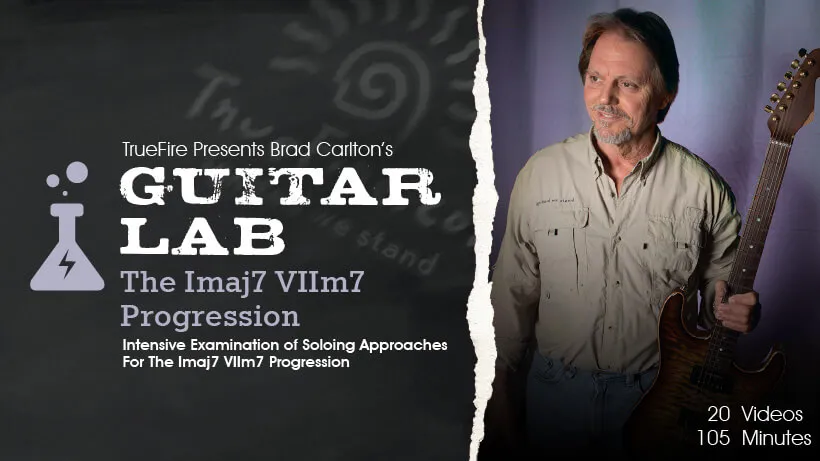
Guitar Lab: The Imaj7 VIIm7 Progression

An intensive examination of guitar techniques and theory

Marty FriedmanTommy EmmanuelSteve VaiEric GalesEric Johnson

Get this course and 1,000+ more with All Access

Try 14 days free. Cancel any time.

Purchase Individual Course for $5.00
Guitar Lab: The Imaj7 VIIm7 Progression

About this course

This course will present a thorough analysis of the modal options for soloing over a Imaj7 VIIm7 progression in the "street key" of D. The term street key refers to the home base chord of the progression (determined by your ear) which may or may not be the home base chord of the theoretical key(s). You'll learn how to view chord voicings as a "safety net" when soloing, how to build arpeggios which serve as a melodic framework, how to organize modal options based on a chord formula with real or implied extensions, how to utilize common tones between different chords, how to apply pentatonic subscales of the various modes, how to utilize power chord structures based off arpeggios for smooth jazz sounds, and how to recognize triads within the heptatonic arpeggios for each mode.

What you'll learn

  • Breaking out of traditional scale-based soloing
  • Identifying strong and weak scale tones
  • Understanding pentatonic scales as mode subsets
  • Understanding how modes can be viewed as interlocking triads
  • Developing melodic choices through ear training
Release date: 06/01/2016 • 1h 45m runtime
Start Course
Sample lessons
7th Chord Voicings
7th Chord Voicings
5th/6th String Root Forms
Harmonic Analysis
Harmonic Analysis
One Key vs Two
Scale Options
Scale Options
Modal Approach
The Safety Net Approach
Chord Voicing Shapes

What's included

20 lessons • 19 charts • 1 Jam Tracks

The Imaj7 VIIm7 Progression
Hi, I'm Brad Carlton and welcome to Guitar Lab: The Imaj7 VIIm7 Progression. This course will present a thorough analysis of the modal options for soloing over a Imaj7 VIIm7 progression in the "street key" of D. The term street key refers to the home base chord of the progression (determined by your ear) which may or may not be the home base chord of the theoretical key(s). You'll learn how to view chord voicings as a "safety net" when soloing, how to build arpeggios which serve as a melodic framework, how to organize modal options based on a chord formula with real or implied extensions, how to utilize common tones between different chords, how to apply pentatonic subscales of the various modes, how to utilize power chord structures based off arpeggios for smooth jazz sounds, and how to recognize triads within the heptatonic arpeggios for each mode. Let's get started.
7th Chord Voicings
We'll base our areas of activity on the fingerboard around the 5th and 6th string rooted chord forms for each of the 2 chords in this progression. Throughout this course, you'll have diagrams for various arpeggios, modes, and pentatonic subscales aligned with these 5th and 6th string rooted chord forms.

Our street key is D. Therefore, the title of this course, which is "The Imaj7 VIIm7 Progression", yields a Dmaj7 C#m7 chord change. This would be determined by looking at Chart 1 and going down to the key of D, which would then reveal that D is I and C# is VII in the key of D. The labels of our formula establish the roots of the chords, and then the chord qualities are defined by the major 7 and minor 7 harmonic labels. Diagrams 1-4 show the chord voicings for these two areas of activity on the fingerboard.
Harmonic Analysis
One harmonic analysis of this progression would be that it's a IVmaj7 IIIm7 in the key of A. This is revealed by looking at Chart 1 and applying the diatonic 7th chords from the bottom of the page to the key of A major. The IVmaj7 in the key of A would be Dmaj7, and the IIIm7 in the key of A would be C#m7.

Be aware that throughout this course I'm utilizing a protocol of uppercase Roman numerals for the roots of the chords and then applying the harmonic label to define the entire sonority. Traditional labeling would use uppercase Roman numerals for major family chords, and lowercase Roman numerals for minor family chords. This protocol eliminates any confusion as to whether the quality of the chord is major, minor, or dominant.

Chart 1 reveals in the box labeled diatonic 7th chords that a maj7 chord can function as a I or IV chord. Likewise, a m7 chord can function as a IIm7, IIIm7, or VIm7 chord. This information offers up various theoretical analyses of this progression in which each chord is in a different key. Throughout this course, we'll explore various combinations of these harmonic options.
Scale Options
The modal options for this progression are as follows: D Ionian mode for the Dmaj7 (Dmaj7 is functioning as the I chord in the key of D), D Lydian mode for the Dmaj7 (Dmaj7 is functioning as the IV chord in the key of A), C# Phrygian mode for the C#m7 (C#m7 is functioning as the IIIm7 in the key of A), C# Aeolian mode for the C#m7 (C#m7 is functioning as the VIm7 in the key of E), and C# Dorian mode for the C#m7 ( C#m7 is functioning as the IIm7 in the key of B).
The Safety Net Approach
If you know how to play the chords to a piece of music, you have a framework from which to play melodies by simply playing any of the notes out of the chord voicings. This is what I term "the safety net approach", which is especially effective when you have to play over fast chord changes in which the duration of each chord is very short. This also provides for a reference point on the fingerboard, because remember, you are presented with the chord first and then you solo over it. In other words, make sure that you can play rhythm guitar with confidence and that you can see the voicings on the fingerboard without linking the notes to specific fingerings.
Building Arpeggio Forms
Now we'll take the chord voicings and flesh them out to establish arpeggio forms in our two areas of activity on the fingerboard. Because these chord forms are obviously one note per string layouts, there will be situations where you have two available chord tones on each string. This can be readily seen in any of the mode diagrams (5-9, 23-26). The arpeggio will be in red scale degrees and the remaining three extensions which define each mode will be in black scale degrees.
Using Common Tones
In this video, I'll demonstrate the principle of using common tones when playing over two different chords. This is a very effective musical technique which allows you to sustain a note over the chord change instead of feeling obligated to play a different note. This principle can also be utilized to provide forward momentum in your melody even when the note you sustain is not a strong chord tone over your destination chord. You simply resolve the weaker note, which was your common tone to a strong chord tone. And remember, you won't always target chord tones but you want to have the skill set to do so.

+ 13 more lessons

Start Course

Reviews

3 results

Resojoe

04/13/22

Eye (and Ears) opening

Ok Brad Carlton is my favorite instructor on TrueFire and this course is a big reason why. I found it through browsing courses as an all Access member. His explanation on what scales you can play over the chords is great and you can put it to use right away. If you only check out the modules on pentatonics you got more than your money’s worth.

nigge99

Verified buyer

12/26/18

Good Learning Material

Sometimes I like it to study progression and it's scales to understand the musical connections. this may create new musical ideas - that's also a good point to go ahead ... under this aspect I like the Guitar lab ... ;-)

mikekuzma12

Verified buyer

11/22/18

5

Truly a great teacher. I have learned so much In the way that it should be taught.Loved the balance of theory and technical. Brad definitely gets you thinking. I like the way that he ties in the titles, For instance, know your neighbors. Truly a great instructor.

Stop searching. Start improving with All Access.

Try 14 days free. Cancel any time.