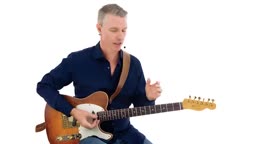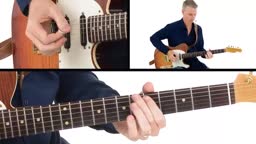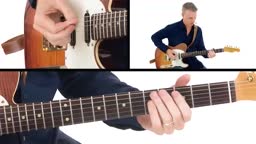

Mixolydian Connections

Unleash Mixolydian's Soloing Super Powers

Marty FriedmanTommy EmmanuelSteve VaiEric GalesEric Johnson

Get this course and 1,000+ more with All Access

Try 14 days free. Cancel any time.

Purchase Individual Course for $24.99
Mixolydian Connections

About this course

Unlock the magic of effortless guitar playing with Rick Stickney’s Mixolydian Connections! This isn’t just about scales—it's about transforming how you make music. Rick’s approach breaks the Mixolydian scale into bite-sized nuggets, turning practice into creative fun.

Learn to weave melodies that flow across the fretboard. Say goodbye to dull routines and hello to a vibrant new sound!

”Learning scales on the guitar is easy. Learning which chords and tonalities those scales can be played over is also relatively easy. Now comes the hard part, making music without sounding like you're just running up and down a scale.

Solving this puzzle is the key to taking your soloing chops to the next level. The solution is simply changing how you learn and practice scales. Instead of practicing scales from top to bottom, in Mixolydian Connections, I'll show you how to break that scale down into smaller 2 and 3 note sections. I'll show you how to craft fresh musical ideas from these smaller sections.

I'll show you how to visualize and create new ideas, and connect these smaller sections across the entire fingerboard. So grab your guitar and let's make music with the Mixolydian Scale.”


You’ll have all of TrueFire’s advanced learning tools at your finger tips to personalize your workspace and learn at your own pace.

You can loop, slow down, or speed up any section of a lesson. Plus, all of the tab and notation is synced to the videos for the optimal learning experience. You’ll also get tab and standard notation files to print out, Guitar Pro files, and all of the backing tracks to practice with.

Grab your guitar, and let’s dig in with Rick Stickney!

What you'll learn

  • Create musical phrases instead of running scales mechanically
  • Apply the Mixolydian scale more musically in solos
  • Apply Mixolydian modes over dominant 7th chords in real-time
  • Break down the Mixolydian scale into smaller 2 and 3 note sections
  • Visualize and connect scale fragments across the entire fingerboard
Release date: 07/11/2024 • 1h 42m runtime
Start Course
Sample lessons
Position One Puzzle Pieces
Demo & Practice Session
12 Bar Blues | Position 2
Performance
Chromatic Jam
Chromatic Jam
Performance

What's included

28 lessons • 16 charts • 6 Jam Tracks

Mixolydian Connections
Hey guys, I'm Rick Stickney and welcome to Mixolydian Connections. Learning scales on the guitar is easy. Learning which chords and tonalities those scales can be played over is also relatively easy. Now comes the hard part: making music without sounding like you're just running up and down a scale.

Solving this puzzle is the key to taking your soloing chops to the next level. The solution is simply changing how you learn and practice scales, rather than practicing scales from top to bottom. In Mixolydian Connections, I'll show you how to break that scale down into smaller 2 and 3-note sections. I'll show you how to craft fresh musical ideas from these smaller sections.

I'll show you how to visualize and create new ideas and connect these smaller sections across the entire fingerboard. So grab your guitar, and let's make music with the Mixolydian Scale.
Position One Puzzle Pieces
Mixolydian Connections / Position One Puzzle Pieces.

In Mixolydian Connections, you are going to learn an entirely different approach to making music with the mixolydian scale. The problem with learning scales has always been knowing what to do with them once you’ve learned your box position patterns.

In Mixolydian Connections, we are going to break the scale down into small 2 or 3 note combinations. Throughout the course I call these note combinations “puzzle pieces.” I’ve identified 6 of these puzzle pieces within the scale, some very tried and true sounds, they are:

  • The 5th-6th-root combo
  • The major 3rd
  • The major 3rd-root-b7 combo
  • The 2nd-root combo
  • The 5th-6th-b7 combo
  • The 4th-major 3rd combo


In this first lesson we are going to work on learning where all these puzzle pieces live within the larger box pattern for G mixolydian, position 1. It’s very important to learn not only where they are but also where they are in relative position to the root. This is crucial as you start to move into other keys. It’s equally important to get the sounds of these note combinations in your ear.

We are then going to start combining these pieces like pieces of a puzzle, hence the name Mixolydian Connections. An example would be connecting the 5th-6th-root combo with the major 3rd, etc. So no more having to memorize licks. You are going to be able to start making very musical sounding phrases immediately, even if this scale is new to you.

This method has helped my private students immensely, and vastly cut down on the time it takes to go from learning a pattern to playing tasty, melodic solos in the mixolydian mode, and it will work for you too!
Position Two Puzzle Pieces
So now that you get the “puzzle pieces” concept we are going to start finding all these sounds up the neck. Here we are looking at position 2 of G mixolydian. Be sure to always reference the position of the nearest root (G) as you learn these shapes up the neck. This is crucial when you start to work in other keys.
Position Three Puzzle Pieces
Here we mapping out our puzzle pieces in G mixolydian position 3. Position 3 contains what players commonly refer to as the “B.B Box”, without a doubt some of the most important real estate on the fingerboard to master!
Position Four Puzzle Pieces
Position four of G Mixolydian centers around the 10th fret on the A string. Focus on key puzzle pieces like the 5th, 6th, root, and major 3rd (9th fret D string and 12th fret B string), the b7 (13th fret low E string and up on the G string), and the 2nd and root combinations (A and B strings). Practice combining these elements and remember to relate everything back to the G root. Experiment with bending the 6th into the b7 or sliding it. Ensure you understand the 4th to the 3rd puzzle piece in both its positions to integrate it seamlessly.
Position Five Puzzle Pieces
In position five, the root is at the 15th fret on the low E string. Key puzzle pieces include the 5th, 6th, and root (starting at the 12th fret on G string, and also on the B and high E strings), the major 3rd (14th fret A string and 12th fret B string), and the 3rd, root, b7 (A & low E string, B, G, and D strings). Map out the 2nd to root on the A and G strings, and the 5th, 6th, and b7 on the D and B strings. Finally, integrate the 4th to 3rd on the A and B strings. Methodically practice each position, slow and meticulous, to build a solid foundation before adding more complex elements like bluesy bends.
Mixing in the b3rd & Blue Note
To add a bluesy feel, integrate the b3rd and b5 (blue note) across all five positions of G Mixolydian. In position one, the b3rd is at the 6th fret on the low E string, 3rd fret G string, and 6th fret high E string, while the b5 is at the 4th fret on the A string and 6th fret on the G string. Move up through positions, noting the b3rd and b5 locations: position two (8th fret D string, 6th fret low and high E string), position three (11th fret B string, 8th fret D string), position four (13th fret A string, 11th fret on the B string), and position five (13th fret A string, 15th fret G string, b5, 14th fret B string). Combining these with puzzle pieces results in a more authentic blues sound.

+ 21 more lessons

Start Course

Reviews

15 results

Darren V.

02/03/26

Transformational Course!

This course has been absolutely eye-opening for me. I have tried for the longest time to make the leap from memorizing tons of patterns and shapes to internalizing what I like to think of as "mini-shapes" -- intervals based on the position of the root. Making the shift from seeing everything solely as a pattern to a perspective based on intervals has opened up the fretboard in ways I never dreamed possible. Added bonus: I now have a much better handle on modes! And a final note for anyone who wants to take this course: Moving through the content didn't help at all. What made a major impact on my playing and understanding was slowing wayyyyyy down, practicing each "puzzle piece" at every root position, and giving myself space to not rush. If you are stuck with the five Pentatonic positions, major and minor scale positions, etc. , and want to break out of the boxes, this is a fantastic way to do it!

Onthe2&4

Verified buyer

09/28/25

Love this video.

I love the example Rick brings to this video package. All very easy to understand concepts with clear application to your playing.

Ohio5665

Verified buyer

09/14/25

Mixolydian Connections

This course really worked for me. By breaking down the mixolydian scales into intervals and then connecting them across the fretboard it opens up a whole world of possibility's not just for the mixolydian but for any scale. I always learn something from Rick's lessons!

Perseus55

Verified buyer

07/23/25

Great course!!!

Mitch

02/20/25

Key to sweet blues

Brilliant course. Step by step breaking down of the mixolydian scale. The study of note relationships - intervals - has provided an invaluable insight into improvising/constructing solos. I feel like I have been handed the key to sweet sounding blues.

Stop searching. Start improving with All Access.

Try 14 days free. Cancel any time.