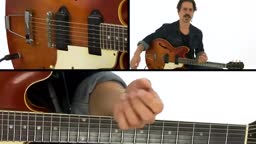

Hip Blues: Outside Lines

Learn How to Play Outside the Box for Richer Harmonic Vocabulary

Marty FriedmanTommy EmmanuelSteve VaiEric GalesEric Johnson

Get this course and 1,000+ more with All Access

Try 14 days free. Cancel any time.

Purchase Individual Course for $19.99
Hip Blues: Outside Lines

About this course

Like most blues guitar players, you probably find yourself searching ‘outside the box’ yearning for a richer harmonic vocabulary that you hear many of your favorite players use in their own improvisations.

In this Outside Lines edition of Hip Blues, Corey Congilio will share some of his own vocabulary and improvisational approaches with you as he guides you through 10 “outside blues” soloing performance studies. Each study highlights a particular approach or concept that you can easily put to use right away in your own blues soloing.

”We’ll work on dominant seven arpeggios for two five ones, incorporating chromatic lines, and diminished applications. I’ll show you minor seven flat five over blues progressions and vamps, and we'll focus on the “elusive” melodic minor scale and the array of outside tones it can spice up your solos with.”

Corey first explains the approach and then applies it over a backing track for demonstration purposes. Corey breaks down all of soloing performance studies for you in detail as well.

”You'll exercise dominant seven arpeggios and two five ones in both a shuffle in A and a straight feel in D. There’s a modern shuffle in E where we’ll incorporate chromatic lines. You'll dip our toe into diminished with a laid back swing groove in the key of C and step outside with Minor 7 flat five arpeggios over a dominant seven using a funky one-chord vamp. There’s a rumba feel with easily digestible melodic minor sounds. And, in your final set of studies, you'll put it all together over two tracks, and pack it with outside applications for everything you've learned.”

Corey will explain and demonstrate all of the key concepts and approaches along the way. You’ll get standard notation and tabs for all of the performance studies. Plus, you’ll be able to use TrueFire’s learning tools to sync the tab and notation to the video lesson. You can also loop or slow down the videos so that you can work with the lessons at your own pace. All of the backing tracks are included to work with on your own as well.

Grab your guitar and let’s head outside with Corey Congilio!

Corey Congilio's Preferred Gear

Below is a list of Corey Congilio's preferred gear including guitars, amps, pedals, accessories, and more. What you see in Corey's lessons may or may not be this actual gear, but if you are trying to capture Corey's sound and tone, the gear listed below is recommended by Corey and it's a great place to start!

Guitars

Amps

Pedals

Accessories & More

What you'll learn

  • Apply D melodic minor scale over G7 chord in a blues context
  • Create outside sounds over the IV chord using melodic minor
  • Use hybrid picking to execute country-influenced blues licks
  • Combine major and minor pentatonic scales fluidly
  • Employ chromaticism as a connecting device between chord tones
Release date: 03/05/2020 • 2h 28m runtime
Start Course
Sample lessons
Puttin' it Together: Funky
Demonstration
Super Sized
Super Sized
Overview
Super Sized
Super Sized
Performance
Super Sized
Super Sized
Breakdown

What's included

42 lessons • 20 charts • 10 Jam Tracks

Hip Blues: Outside Lines
Hi, I'm Corey Congilio. Welcome to this Outside Lines Edition of Hip Blues.

I've been playing blues my entire guitar-playing life. Although I'm quite content to stay inside the box, I always find myself searching "outside the box" for a richer harmonic vocabulary that my favorite jazz and fusion players use in their own improvisations.

In this edition of Hip Blues, I'm excited to share some of this vocabulary with you as we play our way through 10 “outside” soloing performance studies. Each of these studies highlights a particular approach or concept that you can easily put to use right away in your own blues soloing.

We'll work on dominant seven arpeggios for two five ones, incorporating chromatic lines, and diminished applications. We'll talk about minor seven flat five over blues progressions and vamps, and we'll focus on the “elusive” melodic minor scale and the array of outside tones it can create in your solos.

I'll first explain the approach and then we'll apply it over a backing track for demonstration purposes. I'll break down all of soloing performance studies for you in detail as well.

All of the performances are transcribed and you'll be able to sync the tab and notation to the video using TrueFire's learning tools. All of the backing tracks are included, and you can also loop or slow down the videos so you can work with the lessons at your own pace.

Ready to get started? Grab your guitar, and let's go outside!
Dom7 Arps: ii V I
Aside from minor and major pentatonic scales, arpeggios make up a large part of my blues soloing vocabulary. I'm going to show you several that I'll use in the upcoming example as well as how utilizing the II V I progression to approach the four chord of the original blues progression will really help you sound more sophisticated!
Arpeggio Rabbit Hole
The reason I call this one Arpeggio Rabbit Hole is because we're really diving deep into arpeggios. The more you use them in different ways, the easier they'll be to understand!
Arpeggio Rabbit Hole
This laid back swing in A is the perfect track to start inserting arpeggios. The first half of the solo is more tame than the second but both have equal value.
Arpeggio Rabbit Hole
If you pay close attention to the II V I demonstration, you'll see how I implement the arpeggios in both choruses of the solo. If you're having trouble, go back and watch that lesson. You should get a lot of mileage out of this lesson alone!
Dom7 Arps: Straight 8th ii V I
Here we'll talk more about arpeggios and move to the key of D. I'll set you up for the upcoming solo and remind you of the importance of the II V I progression.
Straight Up Arpeggio
We'll be playing a mid tempo straight feel here in the key of D. I love playing over these kinds of grooves and I think you will as well. Feel free to jam some rhythm along with the backing track too!

+ 35 more lessons

Start Course

Reviews

57 results

Sangeetko

Verified buyer

10/28/25

Great excellent. Thanks

EnricoDePaola

Verified buyer

02/05/25

Best of the best. A must have

Really THE BEST course I've ever done. Is what I was looking for since many years and FINALLY I found it. I'm into right now and very very happy. Fully raccomended advanced and intermediate blues players, but not only. To me, it reveled the secretes I always wanted to know about playing outside.

lykotomaro

Verified buyer

12/22/24

super

briandelaney

Verified buyer

08/06/23

Awesome Course!

This course is amazing. Somehow Corey slipped under my radar but now he's shot up to be one of my favourite instructors. He has a clear, calm way of explaining things that just makes you want to go further. I'm loving this course.

Felype

01/28/23

It's called hip outside lines but it's all about playing the changes

By using different tempos, rhythms and tonal centers for each musical topic, Corey helps you develop your ears for the changes. Try mixing up some ideas from one lesson into the backing track of another and you'll begin to understand how you'll have option to go from the I chords to the IV and so on and so forth. When a guitar player is able to highlight and even lead the chord changes within their melodic ideas is when the waters part and the magic truly happens. Your bandmates will appreciate and your audience will too!

Stop searching. Start improving with All Access.

Try 14 days free. Cancel any time.