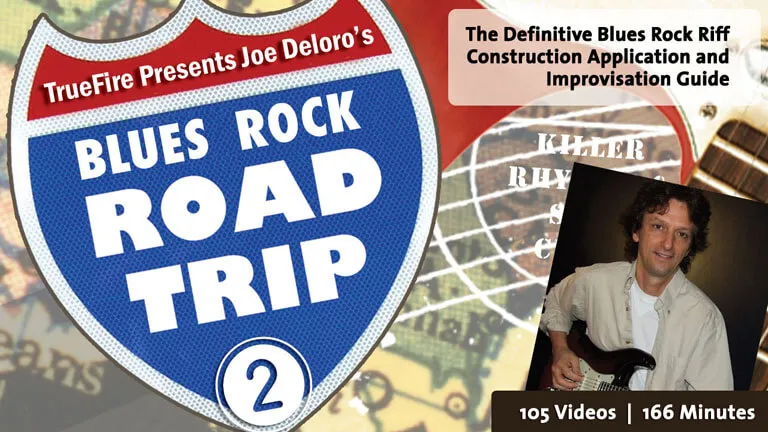
Blues-Rock Road Trip 2

The definitive blues rock riff construction application and improvisation guide

Marty FriedmanTommy EmmanuelSteve VaiEric GalesEric Johnson

Get this course and 1,000+ more with All Access

Try 14 days free. Cancel any time.

Purchase Individual Course for $5.00
Blues-Rock Road Trip 2

About this course

Take a 1-4-5, crank up the drive, blow long improvised solos and you've got a few of the necessary ingredients to start working on your blues-rock bag. But that's just the beginning - everything else you need can be found in Deloro's original Blues Rock Road Trip and Blues Rock Road Trip 2, Deloro's newly updated, eye-opening, ear-bending intensive study program focused solely on riff construction and applications.

At the core of virtually every killer blues rock tune is a solid and memorable "riff." Riffs, not to be confused with solos or melodies, serve as either the driving rhythmic figures of a tune, or as the thematic building block for its featured solo. In either case, riffs are as critical to the composition or solo as the "hook" itself. Could you imagine Suzie Q, Bad Sign, La Grange, One Way Out, Superstitious, Elizabeth Reed, Whole Lotta Love or Abracadabra without their signature riffs?!

Blues Rock Road Trip 2 is all about the construction and application of blues rock riffs for soloing, improvisation and composition. Having transcribed and studied literally thousands of riffs, licks and solos, Joe Deloro is a bona fide expert in the signature stylings of every important blues rock player. In short, Deloro is a walking encyclopedia of riffs, their origins and their applications.

You'll work through 40 original "riffs" styled after Joe Walsh, Steve Miller, Eric Clapton, George Harrison, Dickie Betts, Duane Allman, ZZ Top, Jimmy Page, John Lee Hooker, Clarence White, Jimi Hendrix, Carlos Santana, Albert King, B.B. King, Jeff Beck, James Burton and Stevie Ray Vaughan to name just a few.

Demonstrating each riff over an accompanying practice rhythm track, Deloro will step you through the riff's construction, application and variations. As you play your way through the course, you'll develop a diverse vocabulary of tasty riffs and cultivate your ability to form original ideas for 8, 12 and 16 bar solos.

Whether you're interested in spicing up your solos or composing hit blues rock tunes, Blues Rock Road Trip 2 will serve as an indispensable reference and study program

What you'll learn

  • Apply octave transposition technique to create unified phrasing
  • Play a two-bar G7 theme and variation riff in the style of classic blues rock artists
  • Execute a 4-bar blues/jazz phrase with theme and variation structure
  • Apply pick hand damping technique for staccato articulation
  • Create variations on a melodic theme
Release date: 03/26/2009 • 2h 46m runtime
Start Course
Sample lessons
Been Good
Been Good
Introduction
Been Good 1
Been Good 1
Performance
Been Good 1
Been Good 1
Breakdown
Idlewild
Idlewild
Introduction

What's included

105 lessons • 42 charts • 26 Jam Tracks

Blues Rock Road Trip 2
Welcome to Blues Rock Road Trip 2. What lies ahead are 40 revved-up riffs and solo phrases composed with two things in mind: equipping you with the tools to build your own trick bag of blues rock licks, and developing your understanding of the essential role that phrasing plays in soloing. This approach will cultivate your ability to form original ideas and tastier 8,12, and 16 bar solos.

Heads up, each lesson is divided into two parts referred to as Phrases 1 & 2, and most include variations. Once you're comfortable, be sure to move into the passing lane and mix things up over the Jam tracks. Try combining phrases, TAB variations, etc. as you see fit.

The Basics:
So what is phrasing? Basically, it's following one complete idea with another and making sense. Again, it's two complete ideas that compliment or effectively contrast each other. When you hear a good phrase it sounds like one person answering another, or a two line couplet in poetry.

Each half (complete idea) of a phrase is called a Motive and Motives are often called Licks or Riffs. There's two types of phrases in popular music: Theme and Variation, and Question and Answer. In the lesson texts that follow, the two phrase types will also be referred to as T&V and Q&A. Both types are defined below.

Referring back to poetry, just as a couplet is incomplete until it’s joined by another couplet in order to form a stanza, so is a phrase until it’s followed by another phrase to form a period. In Music, this typically takes 8 bars and completes a basic melody or solo. Of course, things can expand from there (see vocabulary terms below).

Also, on a micro level, it’s important to understand figures. They’re the equivalent of words and get things going. So, just like 5-6 words are often found in a line of poetry (or a sentence), 5-6 figures typically make up a motive in music.

Finally, in order for music to be interesting, it needs to progress logically, like a poem or language in general. And, in order to do that, all phrasing elements need to relate well. This is called unity. Therefore, the better the unity, the better the phrasing.

Vocabulary:

Make sure to familiarize yourself with the following terms:
1. Figure: like a word and typically introduced with an accent, 1-5 notes but typically 3, and primarily consists of chord notes.
2. Motive: a complete idea, like a line or a sentence and punctuated with a rest or a tie, typically 5-6 figures in length and 2 bars long.
3. Phrase: like a couplet, made up of 2 motives and typically 4 bars long.
4. Theme & Variation (T&V): a type of phrase wherein the second motive is similar (up to 50%) to the first.
5. Question & Answer (Q&A): a type of phrase wherein the second motive is different (more than 50%) but complimentary to the first.
6. Period: like a stanza, made up of 2 phrases and typically 8 bars long.
7. Part: like 2 stanzas, made up of 2 periods and typically16 bars long.
8. Riff: usually a 1 or 2 bar motive, but occasionally a full phrase.
9. Unity: the main goal of phrasing, makes things gel and stay on topic, when figures, motives, phrases, periods, etc. are variations of the element(s) that preceded them.
Been Good
Been Good is framed on the Intro riff from Joe Walsh’s, Life’s Been Good. Recorded in Coconut Grove, Florida and released in 1978, it’s a great example of his signature blues-rock riff style. Raised in Ohio, New York, and New Jersey before going pro with the James Gang in Cleveland, and then on his own in Colorado and Los Angeles, Walsh’s style is based on many locations and influences. The Chord progression is based on A5 and D5 “Power Chords.” The lead scale in both phrases is A Pentatonic Minor: A,C,D,E,G,A(1,b3,,4,5,b7,8) enhanced with C# (3). In this lesson you’ll be introduced to most of the phrasing concepts and vocabulary listed above. Also, we’ll go into greater detail here than in the following lessons in order to establish a foundation.
Been Good 1
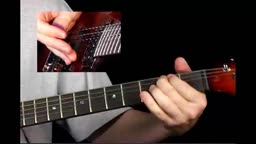
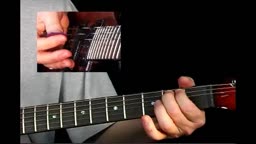
Part 1 is a 4 bar Theme and Variation phrase. Although based on an A major chord, the b3 and D5 chord add nice bluesy tension. Beyond that, we should note that Walsh's riff's are generally more melodic and complex than the average ordinary guy's.
Been Good 1
Part 1 is a 4 bar Theme and Variation phrase. Although based on an A major chord, the b3 and D5 chord add nice bluesy tension. Beyond that, we should note that Walsh's riff's are generally more melodic and complex than the average ordinary guy's.
Been Good 2
Part 2 is a 4 bar Question and Answer phrase. Notice that the same first motive is featured in both Phrases 1 and 2. First, in a T&V phrase, and then here this example in a Q&A phrase. If you combine Phrases 1 and 2 you’ll have an 8 bar T&V period. Try it out. This is a common technique and is also an easy way to develop background parts or solos with strong unity. Also, although figures are indicated in the TAB for Been Good, they're not in the following lessons to allow easier reading. Remember; don’t take these phrasing concepts and definitions too seriously. They’re simply meant as a point of reference for music in general, as well as a way to improve the structure of your solos. So, be patient and check the TAB (for diagramming of the phrasing elements mentioned in this example only) to get started. By the time you’re comfortable with BG and the next few lessons, things should start rolling and be making a lot more musical sense.
Been Good 2
Part 2 is a 4 bar Question and Answer phrase. Notice that the same first motive is featured in both Phrases 1 and 2. First, in a T&V phrase, and then here this example in a Q&A phrase. If you combine Phrases 1 and 2 you’ll have an 8 bar T&V period. Try it out. This is a common technique and is also an easy way to develop background parts or solos with strong unity. Also, although figures are indicated in the TAB for Been Good, they're not in the following lessons to allow easier reading. Remember; don’t take these phrasing concepts and definitions too seriously. They’re simply meant as a point of reference for music in general, as well as a way to improve the structure of your solos. So, be patient and check the TAB (for diagramming of the phrasing elements mentioned in this example only) to get started. By the time you’re comfortable with BG and the next few lessons, things should start rolling and be making a lot more musical sense.
Abra'
Abra' is based on the groove of the Steve Miller tune, Abrcadabra. Released in the summer of 1982, it’s catchy pop sound is due in part to the magic of fusing an A minor reggae riff over a rock drum part and then tying it all together with laid back blues rock vocals. Steve Miller gained international success in the late 60’s with the Steve Miller Band when he was based in San Francisco. However, having started his career at an early age in Wisconsin, Texas, Chicago and New York, his sound is actually a mixed bag of many regions and styles. The chord progression to Abra' is Am, Dm, and E7.

+ 98 more lessons

Start Course

Reviews

7 results

arpeggio5

Verified buyer

01/31/26

vert good course layed out good
Osokin

Verified buyer

04/17/22

Spice Up Your Riffs!

Joe Deloro has put together 40 original 'riffs' in the style of great players like Joe Walsh, Eric Clapton, Hendrix, SRV and many others, and demonstrates them all against a practice rhythm track. He then takes you through the riff's construction, application and variations. A great source to diversify and expand your vocabulary of tasty riffs.

sslugger

Verified buyer

05/30/20

Riffs You Will Know

Lots of great riffs here for you if you are into blues rock. Joe takes you through each one which need some practice to master. Even though they are relatively short, each riff is recognisable to the original and fun to learn. A good course with plenty of material if you are new to blues rock and you want a kicker.

TimHolman

Verified buyer

04/01/20

Good Collection of Riffs and Licks

This is a collection of fairly short riffs and licks in the style of some of the greatest bands and musicians of the genre. Not a lot here for more advanced players but great for intermediate players to get their fingering down and work on some cool licks. Beginners should also be able to find lots to work with. The age of the course shows but does not hinder the clarity at all!

model1994

Verified buyer

03/26/20

I rate Blues Rock Trip as a 5-star product. Blues Rock Road Trip is a definite go to tutoring in my current guitar education. Blues Rock Road Trip has taken my guitar playing around the bend in my string bending.

Stop searching. Start improving with All Access.

Try 14 days free. Cancel any time.