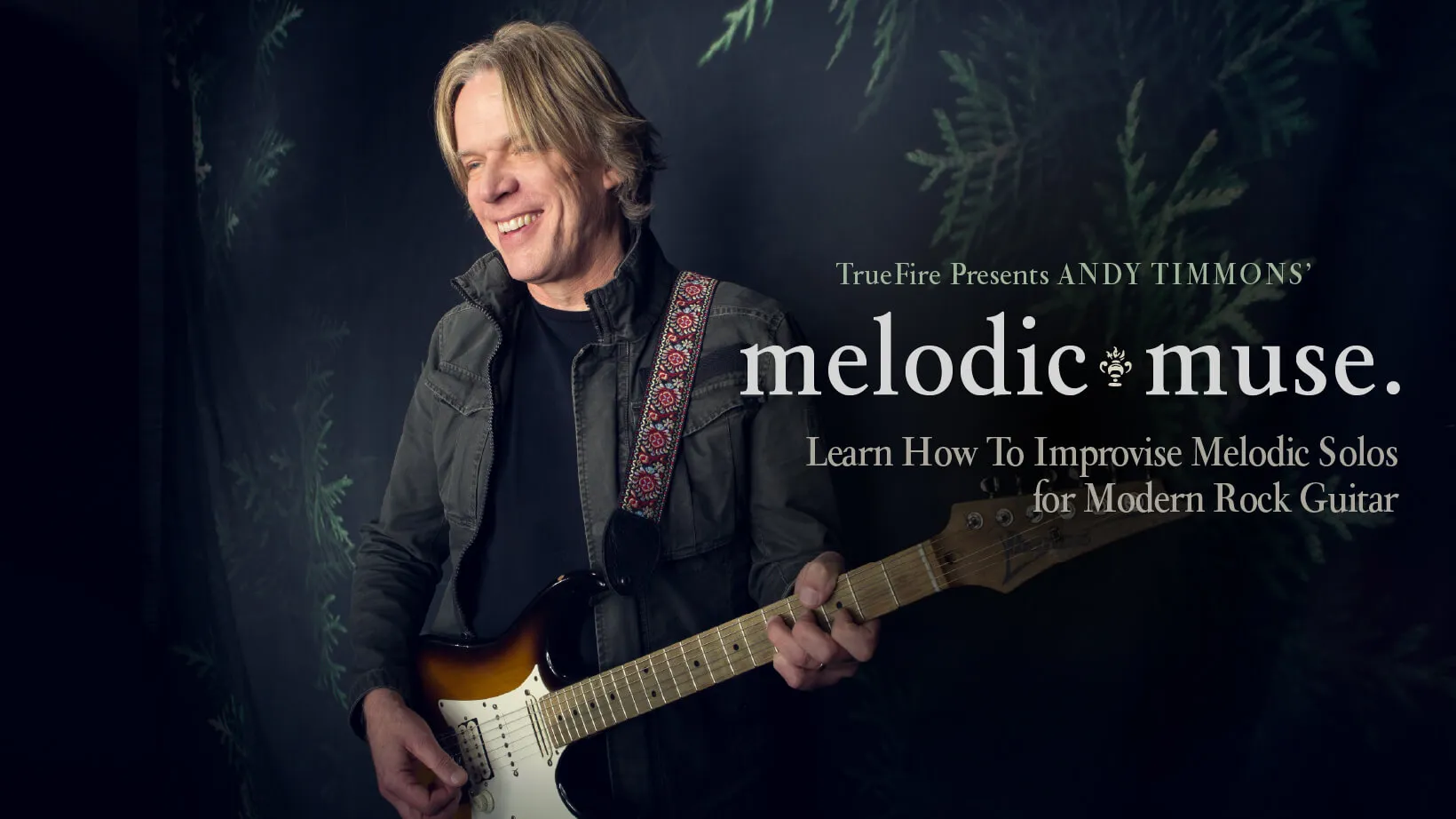
Whether you're composing or improvising, the ability to create a compelling melody is always the key to making your music distinctive, emotional, and memorable. You do that by tapping into your ‘melodic muse’ — a craft that every musician needs to develop and continuously be fine-tuning.
Andy Timmons’ Melodic Muse presents a simple, step-by-step approach for creating melodic lines by fusing what you already know about guitar with your ear’s creative instincts. No tedious theory or boring exercises to struggle through — you will play your way through Andy’s ear-opening curriculum to ignite your own ‘melodic muse.’
”When we talk about playing melodically on the guitar, we're usually thinking of improvising, but this also applies to songwriting. It's really the same "muse" or driving force that helps us create melodies whether we’re improvising or trying to write a tune. I’ve designed this course to help you discover, feed, and nourish your ‘melodic muse’ by bridging the intellectual with what I call the ‘auralectual’ — a term I created to describe the creative direction that your ear leads you towards.”
Melodic Muse is organized the course into 3 sections. In the first section, Andy presents a melody primer describing all of he elements that comprise melodic playing and composing. Andy will also explain how the ‘auralectual’ connects with the intellectual within your own melodic muse.
”In this course, we’ll approach everything we work on using both our intellect and our auralect. We’ll analyze chord progressions and identify the scale and note choices that we might use with those chords — that’s the intellect at work. The "auralect" side of things has to deal with learning through our ears and eyes. Music is an "aural" experience. It's meant to be taken in through those mediums primarily, so we feel it most through these ways. The ear develops instincts based on everything you've taken in. I consider it like a library of ideas collected throughout our lives.
When we're improvising or composing, we're drawing on these experiences as the benchmark of what we'd like to hear. We're really trying to connect these two things — the "auralect" and intellect. And more so, we're applying the intellectual side after the fact, trying to describe the things that we feel first.”
In the second section, Andy guides you through a series of Melody Studies and Key Concepts, each featuring an explanation, a demonstration and then a playalong where you apply the concept in a musical context. You’ll learn and play through 10 studies: One Finger, One String, Play One Note Per Chord, Play Two Notes Per Chord, Target the 3rd of Each Chord, Visualize Simple Triads, Find Melodies in Triads, Train Your Ear, Call & Response Statements, Phrase It Like You Sing It, and Motivic Repetition.
The third section features 2 bonus studies and performances demonstrating Andy’s Melodic Muse principles at work. ”In the final section, we're going to take all these ideas that we've been working on and apply them to a couple of extra tracks. I'm going to take a spin through them but play on them yourself and practice working on these concepts. We’ll work with a progression taken from one of my tracks called All is Forgiven and then we’ll play over a ballad in D minor based around another one of my songs, Cry for You.”
Whatever style of music you play, at whatever level, from beginner to advanced — this is a must-have course of study that you will reference and work with across your entire guitar-playing lifetime.
All of the performance studies are tabbed and notated, plus you’ll have the backing tracks to work with on your own. You can loop and slow down the videos to work with the any of the lessons at your own pace.
Grab your guitar and lets light up your melodic muse with Andy Timmons!
What you'll learn
Apply voice leading concepts to connect chord changes melodically
Use triad inversions as guideposts for melodic choices
Incorporate natural breathing patterns into guitar phrasing
Break away from pre-learned licks and create spontaneous melodies
Develop the ability to improvise melodies vocally throughout daily life
Whether your composing or improvising, crafting a compelling melody is always the key to making your music distinctive, emotional, and memorable. Tapping into your "melodic muse" is a craft that every musician should develop and continuously be fine tuning.
In this course, you'll play your way through a series of lessons and playalongs — a simple, step-by-step approach for creating melodic lines by fusing what you already know about guitar with your ear's creative instincts.
All of the performance studies are tabbed and notated, plus you'll have the backing tracks to play along with. I put them together specifically to provide a foundation for you to connect with your melodic muse. You can loop and slow down the videos to work with at your own pace.
Grab your guitar and let's get started!
In this first section, I really want to dissect what a melody is, talking about all the elements of melodic playing and composing.
So, let's talk about what melody is. The melody is the part of the song that is singable, is memorable, and is really the conveyor of emotion. It's a note on top of a particular chord and how it makes you feel.
All the great melodies that you've heard throughout your life are what you draw upon when you're creating your own melodies — it's the things we've taken in through our ears through the years and have affected us that are trying to come out when we're composing our own music.
When we talk about playing melodies on the guitar, we're usually thinking of improvising, but this also applies to songwriting. I've realized over the years that it's really the same "muse" or driving force that helps me create melodies whether I'm improvising or trying to write a tune. One of the things the great pianist Bill Evans said was, "Improvising [soloing] is a minute's music in a minute's time." It's happening right now. As opposed to composing, which can take over a year to make a minute's music.
To me, they're equally as valid. Again, it seems to me to be the same muse that drives both of these things. In the course, we're going to break down different ways that I approach this process. This includes the intellectual side of things, with theory, thinking about the fretboard and applying your music knowledge, as well as the "auralectual" — a term I created meaning the direction that your ear is leading you.
Let's dig in.
So, let's discuss the difference between intellectual vs. "auralectual".
We'll break things down in this course in an intellectual way — we can analyze chord progressions and note choices with those chords that are very academic. There are chord tones, playing certain scales, etc. that we can look at to make up a melody.
The "auralect" side of things has to deal with learning through your ears and eyes. Music is certainly foremost an "aural" experience. It's meant to be taken in through those mediums primarily, so we feel it most through these ways. So, the ear develops instincts based on everything you've taken in. I consider it like a library of ideas collected throughout our lives.
When we're improvising or composing, we're drawing on these experiences as the benchmark of what we'd like to hear. It's really a selfish thing, and you're hoping to reach other people, but we have to be honest with ourselves and understand that it's based on what we want to hear.
We're really trying to connect these two things — the "auralect" and intellect. And more so, we're applying the intellectual side after the fact, trying to describe the things that we feel first. Again, in the moment, I'm not thinking about what I'm playing at all, just what I want to hear.
So, if you know me, you know that I'm a huge Beatles fan. I think they're a great example of an artist who combine the intellect and auralect. It's one of the great things that they did, and they weren't necessarily thinking about doing it. When they got together in the early 60's, they got these gigs in Hamburg, Germany where they'd have to be playing 8-10 hours a night. They got so much better as a band because they were playing so much, but they also had to learn so many songs (show tunes, things from childhood or their parents' record collections, etc.), some of which had some pretty tricky chord changes.
We can consider this part the intellect, actually learning the chord changes that a song has. But when they internalized that into their own music, and created new melodies from them, that is when the auralect comes into play. By internalizing all these ideas learned through their intellect, they were able to think aurally about music.
The most obvious thing to do is to learn more of your favorite melodies — it's very important to get inside the great melodies, get inside the fretboard, and see how they work. Really break it down. This is something I've known most of my life, but I hadn't applied until the last 10 years.
By learning these melodies, it feeds both our intellect and auralect. You can break it down theoretically and see what's happening, but you can also get it in your ear so when it's time to create your own you've got it in your library.
In this next section, we're really going to break down some of the elements of melody. We're going to start simply and work our way into some more developed ideas. Let's get started.
A gem of a course. Offer a lot concepts and pleasing melodies to learn
C
christopherbuddha
Verified buyer
03/05/26
Great beginners solo course
Very happy with this course ! Instructor takes the time to understand what is needed for student and explains it in a pleasant manner. Also his solo ideas are great for learning ! Not boring solo’s