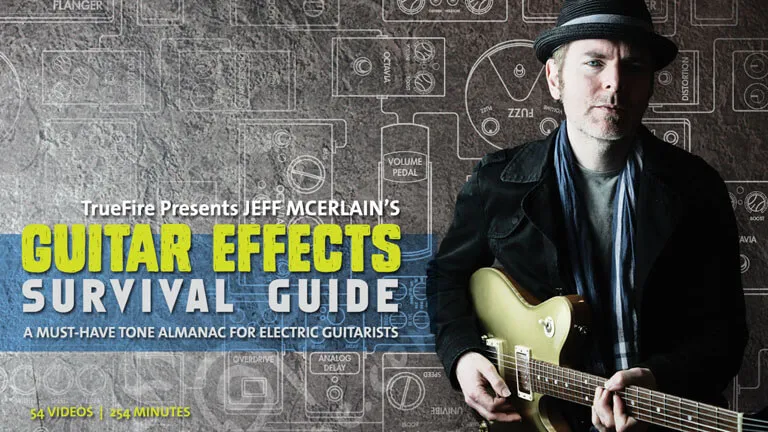
Guitar Effects Survival Guide

A must-have tone almanac for electric guitar players

Marty FriedmanTommy EmmanuelSteve VaiEric GalesEric Johnson

Get this course and 1,000+ more with All Access

Try 14 days free. Cancel any time.

Purchase Individual Course for $19.99
Guitar Effects Survival Guide

About this course

If you're one of those "I plug directly into the amp and don't need no stinkin' effects" kinda dude, then godspeed and thanks for stopping by. On the other hand, if you own a pedal board upon which you trip the light fantastic, stick around -- the Guitar Effects Survival Guide will validate what you might know, illuminate what you don't know, and quickly help you generate a massive and highly versatile sound palette.

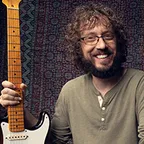
Your effects sensei Jeff McErlain is a tone hound from the word go. Over the past 30 years, McErlain has chased down the effects, chains and parameters that power the entire rock, blues and pop tonal spectrum. Jeff can tell you how to easily replicate virtually any tone with the pedals, amps and guitars that you likely already have in your closet.

The Guitar Effects Survival Guide is organized into two sections. In the first section, Jeff drills down deep on the parameters, settings, sonic qualities and applications for 16 essential pedals; Boost, Overdrive, Distortion, Fuzz, Octavia, Reverb, Analog Delay, Digital Delay, Tremolo, Chorus, Flanger, Univibe, Phase Shifter, Compressor, Volume and Wah.

In the second section, Jeff presents 33 individual effect chain video tutorials demonstrating how to produce, and tweak to your liking, a vast range of tones suitable for virtually any classic or modern style of rock, blues and pop. You'll learn how to select the right combination of pedals, how to arrange the pedals in the chain, and how to tweak the parameters of the pedals to dial in that "perfect" tone.

To reduce external factors that might effect tonal qualities, no super-expensive pedals, amps or guitars were used in any of the demonstrations. Jeff exclusively worked with the same strat-type guitar (Tuttle), small tube amp (Lone Star) and 16 commonly found, affordable pedals for everything that you hear and see in the Guitar Effects Survival Guide.

Every pedal and effect chain video tutorial also features text guides and graphic schematics depicting the pedals used in a particular chain, the order of those pedals, and the exact settings used in the tutorial. Plus, an interactive schematic creation tool is also included with the course so that you can record and print out your own chains and settings.

DISCLAIMER! The Guitar Effects Survival Guide will not reduce the fiscal risks of the G.A.S. Affliction, nor will it prevent future purchases of bright shiny things that promise to shape tone in new and wonderful ways. The only warranty made herein is the guaranteed transfer of priceless grey matter that will significantly aid in the shaping of tone and aural ecstasy.

Pssst... dude who just plugs directly in but is still reading this description: go ahead, you know you want to, we won't tell.

Jeff McErlain's Preferred Gear

Below is a list of Jeff McErlain's preferred gear including guitars, amps, pedals, accessories, and more. What you see in Jeff's lessons may or may not be this actual gear, but if you are trying to capture Jeff's sound and tone, the gear listed below is recommended by Jeff and it's a great place to start!

Guitars

Amps

Pedals

Accessories & More

What you'll learn

  • Use tap tempo to synchronize delay with different tempos
  • Apply this sound to famous songs like Strawberry Fields Forever and Badge
  • Replicate Leslie speaker cabinet effect
  • Understand how to order effects in a signal chain for specific sounds
  • Understand why digital delay is important for precise rhythmic subdivisions
Release date: 11/01/2012 • 4h 14m runtime
Start Course
Sample lessons
Effects Tutorials
Effects Tutorials
Overview
Distortion
Distortion
Tutorial
Digital Delay
Digital Delay
Tutorial
Wet Lead
Wet Lead
CMP+OD+DLY+REV

What's included

54 lessons • 33 charts

Guitar Effects Survival Guide
Welcome to the Guitar Effects Survival Guide, I am so happy to have the opportunity to share my years of tone hunting experience with you. It is a never ending search and a lot of fun, but be careful - it can turn into an obsession! I have chosen 16 classic effect pedals to work with, all readily available at your local music store. I will show you how to dial in each of those pedals individually, and show you how each parameter works in shaping your tone. I will then take you through some cool effects chains to show you how to achieve the tones you hear in your head, or help you dial in a tone you hear on a recording. The order of effects is very important to achieving optimal tone! I have provided schematics for each effect chain that you can download and start tweaking. I have also provided blank sheets so you can catalog your own sounds. The point of this course is not to make you sound like a certain player, it’s more about understanding how to use guitar effects optimally. I do get pretty geeky with this stuff like discussing power supplies, alkaline vs carbon batteries, cable length, true bypass vs buffered, and more stuff that can truly make a difference. But the truth here is that Jimi Hendrix used long curly cables and a bunch of non-true bypass pedals to create some of the greatest guitar sounds ever. By today’s standards he was doing it all wrong. So please keep in mind it is WHAT YOU DO WITH THE PEDALS that matters.

So let’s get started and dive into the Guitar Effects Survival Guide and above all have fun! I know I love this stuff!
Effects Tutorials
There are so many effect pedals out there and chatter on the Internet about the right and wrong way to do things. The first thing I would say is to experiment with whatever you want, it's not like you are going to hurt yourself! Also some of the coolest guitar sounds out there were produced by some guy saying "what happens if I plug this pedal in here"? For this course I have chosen sixteen classic pedals to work with. Before we get into multiple effects and pedal chains, let's dig into each pedal individually. I'll show you what the pedal does and how to tweak it to help you get the tone you hear in your head or on your favorite recording.
Boost
The simplest effect pedal is the clean boost. All it essentially does is boost the signal of your guitar. Guitar players loved this because it allows us to hit the front end of our amp with more signal. This increased volume level will drive the input section of your amp harder and provide some more gain. The earliest boost pedals used a germanium transistor and was often in the form of a treble booster. The most famous treble booster is the Dallas Rangemaster which is rumored to have been used by Eric Clapton on the Bluesbreakers record, often referred to as the Beano record or Beano tone. (This is because Clapton is reading a Beano comic on the record cover). At the time Eric was using a Marshall JTM45 2x12 combo (commonly referred to as the Bluesbreaker because of this recording) and a Les Paul and man does it sound good. Allegedly he was using the Rangemaster to push the front end of the amp into more distortion. This has never been confirmed to my knowledge but is the source of much Internet speculation. But I have played an old Bluesbreaker amp with a Les Paul and it sounded pretty darn close. Both Brian May from Queen and Ritchie Blackmore did use treble boosters for sure in their rigs to get more gain out of their amps. Germanium transistors are very inconsistent and are subject to temperature changes so they can be finicky. They also certainly color your tone to a large extent, which is something you may want. Clean boosts that use silicon transistors are much more common and reliable, they can also boost your signal without effecting your tone too much. For a general clean boost I would go for a modern one. If you want an old school sound, I'd check out a germanium based unit. Or like me, I'd get both.
Overdrive
The term overdrive refers to when a tube amp is driven past its range to supply a clean tone. This is something we as guitar players have come to love and seek out. A common question is “what is the difference between overdrive, distortion, and fuzz as the terms have become interchangeable?” The short answer is not a lot, just one is more extreme as we go down the line. Overdrive can be subtle and produce warm slightly overdriven tones, think SRV. Distortion is easy to see as simply more overdrive, these tones are more saturated and compressed. The spectrum of overdriven tones is huge, from BB King’s slightly overdriven tube amp tones to Eddie Van Halen’s cranked Marshall, to Metallica’s thick distortion, to Smashing Pumpkins' fuzz tones. It is all actually the same idea is a general sense, these tones may be gotten with amps, pedals, or a combination of both but it is all the same idea, overdrive.  What was considered a heavy distorted tone in the 70’s is tame to the metal sounds of today. The Ibanez Tube Screamer is the industry standard for overdrive pedals. Kicked into legendary status by the late great Stevie Ray Vaughan. The Tube Screamer TS808 was first released in the late 70’s and now catches a small fortune on the vintage market but fortunately there are reissues and many boutique clones out there. The Tube Screamer is not the only overdrive circuit of course, there are many excellent options, it is just clearly the most famous. What makes the TS so cool is the way it interacts with an already overdriven amplifier. It can add a nice amount of gain, sustain, and tonal shaping options. They do provide a bit of a boost in the mid frequencies that many people love as it helps to cut through a band. The list of TS users is extensive but Stevie Ray is the most notable.
Distortion
A distortion box produces what we call hard clipping, as opposed to an overdrive pedal that produces soft clipping. What does that mean? If we were to look at a note on an oscilloscope we would see a wave (hence the term sound wave) with a nice rounded top and bottom. When we overdrive or distort a note the top and bottom of the sound wave flattens out, or clips. The more clipping of the wave the more distorted the note. A fuzz pedal produces so much clipping it is seen as a square wave, completely flat on the top and bottom of the wave. There are many excellent distortion boxes on the market but some classic industry standards are the Rat distortion box, the Boss Super Overdrive (a bit more of a distortion box really), MXR Distortion +, Boss Distortion, and the Boss Heavy Metal Pedal.

Many distortion pedals can also be used as overdrive pedals simply by reducing the gain, so once again we see how these terms are a little loose. In high gain amps like a Mesa rectifier the amp is taking advantage of gain staging, many pedals do this as well. Gain staging is simply putting one overdriven tone into another and cascading them to produce even more gain or distortion. So in a Mesa, one preamp tube is being run into another to bump up the level of distortion, there can be any number of gain stages. We can also do this by stacking pedals as well, as we will see in the gain staging pedal chain section. Dialing in a good distorted tone can take some time and slight EQ changes can make a big difference.
Fuzz
The fuzz pedal is one of the earliest stomp boxes on the market. A very simple circuit the fuzz box altered the guitar's signal by transforming it into a square wave. The first widely available fuzz was the Maestro Fuzz Tone by Gibson. The Fuzz Tone pedal was released in 1962 and didn’t really catch on until Keith Richards used one on the opening riff of “Satisfaction” and the floodgates opened. Another definitive fuzz pedal of the late 1960’s was the Sola Sound Tone Bender made famous by Jeff Beck and Jimmy Page. You can hear one all over Led Zeppelin’s debut record and all over Jeff Beck’s trademark “Heart Full of Soul” intro riff from the Yardbirds. He also used it extensively on the Jeff Beck Group sessions. Of course the most famous fuzz pedal is the Dallas Arbiter Fuzz Face. This pedal was favored by Jimi Hendrix and set the benchmark for fuzz tones that we are still chasing to this day.

There are two distinct kinds of transistors used in fuzz pedals, germanium and silicon. In the early 1960’s silicon transistors were fairly new and very expensive and germanium was the norm. Germanium transistors are susceptible to temperature changes and noise so they can be unreliable at times. They do have a very distinct tone, they also react very well to the guitar's volume knob by cleaning up very well. As silicon transistors became less expensive they largely replaced their germanium counterparts in pedals due to their stability. The Silicon fuzzes generally produce more gain but often don’t clean up as well. As a lover of fuzz pedals myself I have both kinds and find uses for them, they sound different and excellent. Other famous fuzz users are Eric Johnson, David Gilmour, Joe Bonamassa, and Stevie Ray Vaughan to name a few. When shopping for a fuzz, try to play as many as you can next to each other, even of the same model. Due to the transistor values the same model pedal can sound and feel very different from pedal to pedal.
Octavia
The Octavia was created by Roger Mayer for Jimi Hendrix in 1967. It’s musical debut can be heard on “Purple Haze” on the Are You Experienced record. One of the many ground breaking sounds on this recording. The pedal produces a doubling effect an octave above the fundamental note. The octave is similar to a ring modulator in that it is kind of dirty and strange sounding. The best way to get this sound out of an Octavia is by using the neck pickup on the guitar and by experimenting with the tone knob to get a more pronounced octave effect. Some other famous Hendrix tunes using the Octavia are “Who Knows” and “Machine Gun” from Band of Gypsies. If you want to put together a Jimi Hendrix pedal board, the Octavia is a must. There are many great reissues of this pedal on the market, but if you get a chance, like fuzzes, try a few of them next to each other. Even a few of the same pedal, as they often sound very different. One may have more of an octave effect, or be warmer sounding etc. This is due to the use of the transistors that can often have slightly different values that can make big tonal changes.

+ 47 more lessons

Start Course

Reviews

29 results

TravoneL

Verified buyer

09/13/25

Very informative

This course was great for learning the ins and outs of guitar effects chains, how they work, and how they’re used in musical arrangements. Great for learning how to get all the sounds out of your guitar. Jeff is a great teacher

JG776

Verified buyer

10/09/22

I like how he displaces the different effects.,.

mblaide

08/11/22

Great Content

I wanted a course I could watch when I didn't have my guitar handy so I chose this one. I haven't really been one to play around with effects too much but I ended up playing around with my effects to try to come close to what Jeff was demonstrating. It's great to come away with more than what you expected in the first place.

mikehargreaves

Verified buyer

03/01/22

Jeff's great, as usual, and this is exactly the piece-by-piece breakdown I needed to start getting the tones I want out of my own gear.

ianmitchell

10/27/21

Learned way more than I expected

I don't even have real pedals, just a modelling amp that can emulate them that came with a bunch of presets. However I picked this course up on a sale and gave it a whirl, and ended up learning way more than I expected. Even with my modelling amp I was able to apply most of the content from this course and use it to create the guitar sounds I wanted.

Stop searching. Start improving with All Access.

Try 14 days free. Cancel any time.