
Western Swing Guitar Guidebook

Key Rhythm & Soloing Approaches for Western Swing Guitar

Marty FriedmanTommy EmmanuelSteve VaiEric GalesEric Johnson

Get this course and 1,000+ more with All Access

Try 14 days free. Cancel any time.

Purchase Individual Course for $14.99
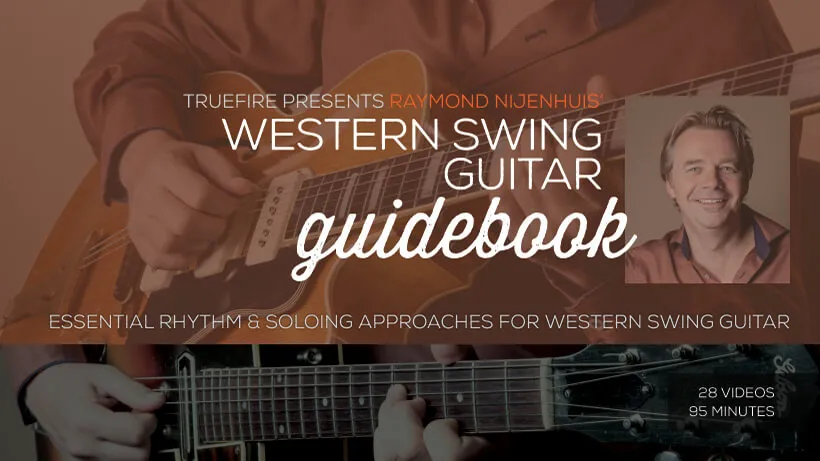
Western Swing Guitar Guidebook

About this course

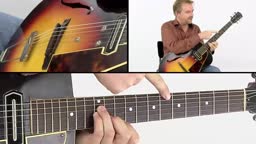
There’s very few musical styles that combine as many varieties of American roots music as Western swing. Blues, big band, hot jazz, New Orleans, pop songs from the 20's and 30's, cowboy songs, boogie-woogie, and even Hawaiian styles have all influenced the Western Swing sound to one degree or another. The guitarist plays a pivotal role, particularly in the rhythm section. Ray Nijenhuis’ Western Swing Guitar Guidebook is your key to taking that hot seat and becoming an accomplished Western Swing rhythm player.

”I’ll give you the tools to expand and upgrade your basic swing rhythm playing. We'll go from 1 chord in 4 beats to chords with inner voicings and bass melodies, using chromaticism, inversions and chord substitutes. We'll examine imitating cool 3-part harmonies of a string or horn section, creating supercool twin lead solos, the "5-of-Rule", chordal riffs and fills, creating anticipation and suspense using the jazzier ii-V-I progression, and even dig into melodic rhythm playing á la "Faded Love" by chord wizard Eldon Shamblin.”

The Western Swing Guitar Guidebook will take your rhythm playing to a whole new level by expanding your chord and rhythmic vocabulary. Ray will also pass on many key approaches such as chord inversions applications, interchanging chords with its own V chord, playing chains of dominant 7th chords (back-cycling circle of fifths), turning common chord progressions into Western Swing style arrangements, and how to liven up simple repetitive progressions.
Ray organized the course into two sections. In the first section, you’ll work through five key concepts and approaches: Two-Part Harmony Runs, The 5-Of Rule, Chordal Riffs & Fills, Connecting Dom 7 Chords, and Triads & Their Inversions.

In the second section, you’ll put all of the key concepts and techniques to work as you play your way through 9 Performance Studies inspired by Western Swing classics. Ray demonstrates all of the Performance Studies over rhythm tracks and then breaks them down by stepping you through the key concepts, techniques and creative approaches that he used in each study.

All of the Performance Studies are tabbed and notated for your practice, reference and study purposes. You’ll also get Guitar Pro files so that you can play, loop and/or slow down the tab and notation as you work through the lessons. Plus, Ray generously includes all of the rhythm tracks for you to work with on your own.

Grab your guitar and let’s swing with Ray Nijenhuis!

What you'll learn

  • Master chord inversions and voicings
  • Create complex chord voicings
  • Understand Western swing musical fusion
  • Developing bass line movement techniques
  • Develop rhythmic guitar techniques
Release date: 12/07/2016 • 1h 35m runtime
Start Course
Sample lessons
The 5-Of Rule
The 5-Of Rule
Concept 2
12 Bar Swing Blues
12 Bar Swing Blues
Performance
12 Bar Swing Blues
12 Bar Swing Blues
Breakdown
Take Me Home To Tulsa
Performance

What's included

28 lessons • 15 charts • 11 Jam Tracks

Western Swing Guitar Guidebook
Hi, I'm Ray Nijenhuis and welcome to the Western Swing Guitar Guidebook. Swing or Western swing; what's the difference? There's hardly any other style that combines so many varieties of American roots music as Western swing: Blues, big band, hot jazz, New Orleans, pop songs from the 20's and 30's, cowboy songs, boogie-woogie, even Hawaiian songs - and the guitar is in the hot seat.

This Western Swing Guitar Guidebook will give you the tools to expand and upgrade your basic swing rhythm playing. We'll go from one chord in four beats to chords with inner voicings and bass melodies, using chromaticism, inversions and chord substitutes. We'll look at imitating the cool 3 part harmonies of a string or horn section with just one guitar. You'll get a great tool for creating supercool twin lead solos. And we'll investigate the "5-of-rule", one of the basics to create a moving and alternating bass.

Chordal riffs and fills will make you sound like a string or horn section all by yourself. We'll create anticipation and suspense using the jazzier ii-V-I progression and dig into melodic rhythm playing á la "Faded Love" by chord wizard Eldon Shamblin.

Would you rather stay stagnant in one position or enrich your backup parts? You'll open up the fretboard by playing inversions of common dominant seventh chords. And what about turning a standard I-IV-V blues progression upside down and inside out? We'll learn how to play backup in a two chord, square dance fiddle tune without ever getting bored.

This guidebook goes beyond playing licks. Now, I don't pretend to be a complete resource in any way, but I will provide you with the essential tools and concepts to inspire you to pick up the guitar and get into this classic American roots music, originated in Texas. This course comes with tabs, backing tracks, and text descriptions. Okay, here we go!
Swing To Western Swing
To get a thorough understanding of how to play rhythm guitar, Western swing style, we'll have to define Western swing. That is our first challenge. Why? Well, there's hardly any other style or music genre that is built on such a variety of sub genres and influences as Western swing:

Western Swing started in the state of Texas in the late 20's of the 20th century with stringed instruments; guitar and fiddle. Not only did they play fiddle tunes, they started to play the popular music of the day and gave them an upbeat treatment so people could dance to it. Blues, reels, New Orleans style, big band, hot and sweet jazz, waltzes, pop songs from the 20's and 30's, medicine show repertoire, polka's, Mexican, cowboy, boogie-woogie, yodeling, even Hawaiian songs, and so on. Whatever was popular at the time, the craze of the moment: you name it, they played it. That must have been quite a challenge. Let's face it. There was no YouTube to see how things were played, so those guys just played it to their best ability and thus bands like Milton Brown and the Lightcrust Doughboys developed their own style.

One band went a little further than most of the others: Bob Wills and the Texas Playboys. One of the things that set them apart was their adaptation of big band arrangements, doing so with stringed instruments. The invention of the electric guitar in the 30's played a major role in this: electric mandolin, standard and lap steel guitar were used to emulate a horn section. In 1937, Bob Wills added the 21-year-old guitar player Eldon Shamblin to the band, already known back then as "The Chord Wizard from Oklahoma". His knowledge of harmonies and arranging was exactly what Bob needed to take his band a step further. Shamblin became the band's arranger and in a way a teacher for his fellow band members. Because of his arranging skills, Eldon knew perfectly well what to play and what not. He was influenced by jazz guitarist Eddie Lang who himself was known for his use of sophisticated chord voicings. Actually, if you listen to Lang's 1928 duo recording of "I'll Never Be the Same" with pianist Rube Bloom, it'll be obvious what inspired Shamblin. During the piano solo, Lang starts playing a chord or inversion on every beat, just like Freddie Green would do years later with Count Basie. But after a few bars, Lang starts adding bass run and melodies to connect the chords! By 1940, Shamblin had more or less written the book on Western swing rhythm guitar playing with the landmark recording of "Take Me Back to Tulsa". During the recording session, Bob instructed Eldon to "play a lot of runs". He did so by connecting chords by means of inversions and moving basslines while keeping a steady rhythm. And so, in a nutshell, Western swing moved from campfire chords to sophisticated cowboy jazz also named "Jazz of the Midwest".

Since Eldon Shamblin was so important in defining Western Swing style rhythm guitar playing, this will be a large part of this course. We will examine the use of:

1. chord inversions (mostly triads, 6, and 7 chords) and the typical fingerings Shamblin used to allow him to add his "runs".
2. The concept of "interchanging a chord with its own 5 chord", which I will refer to as the "5 of rule", to create the extra ‘step’ between chords and inversions.
3. Playing a chain of dominant 7 chords (back cycling circle of fifths)
4. How to turn common chord progressions into Shamblin/Western swing style arrangements.
5. how to play exciting rhythm parts backing up a typical 8-bar fiddle tune. Building it up from two or three basic chords to the full blown Shamblin treatment.

The cool thing about the Eldon Shamblin rhythm style is that although there is a lot of chordal and melodic movement going on you will not be in anybody’s way!
2 Part Harmony Runs
Playing two and three-part harmony is a great tool for intros, section-like interludes and endings. They can also be used for soloing and playing back up in a more melodic way. This concept focuses on two-part harmony which can be defined as simultaneously playing two notes of a chord or two scale notes of the key we're in. We'll have to be able to locate dyads or double stops anywhere on the fretboard in order to come up with runs based on major, minor, diminished and augmented triads. We'll also dig into a hybrid technique enabling you to a play double stops with alternating picking.
The 5-Of Rule
The "5 of rule" is one of if not THE tool to create moving bass lines. One of the things that helped me a lot in understanding Eldon Shamblin's sophisticated chordal style, was realizing that one can place a dominant 7 chord, also known as the 5 chord, before ANY chord. For example, when you're in the key of G, you could interchange G with its 5 chord, D7. The next step would be playing the dominant 7 chord of the dominant 7 chord. This so called secondary dominant resolves to a scale degree other than the tonic. It enables you to smoothly connect the bass notes of chords and their inversions.
Chordal Riffs & Fills
Now we'll look at using minor triads in major and dominant 7 chords. Depending on the line up you're playing with or the setting you're in, you may want to have a few other options than playing strictly rhythm. When there is another guitar or tenor banjo playing rhythm, there is more freedom. Chordal riffs and fills will provide you with tools to play string or horn section-like layers. Three-part harmony like a "guitar/mandolin/lap steel" section, but played all by yourself. It's great for using behind a soloist or for specials, intros, and endings. The basic idea is the use of familiar minor triads over major and dominant 7 chords for that lap steel "major 6" flavor.
Connecting Dom 7 Chords
Just like many pop and swing tunes from the first half of the 20th century, quite a few Western swing classics are based around a sequence of dominant 7 chords. This concept focuses on how to turn it into an exciting progression with moving bass melodies using chord inversions all over the fretboard.
Triads & Their Inversions
Before we dive into all the great chord variations, melodic bass runs, and melodic embellishments used in the Eldon Shamblin style of Western swing rhythm playing, we need to make sure to get the basics covered. These are triads and their inversions.

+ 21 more lessons

Start Course

Reviews

12 results

sindibad

10/05/22

Western Swing Guitar Guidebook

This tool allows you to feel the bridges between many known styles. It's surprising musical richness. You always have to hang on to it.
Okeh78RPM

12/28/21

One Of The Best TrueFire Videos

As a learning guitar player, I've had a TrueFire subscription for several years. I have worked through a lot of the great teachers. There's a lifetime of learning in every genre. I had previously checked out Ray Nijenhuis' videos out of interest, but did not focus on them. I realize now I wasn't at the level to really appreciate them. Only recently have I come to a deeper understanding of how to play jazz and more advanced rhythm chords, and get better at it. I have re-discovered Ray's "Western Swing Guitar" and am now able to fully appreciate what he's teaching. Although it's called "Western Swing", the music principles he teaches are applicable to jazz and other styles. Ray's clear and comprehensive teaching is truly exceptional. This is a course for more advanced players who really want to open their understanding of rhythmic/harmonic chord movement. I think it's one of the best TrueFire videos I've ever seen, and highly recommend it to everyone who wants to expand their playing. Five stars!!

Robbie1351

Verified buyer

12/04/21

Western Swing Guitar

Very helpful material, a complex subject matter that I am capable of mastering, but it will take some time to absorb all of it. Some segments have better interfaces of tabs and music, overall, very good and an excellent instructor.

Neil G.

08/16/21

Great course with often overlooked basics that really strengthen your foundations on rhythm guitar

This course taught me not just Western swing knowledge and techniques but more general things of use too. The section on moving from one inversion to another just using basic triads (Chordal Riffs and Fills) was gold. It's made my rhythm playing much more interesting when playing over major chords. There's a lot to digest here and I think, for those of us who want to take this further, a more in-depth course focusing on rhythm guitar playing in Eldon Shamblin's style would be fantastic. At times, I would have liked a little more explanation of why certain passing chords made sense but that was probably beyond the remit of this course. A great course with a lovable instructor. His course with 51 Western Swing licks is also fantastic. There are a few really tricky licks in that one!

emmettstock

Verified buyer

08/04/21

It will be perfect if some resources as chords shapes, scale patterns used in a lesson were given.

Stop searching. Start improving with All Access.

Try 14 days free. Cancel any time.