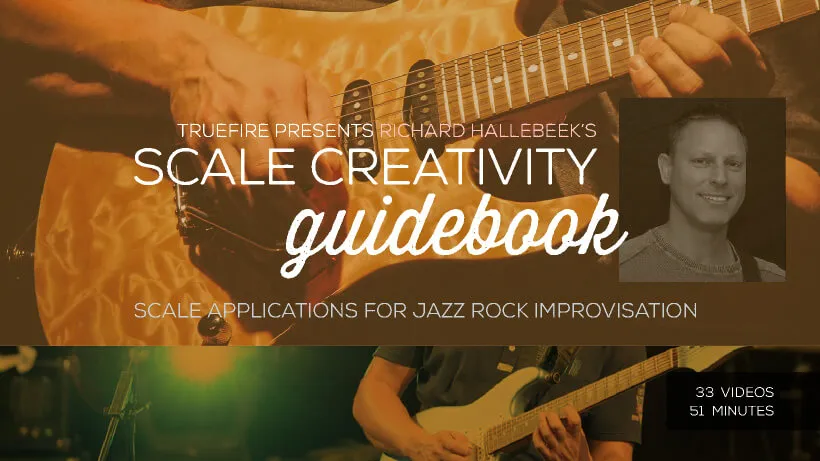
When learning to improvise, we students of guitar tend to be singularly focused on ‘what’ scales should be played, rather than ‘how’ those scales should be played. That’s why, at that stage in our development, our solos sound like a series of scales being run up and down — because that’s precisely what we’re doing. Not very musical, and not very creative. If this describes the challenge that you’re currently facing, then Richard Hallebeek’s Scale Creativity Guidebook is your ticket to creative freedom when improvising and soloing.
”My Scale Creativity Guidebook will give you the tools you need to organize your scales and free up your mind to just play music. You'll learn how to connect scales, play more interesting intervals and craft unlimited creative melodies from any scale, in any musical situation.”
Richard Hallebeek is a monster guitar player, widely respected recording artist and top-notch educator. He has collaborated with the likes of Scott Henderson, Frank Gambale, Scott Kinsey, Dan Gilbert, Carl Verheyen, Michael Angelo Batio, and Allan Holdsworth, Guthrie Govan and Jose de Castro to name but a few. We’re thrilled to welcome Richard to the family with his first TrueFire course.
Richard organized the course into two sections. In the first section, he will guide you through 8 key concepts and techniques for organizing and playing your scales: 3 Notes Per String, 1-2-4 & 1-3-4 Fingering Patterns, 3 Note Pentatonic Patterns, 7 Note Permutations, Arpeggios , Diminished Applications, Intervals and Hybrid Picking.
In the second section, you’ll put all of the key concepts and techniques to work as you play your way through a series of Performance Studies designed to unleash your creativity all over the fretboard.
”We’ll focus on organizing the most usable scales for jazz rock and rock players and I'll show you how to break up those scales using what I call 1-2-4 and 1-3-4 fingerings to connect them and play wider intervals. You'll learn to craft melodic solos across the whole neck, from the lowest to highest available notes.”
Richard demonstrates all of the Performance Studies over rhythm tracks and then breaks them down by stepping you through the key concepts, techniques and creative approaches that he used in each study.
All of the Performance Studies are tabbed and notated for your practice, reference and study purposes. You’ll also get Guitar Pro files so that you can play, loop and/or slow down the tab and notation as you work through the lessons. Plus, Richard generously includes all of the rhythm tracks for you to work with on your own.
Grab your guitar and let’s get creative improvising with Richard Hallebeek!
What you'll learn
Apply hybrid picking technique
Create melodic lines using organized scale concepts
Hi, I'm Richard Hallebeek and welcome to Scale Creativity Guidebook! From the past 35 years of teaching, I feel the most valuable lesson I could give to students is how to learn and practice their scales and how to be creative with it. Most people practice their scales up and down, and that’s how they end up sounding when they improvise: like they're running scales up and down. In order to improvise well, in any style of music, you need to know your scale material and be able to be creative with it.
In this course, I'll hand you tools to organize your scales so you can free up your mind to just play music. You'll learn how to connect scales, play more interesting intervals, and find new melodies in the scales.
In the first section of this course, I'll take you through organizing the most usable scales for jazz rock and rock players so it will be clearly laid out in your mind. Then, I'll show you how to break up these scales using what I call 1-2-4 and 1-3-4 scales to connect them together and play wider intervals. You'll learn to play across the whole neck from the lowest to highest available notes and learn how to find melodies in these scales. I'll show you how to play three note per string pentatonics with musical examples that will feel comfortable to any player who is used to playing two note per string box shapes. We'll talk about the diminished scale, a subject that lots of players find hard to understand, but I guarantee that you'll finally get a deeper understanding of it and use it like never before. But that’s not all...there’s also arpeggios, intervals, and chord examples for all the tracks that are shown.
In the technique section, we'll focus on developing your hybrid picking to the highest possible level. Every example is clearly written in standard notation and tab so you can see the left hand fingering AND the right hand hybrid picking movements. I'll musically guide you through these concepts to show you how to be less mathematical and more musical.
All backing tracks are provided from the original CD's with the guitar omitted, so you can join in and find your own lines. It’s finally time to get musical and creative with your scales, so grab your guitar and join me on Scale Creativity Guidebook!
It’s a good idea to start organizing your scales and playing them all with 3 notes per string so you can easily see the 4 note options and you're more aware of the overlap between scales and how they connect. All three note scale forms are included in the notation. So, if you have three notes per string, your options are: 1-2-3, 1-3-2, 2-3-1, 2-1-3, 3-1-2, and 3-2-1.
If you play three note per string scales, one thing you can do to open up your scales is to play what I call 1-2-4 and 1-3-4 scales. In a 1-2-4 scale, you play a regular 3 note per string scale, but skip the 3rd note and extend to the 4th note.
In a 1-3-4 scale, it’s the same thing, but you skip the 2nd note and substitute that note with the 3rd note of the scale, then move on to the 4th note. So it’s still a three note per string form, but with a much more interesting intervallic leap. For left hand fingering, you can play those scales with slides or with regular fingering, or with two hand tapping; I don't care how you play it. Just remember, If it sounds good, it is good!
You can also play your pentatonic scales with 3 notes per string. You probably know one or more of the 5 regular pentatonic box shapes that use two notes per string, so take one of those shapes and extend it to the next note in the scale to find the 3rd note. When you start out, it might be hard to make that stretch, but if you start around the middle section of the neck it will be more comfortable to start with. The first thing you'll notice is that if you play this scale up and down, it will give you a repetition on each string. I'll show you some ways to play around that, or the repetition might be a nice effect to use.
You can take the notes in a 7 note scale and turn them around in many ways. This might sound mathematical, but it’s actually really helpful and gives a lot of inspiration and new melodies that you might not have found before.
I'll also exercise your fingers to move in new ways. In the booklet, there are over 5000 examples of the different orders of 7 notes, surely giving you enough ideas to play for a lifetime! This is also a nice inspiration for composition if you are stuck with an idea and can't find a melody.
The concepts in this course also lend themselves well to getting more mileage out of your arpeggios. You hear lots of guitar players play arpeggios up and down really fast, and that’s a cool sound, however, you can also turn the notes in an arpeggio around to get some more interesting sounds. You can use 1-2-4 and 1-3-4 shapes in an arpeggio really well and also intervals like 6ths and 7ths. Here’s a couple of examples of regular major and minor arpeggios with the notes turned around in a more playful manner.
The diminished scale might be confusing to some, but if you use 3 note per string forms, then it’s actually quite clear to see across the neck. Also, you don't have to learn different scales, you can move the diminished scale up a minor 3rd to get to the next scale. If you start connecting these scales that are a minor 3rd apart, you'll get some really cool sounds.
There are three different types of diminished scales:
1. A form with all the notes a minor third apart from each other 2. The half-whole diminished scale – starts out with a half step, then a whole step 3. The Whole-half diminished scale – starts out with a whole step, then a half step.
The good thing is that the shapes you find in the scale are the same for the G and high E string and the same for the D and B string.
one of the best (if not the best) course i ever came across for Jazz Fusion
F
Fred
10/17/25
Great lesson
Richard is the real deal and gives away high value material that will take time to digest but could cost you much more to acquire!
M
mastrocm
Verified buyer
10/06/25
Great products
O
Osokin
Verified buyer
01/18/23
Scale Creativity!
Richard Hallebeek is a very talented guitarist, and in this course provides several different approaches that allow the player to be more creative with their use of scales. The playing examples are in the style of jazz rock, but the concepts can be applied across different genres.
F
funkyman
Verified buyer
04/12/21
Clickers 4 Pickers
I've been following RH for several years. I'm always amazed by fusion guitar players but dumbfounded on how they connect their notes. RH makes tis easy to view and understand. Great resource for confused fusion pickers.
Thank you RH.