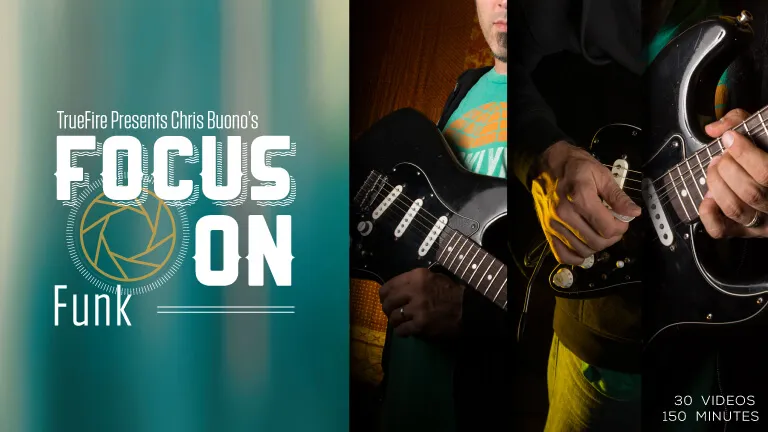
Focus On: Funk Guitar

Learn the requisite techniques and approaches for funk guitar

Marty FriedmanTommy EmmanuelSteve VaiEric GalesEric Johnson

Get this course and 1,000+ more with All Access

Try 14 days free. Cancel any time.
Purchase Individual Course for $9.99
Focus On: Funk Guitar

About this course

Funk music electrified the airwaves and bandstands in the late 60’s, thanks largely to the Godfather of Soul, Mr. James Brown. Funk music from bands like Parliament, Funkadelic, The Meters, Sly and the Family Stone, Ohio Players, Kool & the Gang and dozens of others kept the funk fire burning and the dancers on their feet. Contemporary artists like Red Hot Chili Peppers, Living Color and many others embraced the styler and kept the funk very much alive.

To this day, you’d be hard-pressed to name any genre of music that hasn’t been flavored with a bit of funk — blues, rock, jazz and even country music borrow heavily from funk’s rhythmic vocabulary. Chris Buono’s Focus On: Funk will quickly impart the requisite right and left-hand techniques, harmonic considerations, rhythm and soloing approaches characteristic of Funk guitar.

Chris organized the course into four sections. In the first section, Chris presents a quick summary of the history of Funk and some of the key players that helped define genre. He’ll also runs down some of the most common gear and tone considerations required to get that signature Funk sound.

In the second section, Chris demonstrates essential Funk rhythm techniques including the go-to chordal families, 16th-note concepts, and some of the critical pick-hand and fret-hand techniques you’ll need to develop for the style.

The third section focuses on Funk soloing. Chris demonstrates essential scales and modes, funk-centric picking techniques, and a variety of characteristic ways to beef up your licks with octaves and double stops.

In the fourth and final section, Chris guides you through four performance studies where you’ll apply all of the key rhythmic and soloing concepts from the first three sections:

“We'll start off with a fun jam called Chock Fulla Pocket, which will have you playing through all the chords we first learned in Section 1. We'll play them within those two essential rhythms you learned in Rhythm Concept 5 and run straight through 16 bars of pure groove. Take note: You'll need to really have your muting techniques together as well as your dynamics.”

Chris continues working your newly found and fully funkified rhythm and soling skills in the second Performance Study, “Next up, the Hybrolicious Power jam, once again in the key of Am. Weighing in at 16 bars, you’ll work on a deep I-IV groove intentionally influenced by Chock Fulla Pocket. As a rhythm player you need to listen carefully. Until you develop a keen ear for where soloists go, it's best to lock into a groove and play TIGHT. The entire jam will be better for it and, trust me, your efforts will be most appreciated.”

The third Performance Study is called Modal Mothership. I upped the tempo a little quicker to 79 bpm. In the rhythm part, you’ll start to use extended harmonies including m9 and dom9 chords along with various new takes on 16th note grooves. The main soloing ingredient here is the Dorian and Mixolydian modes that I dropped on you in Solo Concept 3.”

Chris’ final performance study spans 32 bars at a laid-back 84 bpm. “Just like the previous two solos be sure to examine the chord playing going underneath this tour-de-force. There's sliding chords, power wrist riffs, top note movements and more! Soloing-wise the spotlight is now the addition of the ultimate funk soloing element: Gritty, thick-as-a-brick double stops including octaves AND the never-saw-it-coming unison bends!”

Chris demonstrates all of the Performance Studies over rhythm tracks and then breaks them down measure-by-measure, technique-by-technique. All of the key examples and performance studies are tabbed and notated for your practice, reference and study purposes.

You’ll also get Guitar Pro files so that you can loop and/or slow any section down as you work through the lessons. Plus, you'll get all of the rhythm tracks arranged, recorded and produced with bassist Steve Jenkins.

Grab your guitar, put your dancing shoes on, and lets get it on!

What you'll learn

  • Execute power wrist picking technique with proper muting
  • Apply funky articulation to pentatonic scales
  • Use fret hand muting to control unwanted string noise
  • Master essential funk rhythm techniques including 16th note patterns
  • Understand the history and key players of funk guitar
Release date: 04/24/2015 • 2h 30m runtime
Start Course
Sample lessons
16th Notes
16th Notes
Rhythm Concept 3
Fret Hand Technique
Fret Hand Technique
Rhythm Concept 5
Picking Techniques
Picking Techniques
Soloing Concept 2
Thick-As-A-Brick
Thick-As-A-Brick
Overview

What's included

30 lessons • 14 charts • 8 Jam Tracks

Focus On: Funk Guitar
Funk is quintessential groove-based music style that most every musician loves to play, especially guitar players. Emanating from New Orleans as early as the late 40’s funk was officially born in the late 60’s with the rise of the Godfather of Soul, James Brown, backed by collection of legendary guitarists led by Jimmy Nolan. Following Soul Brother #1 were bands like Parliament & Funkadelic led by George Clinton, The Meters featuring the guitar work of Leo Nocentelli, the mighty Sly and the Family Stone and even more contemporary artists like Red Hot Chili Peppers, Living Color and others solidified the groove in this slickly syncopated style. In this course we're going to focus on the key elements and techniques that define this genre so you can get your own groove on.

I've organized this course into four sections. Kicking things off will be the history of funk and its key players. I'll also talk about gear and tone considerations to get that signature funk sound. In the second section we’ll get the guitars out and dig into some essential rhythm techniques. I'll show you the go-to chordal families, concepts behind the ever-important 16th note and some of key pick-hand and fret-hand techniques for the style. The third section is all about soloing. I'll show you essential scales and modes, funk-centric picking techniques and some characteristic ways to beef up your licks with octaves and double stops. At the close will be four performance studies that use all of the concepts learned in the first three sections.

Within the lessons you’ll find the tab and notation as well as all of the rhythm tracks that include stellar bass playing and drum programming by my longtime partner in all things groove, Steve Jenkins.
SECTION 1: Background
In getting to know any new style of music it's imperative you do your listening research and soak in the sounds. Speaking of sounds, it's never a bad idea to try and cop the sounds you're hearing on all these great recordings by hunting and gathering some funk-approved gear. So, before we dive into the playing let me take a minute and hip you to some funk guitar history as well as some players to seek out and some gear to consider.
History & Players
Funk - a term originally used for describing something that smells not-so-good - is a word we all lovingly use to describe this incredibly fun and rhythmic music. Alas, the term, even in music, ends up being used in the same parlance as one or more of your fellow funkateers will shout out for you to "put some stank" on whatever it is you're playing in a jam session to make it even more fonky! Rooted in African music traditions the funk started to emerge as early as the late 1940's as an amazing amalgam of soul and soul/jazz as well as R&B and a healthy dash of Afro-Cuban rhythms, most notably the clave. All of these ingredients were thrown in a groovy stew and cooked to perfection in a melting pot with the words New Orleans etched in capital letters. By the mid-60's a master chef emerged and he was none other than Soul Brother No. 1, the Godfather of Soul, the Hardest Working Man in Show Business: Mr. James Brown. But, a chef is only as effective as his ingredients…

Funk is ALL about the rhythm section: The bass and drums. Drummers including John "Jabo" Starks and Clyde Stubblefield (THE funky drummer) and bass players like Bernard Odum and William "Bootsy" Collins literally wrote the book on the propulsive, interlocking rhythms lovers of the funk go crazy over. Completing the contrapuntal nirvana was the percussive role the guitar played in these jams and those axes were wielded by funk guitar legends such as Jimmy Nolen, Phelps "Catfish" Collins (yes, it's Bootsy's brother), Alphonso "Country" Kellum and Hearlon "Cheese" Martin. As the late 60's rolled on into the golden era of funk - the 70's - new bands were emerging and they brought with them many more guitarists to the funk forefront. Draped in polyester and sporting massive bell bottoms came players such as Ernie Isley of the Isley Brothers, Freddie Stone who was a founding member of Sly & the Family Stone, Leo Nocentelli of the Meters and the inimitable Eddie Hazel. The latter coming from the close second in significance to the evolution of funk: George Clinton's Parliament and Funkadelic ensembles. Eddie Hazel emerged as the premiere funk guitar soloist helping to usher in a more rock vibe to the music. He was followed by funk rock mavens Michael "Kidd Funkadelic" Hampton, Garry Shider, Glenn Goins and DeWayne "Blackbyrd" McKnight to name but a few.

There were many other bands and bandleaders to come up the ranks in the 70's as well as the 80's and they brought with them incredibly funky guitar players. Here's a list of some must-know six-string funk masters from those great years:

Bruce Conte (Tower of Power)
Leroy "Sugarfoot" Bonner (Ohio Players)
Al McKay (Earth, Wind & Fire)
Tony Maiden (Rufus)
Calvin Brown (Roy Ayers)
Michael Toles & Jimmy King (The Bar-Kays)
David Williams (Session guitarist, played on "Billie Jean")
Prince
Nile Rodgers (Chic)
Charlie Singleton (Cameo)
Jesse Johnson (The Time)

While funk gave way to disco and synth-pop music as the 70's and 80's raged on, the music has been kept alive and even saw a revival at times through styles like acid-jazz and jazz/funk by the following players and their respective bands:

Vernon Reid (Living Colour)
John Frusciante (Red Hot Chili Peppers)
Adam Rogers (Groove Collective)
David "Fuze" Fiuczynski (Screaming Headless Torsos)
Simon Katz and Gavin Dodds (Jamiroquai)
Simon Bartholomew (Brand New Heavies)
Adam Horowitz (aka Ad-Rock of the Beastie Boys)
G. Love (G. Love & Special Sauce)
Brian Dennis (Dag)
John Scofield & Avi Bortnick (John Scofield)
Wayne Krantz

While this is not meant to be a complete list of every guitarist who laid down a funky lick on a commercial recording this a great place to start. In fact, if you really go digging you'll find there's a lot of funk music recorded on small labels and even homemade labels that's absolutely disgusting (in a good way!). For example, seek out the vat of 45's out there recorded by high school bands in the midwest and you'll be floored! Thanks to DJs and their insatiable lust for vinyl, many recordings that were previously doomed for extinction are being reissued and, even better, there are modern artists out there such as Breakestra and Tommy Guerrero who strive to produce pure, unadulterated funk music in today's laptop landscape. Kudos to those brothers (and sistas ;)
Tones & Gear
When beginning to explore what it takes to make great funk tones and the gear used to do it we'll first look at the go-to components in the guitar, amp and effects categories. Starting with the guitars, look towards single coil-equipped guitars such as a Fender Strat and/or Tele with a focus on the former. Of course, Strat- and Tele-style guitars made by other builders could be considered. Unless you have super bright hands a maple neck would serve you well as they help produce a snappier attack and overall tone. It's a good idea to go with .010 gauge strings as opposed to the thinner .009 gauge as you'll be putting them through some formidable punishment when playing funk rhythms as well as playing with lighter gain levels and thus benefit from a thicker gauge. When it comes to amps it starts with Fender once again with a focus on the Deluxe Reverb and Twin Reverb models for respective 1X12 and 2X12 options. These amps stay basically clean, but will deliver their versions of light clipping when pushed. Depending on your tastes when it comes to how much gain you want to incorporate will serve as part of the criteria for what speaker configuration as well as power rating you look towards. As for effects your first one should be the ubiquitous wah pedal. Close seconds are a phat-sounding phaser and an even phatter-sounding envelope filter! If you plan to take a solo or start delving into heavier funk rock riff playing then a light OD pedal much like a Tube Screamer and/or a bit heavier distortion pedal will be on your shopping list as well.

As you pursue the funk you'll learn about a universal truth any funk player worth his salt is hip to: You can get down with just about any rig if you have a good sense of rhythm and pure intentions. At the same time, funk music invites absurdly cool sounds and provides a completely inspiring platform to get your sonic freak on. Be it liberal use of compression, massive fuzz tones ala Eddie Hazel or the whacked out ring modulated tones from Wayne Krantz and deft Whammy pedal antics from Tom Morello, funk music almost begs for you to go for it. Go digging and you'll discover all sorts of approaches from the masters such as Prince's penchant for Boss pedals or John Frusciante's devotion to Marshall amps particularly the Jubliee and vintage Boss CE-1 chorus pedals. And, don't stop there - look to keyboard/synth players as well like Bernie Worrell, Hernie Hancock and Steve Wonder. If not for those guys we guitarists may never have know what a Mu-Tron III is!

Once you've put some time into your funk rig consider some of my tried-and-true funk gear tricks I've learned over the years through other players and just some good old trial and error:

-If you can handle it, use .011 gauge strings.
-Try to avoid 10" speakers as they make your sound some across as, well, small. Plus, they break up too quickly robbing you of precious headroom.
-If your budget allows, go for a tunable wah pedal such as a Teese RMC3FL. You'll love having options.
-A Gibson ES-175 goes a long way with its inherent archtop snap. Think I'm crazy? Look into what Jimmy Nolen, Tony Maiden and Neo Nocentelli used on more than a handful of classics recordings.
-Other Gibsons that have made an impact on classic funk records are ES-335's, the ES-5 Swithmaster and, ready for this, Les Pauls!
-Go for low output pickups especially if you use humbuckers or think about P-90s for that matter.
-Speaking of pickups try the middle position (#3) on a Strat or the middle position on a three-way toggle for two humbuckers on the aforementioned Les Paul. Totally funky!
-Other go-to tube amps to consider are the Fender Pro Reverb and Vox AC-30(!). Yes, the amp that defined various eras of The Beatles, Queen and U2 is a beautiful sounding amp in a funk context.
-Don't raise your nose to non-boutique amps such as a quirky old Kustom or beat up Peavey Classic 50. They both will do your funk tone tweaking big time justice.
-Love'm or hate'm a Roland JC-120 in the right hands is a solid state force to be reckoned with.
-Try avoid using chorus unless it's an analog chorus and you set the rate very low and the depth in the middle range. When it comes to wetting up your tone with modulation effects make phasing the first choice and flanger the second with chorus being last.
-Be conservative about reverb - too much will cloud your sound. Considering funk's inherent syncopation reverb should be used sparingly and with respect.
-Be patient with envelope filters. I've found the better the filters, the harder I had to work at them to get them going. Once I did - OH MAN. It's amazing. Perfect example: A Lovetone Meatball.
-Keep an octave pedal in the back of your mind. It's a great first pedal to start copping raunchy synth tones and can sound great when correctly placed.

I could gladly go on and on with this tips, but this is a great start. Have fun!
SECTION 2: Essential Rhythm Concepts
Playing funk is all about the groove. To make those grooves come to life there are some signature harmonic devices that are played with essential techniques. Here in Section 2 we're going to explore the sounds of funk rhythm guitar through extended minor and dominant chord sounds, 16th notes rhythms as well as playing techniques that both of your hands will need to execute in order to get your groove on.
Minor Chords
When it comes to funk rhythm guitar harmony a great place to start is m7 and m9 chords - they're easy to grab and they sound great! In this first Rhythm Concept lesson we'll explore m7 and m9 chords in the key of Am. We'll check them out from the two most common approaches - root position chords built from sixth string and fifth string roots. In Am those chord roots will be on the 5th and 12th frets respectively.

I'll start with basic drop 3 m7 voicings and then systematically show you the real deal chords that will get you the sounds you're looking for. Following the m7 chords I'll show how they can become slick sounding m9 chords! I'll break down the chords into mid-range and high-range voicings, which we'll explore in various grooves in Section 4.
Dominant Chords
Tied for first when it comes to the quintessential funk harmony is dom7 and dom9 chords - the latter being the ultimate go-to sound. This time we'll explore dom7 and dom9 chords in the key of D. Once again we'll check them out from the two most common approaches of root position chords built from sixth string and fifth string roots. In D the chord roots will be on the 5th and 10th frets respectively.

Once again starting with the basic drop 3 dom7 voicings I'll again breakdown the chords into mid-range and high-range voicings setting you up for the jams in Section 4. Once those dom7 chords are under your fingers I'll drop the legendary dom9 chord in various forms!

+ 23 more lessons

Start Course

Reviews

16 results

Kkeshav1

Verified buyer

10/12/25

Explanation with the use of lots of resources,making the understanding of each lessson easy and satisfying.

Freakyrom

12/23/21

Superbly thought out course

Coming from Hard Rock and Metal, I always enjoyed listening to funk but I never really took the time to learn how to play it well. I couldn't think of a better course to learn the basics (theory, rhythm, lead) of this style. The sequencing of the case studies is extremely well thought out as it really allows you to grasp the concepts. Highly recommended !

red52

04/04/21

Funk Focus

Funk rhythm guitar is the gateway to cross over to any style. Chris Buono shows you how in this course. I have all of Chris Buono's Funk courses on Truefire and this one, Focus on Funk does not disappoint! Chris lays out your objectives clear and each one is achievable. Best of all, you'll have lots of fun learning it. You'll come out on the other side with a much better ability for rhythm guitar and appreciation for funk. Just buy it!

Ash

04/27/20

Focus on: Funk

Chris has put together a real handy set of videos to get your funk fundamentals going. I found the exercises real useful in building that all important connection between my right and left hands. Recommended!

Sean K.

04/20/20

Funk Yeah!!

Honestly I really did not know much about funk, but I know Chris is an excellent instructor. I purchased this course after browsing through several of the lesson. The rhythm/timing lessons in this course were a big selling point for me! Chris breaks down the chords, the rhythms, the left and right hand techniques, the solos and builds up to the performance studies! This is a must have course for anyone looking to funk up their rhythm playing!

Stop searching. Start improving with All Access.

Try 14 days free. Cancel any time.