Thermodon1
Verified buyer
02/21/26
Good





Get this course and 1,000+ more with All Access
Try 7 days free. Cancel any time.
About this course
What you'll learn
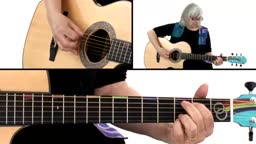
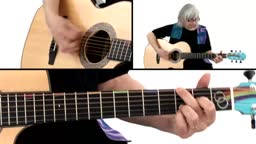
39 lessons • 20 charts • 13 Jam Tracks
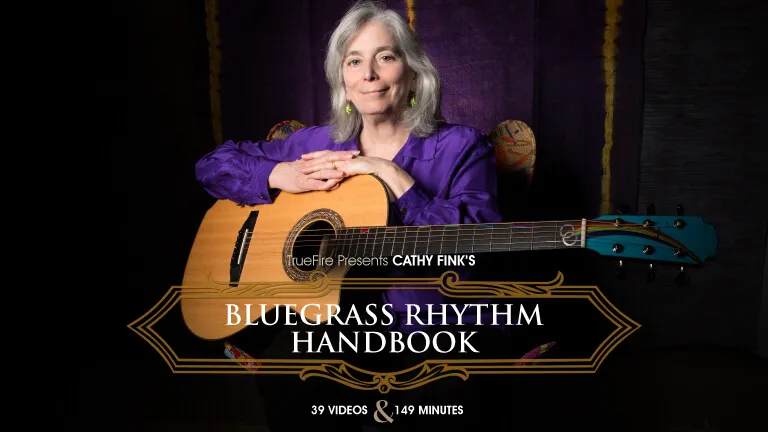
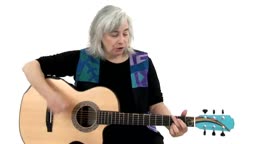
Hi, I'm Cathy Fink and welcome to Bluegrass Rhythm Handbook.
The rhythm guitar is often taken for granted, but really, that player is the unsung hero of the band. A great rhythm guitar player becomes the glue in a band, offering both a sonic backdrop and a clean, steady bass line.
If you're coming to bluegrass from another style of guitar playing, you'll find new sounds in the basics and nuances of playing bluegrass rhythm. I've listened to bluegrass music for forty years and have learned by listening to others, watching bluegrass guitar players in concerts and festivals, and of course, as the rhythm guitar player in many a band starting in the 1970's. Timing, tone, and finesse are all key to a great bluegrass rhythm guitarist. Of course, these same techniques will give you chops for old-time country music, classic country music, and many folk song as well. Enjoy!
My approach to playing bluegrass rhythm comes from playing in a pre-bluegrass duo, a bluegrass band, a country band and many old-time country bands.
The solid bass note and strum can truly define a band's timbre. I think it’s easier learning to play loud and hard and then toning it down rather than learning to play with a "light" right hand and then trying to make it louder. The muscle memory works better the first way. Power to the rhythm guitarist!
Bluegrass songs and tunes come in all tempos. When you're building your speed, take your time; use a metronome to practice and don't go faster than you can while staying in time. I guarantee that a few days/weeks of practicing like this will serve you very well later on.
Speed takes a good sense of timing but also stamina, which takes a little time to build. Be patient!
Bluegrass demands a clean, crisp tone and clock-like rhythm. In this lesson, we'll look at right hand placement and how you hold the pick. We'll explore options with these, and see how they'll have a great deal of impact on the tone.
The right key for a bluegrass instrumental will be determined by the lead instrumentalist. Some common instrumentals have universal keys, such as "Old Joe Clark." It's generally played in A, though you may find a few folks who play it in G. The right key for singing is determined by the lead singer.
I frequently use a capo to play G chord positions in A (second fret), Bb (third fret), and B. I usually personally prefer that sound to the open A chords. But in "In the Pines," the open A really speaks to me. Experiment and see what you enjoy for your voice and your hands.
A lot of bluegrass guitar is built around chord shapes in the key of G, which give it a classic sound.
Let's learn the basic chords and bass notes in the G position. We'll play alternating bass notes to create our shapes, starting with the G cord, then going to the C chord, the D chord, the A chord, and finishing on the E chord.
+ 32 more lessons
8 results
Thermodon1
Verified buyer
02/21/26
Good
acroswell
Verified buyer
12/24/25
Bluegrass Rhythm Handbook
If your goal is to become a solid Bluegrass rhythm guitarist, this course is for you. The 4 main parts of this course are: Play Clean. , Playing in Time, Building Speed, and Building Stamina. And of course falling in love with the Bluegrass music.
BlindRaspberryRage
Verified buyer
04/18/22
Bluegrass Rhythm Handbook
Yes OK as an add on and free purchase but I am now intermediate
RickBlanco
Verified buyer
02/10/22
Excellent Product!
Cathy Fink is an excellent instructor!
TravisTrucker
Verified buyer
02/19/21
Excellent course in Bluegrass Rhythm playing. Great stuff to learn, not only for Bluegrass/acoustic players.
Try 14 days free. Cancel any time.