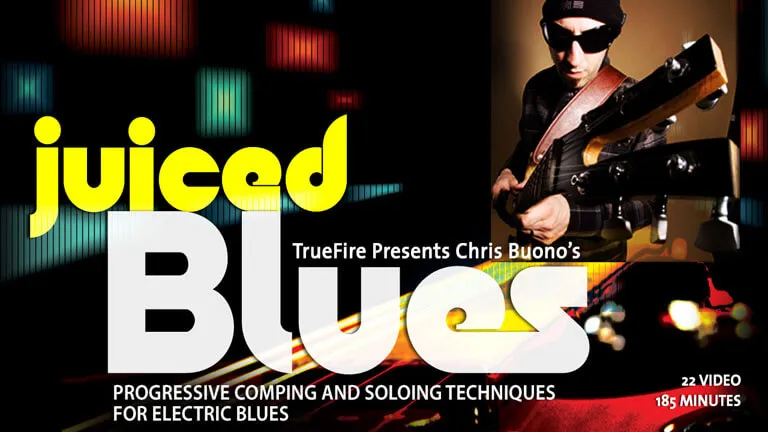
Juiced Blues

Progressive comping and soloing techniques for electric blues

Marty FriedmanTommy EmmanuelSteve VaiEric GalesEric Johnson

Get this course and 1,000+ more with All Access

Try 14 days free. Cancel any time.

Purchase Individual Course for $5.00
Juiced Blues

About this course

The “blues” is the ideal educational playground for players in their early stages of development. It doesn’t take a lot of time to get a basic grip on the pentatonic scale and a few I-IV-V progressions before we’re off and running building up our chops and learning how to solo, improvise, and comp. Eventually though, we all hit the proverbial “rut” where we grow tired of playing the same old same old and thirst for insight to help us “juice” up our blues.

Blues waters can run plenty deep technically and harmonically as evidenced by Robben Ford, Scott Henderson, Greg Koch, David "Fuze" Fiuczynski and Mike Stern to name a few. Sure, there’s a lot of bends, blue notes and pentatonic happening - and the progressions are still pretty straightforward - but the lines are very sophisticated and fresh. Juiced Blues examines some of the deeper qualities of this style and will introduce you to a whole new way of thinking about and playing the blues.

Recording artist, stunt guitarist and TrueFire’s resident professor of the “deep,” Chris Buono guides you through the application of superimposed m7b5 arpeggios, modal pentatonics, melodic minor modes, symmetrical diminished scales, chord fragments, melodic contrary motion, and the Diamond theory for juicing up your blues soloing and comping.

Buono presents Juiced Blues across five sections, each examining a variety of harmonic and expressive concepts. You'll work with a different blues rhythm track in each section, over which you'll learn a "juiced" solo and a "juiced" comp, which Chris breaks down in meticulous detail. You'll walk away with enough "juice" to last your blues for quite sometime. But the theoretical and harmonic mind dump alone is worth the price of admission.

SECTION 1
Super Dom Blues: Chris kicks things off with Super Dom Blues, as in "superimposed dominant" blues, where you'll learn how to play secondary melodic ideas over primary harmony by playing superimposed m7b5 arpeggios and a lone minor pentatonic scale over a textbook I-IV-V in G. Chris also walks you through the "Diamond Theory" in this series and shows you how to apply it when comping.

SECTION 2
M&M Blues: In this series, you'll learn how to take the underlying structure of a pentatonic scale and modulate its properties to produce fresh sounding options. Buono shows you how to organize specific key notes from relative, yet evocative sounding 7-tone modes into 5-note formulae to produce "very hip alternative pentatonic scales" to be played over a minor blues.

SECTION 3
Fuzy the Lydian-Loader: With a tip of the hat to David "Fuze" Fiuczynski, this series explores more of an outside approach for "juicing" up your blues. Chris shows you how to apply the Lydian Dominant scale - spelled 1 2 3 #4 5 6 b7 – and solo both horizontally and vertically with this versatile fourth mode of the Melodic minor. You’ll also learn how to construct applicable chord diamonds for comping.

SECTION 4
Blues for Symmy: In this series, Chris has you working with a 12-bar blues in D that has been "super-juiced with the intellectually satisfying symmetrical diminished scale." Also known as the half-whole scale, this octatonic scale will serve as the template for both melodic soloing (albeit the focus will be on one of the two dim7 arpeggios nested within the scale) and harmonic comping ideas.

SECTION 5
Altered Stormy: This final series borrows the changes from the iconic blues standard over which you will apply all of the "juiced" approaches from the previous four, plus! Superimposed min7b5 arpeggios, symmetrical diminished scales, half step approach chords, chord fragments and 'melodic contrary motion' where the lines that are being played go in the opposite direction that the harmony is going.

Ready to step up your blues game texturally and harmonically? Juiced Blues is likely the elixir you’ve been thirsting for. The playing examples alone will feed your blues bag with a bagful of fresh moves, but the theoretical knowledge Buono passes on will feed you for life.

What you'll learn

  • Applying musical symmetry concepts to voice leading
  • Discovering symmetrical relationships between chord voicings
  • Construct and execute a complete advanced blues solo using multiple superimposition techniques
  • Learning to play 7b5 chords vertically and horizontally across the neck
  • Learning that musical rules can be broken with conviction
Release date: 12/12/2009 • 3h 05m runtime
Start Course
Sample lessons
Super Dom Blues 2
Super Dom Blues 2
Soloing Breakdown
M&M Blues 4
M&M Blues 4
Comping Breakdown
Fuzy Lydian-Loader 1
Soloing
Blues for Symmy 4
Blues for Symmy 4
Comping Breakdown

What's included

22 lessons • 20 charts • 5 Jam Tracks

Introduction
Playin' the Blues has been a gateway for just about every guitarist who's ever developed calluses while getting their soloing chops together. It's as if the Minor pentatonic scale was embedded into our very beings eagerly waiting to be cultivated into an improvisatory life force. Though for some, once they get over that initial hump the licks remain the same and that flame that first ignited their passion for bent notes and b5's is left flickering at best. If this sounds like you and you're looking for a way to juice your playing, then you've come to the right place--welcome to Juiced Blues.

Split up into five sections, Juiced Blues explores concepts for both soloing and comping. Throughout Juiced Blues you're going to discover how to make seemingly un-bluesy devices such as m7b5 arpeggios or Lydian Dominant scales seem as if they're right at home. To do this, we're gonna juice your blues utilizing some tried-and-true blues progressions so you can take these ideas straight to the jam session. The 12-bar progressions on the chopping block include “The Thrill Is Gone", “Freddie the Freeloader" and “Stormy Monday" as well as a pair of stock I-IV-V's. Within this quintet of juiced jams will be concepts like superimposing m7b5 arpeggios, modal pentatonics, making use of some choice melodic minor modes as well as the symmetrical diminished scale to name a few.

Many of these concepts can be heard in the playing of modern masters such as Robben Ford,Scott Henderson,Greg Koch,David "Fuze" Fiuczynski,Wayne Krantz,Mike Stern--even in the playing of a traditionalist like Little Charlie Baty. As you go through Juiced Blues and beyond, be sure to seek out the incredible music that flows from the hands of guys like these to subconsciously get their genius inside your psyche, and not to mention--steal their licks!

Part of juicing your blues may involve juicing your current rig, so here's a look into what was used throughout the course: Sporting a lightweight solid body korina Unk Custom loaded with a pair of DiMarzio humbuckers--a FRED in the bridge and a PAF Pro in the neck--I plugged into a very sweet Mesa Lonestar 1X12 combo that resides here at TrueFire. To sonically juice this already stellar rig I whipped out my vintage TS-808 for its signature compressed saturation. Along with the Unk's unique wiring scheme this setup was nothing short of, well, juicy!

The Blues could very well be the universal language spoken in fingers by guitarists all over the world. What better way to spice up the conversation than with some truly juiced options.

Let's do it!
Super Dom Blues 1
Kicking things off is a set of lessons called Super Dom Blues--short for Superimposed Dominant Blues. While the concept of superimposition will be discussed several times throughout Juiced Blues, put simply its playing a secondary element over a primary element. In regards to Super Dom Blues, you're going to learn how to play secondary melodic ideas over primary harmony by playing superimposed m7b5 arpeggios and a lone minor pentatonic scale over a textbook I-IV-V in G. Playing these arps over the changes will bring out tones such as the 3rd, b7th and 9th contained within interval and line sequences that will be new to your ear. As for the minor pentatonic scale, you'll hear b7th, 9th, and 11th tones over the V chord. This approach will produce a more sophisticated sound in your lines and will sound very cool when pitted against those gritty sounding minor pentatonic and minor blues licks we all know and love (albeit play to death).
Super Dom Blues 2
** Take note: Overall Super Dom Blues is based on a simple I-IV-V in G consisting of dominant 7th leanings for each of the three chords. I say "leanings" because as you'll see in the comping lesson that follows (Super Dom 3) there's going to not only be dom7 chords coming at you, but also extended dominant chords and stacked fourth voicings as well. It's all part of the juicing process, my friends. This freedom of interpretation is something you should be aware of and should begin to feel free to use. With that cleared up, let's get into the secret behind the sauce, shall we?

As said in the previous segment, superimposing consists of playing a secondary element over a primary element. In this instance, secondary melodic ideas in the form of superimposed m7b5 arpeggios and a single pentatonic scale are played over the primary harmonic movement as dictated by the bass line (speaking of, going right along with the idea of freely interpreting the vibe as dominant; in regards to what's going on in the background--i.e., the practice rhythm track--that concept applies here as well). Now, a m7b5 arpeggio is made up of the following formula: 1, b3, b5, b7. But when played over the I and IV chords, the notes within the arps change to this formula: 3, 5, b7, 9. So the superimposition is derived from playing a m7b5 arpeggio a major 3rd above the chord's root, or put simply, from the 3rd. Let's examine one instance closely to make sure you got the gist. Over G7 whose 3rd is B, a Bm7b5 would be employed, which is made up of B, D, F, and A. Considering G as the root, the notes in that Bm7b5 arpeggio are as follows: B is the 3rd, D is the 5th, F is the b7, and A is the 9th. That, ladies and gents is the gig.

While the same concept is used over the C7 (IV) with the Em7b5 serving as the arpeggio built on the 3rd of the chord, the A minor pentatonic scale played over the D7 (V) superimposition works out as follows. Against the D root the notes are: A (5th), C (b7), D (root), E (9th), and G (11th). Keep in mind that 11th shouldn't be a note you resolve on as that will directly clash with the powerfully present tritone interval between the 3rd and b7th. It works within a line for sure, but just make sure you fly on by and land on anything but.

** Take note: all the arpeggio and scale "visions" I'm utilizing in every solo will be found below the solo transcription both in the PDF and Power Tab charts that are included within all five Part 2 segments. And, when I say "all", I mean ALL--you'll find not only the ones used in the solo (marked with an *) but all the available options starting from the bottom of the neck so you can begin to take these ideas and play them throughout the fretboard. To be consistent, every vision will begin from the lowest position on the neck that does not include open strings so you can see every movable option. This approach provides you with a complete "conveyor belt" vision that can be moved accordingly to work with any key.

Overall this approach gives you a fresh sound to work with and let's be honest--that's something we all need when blowing over a 12-bar as we tend to go right for the pentatonic gold all too often. That said, the approach here as well as any other presented here in Juiced Blues is by no means "better" than another. Those tried-and-true minor blues licks are still with us for a reason--they're AWESOME. By all means, keep them in your lick bag and enjoy the fact of having something you've been craving for--options!

A few other things to note as you play your way through your first set of juiced ideas are the way the arpeggios are fingered and positioned and the picking techniques that were used to make them more playable. The arpeggios are intentionally fingered so they start on the 5th string with two notes and then proceed to follow a one-note-per-string/two-note-per-string pattern on the ascending adjacent strings. This is an approach that I found a few guys abide by including the incredible Tim Miller whom I had the pleasure to work alongside while teaching at Berklee. This fingering scheme will allow you to play the arps more easily and efficiently with techniques such as sweep picking and hybrid picking mixed with common legato moves. If your what-did-he-just-say meter just blew a gasket--hold on--sweep picking is not just for Yngwie and the like. It's an extremely economical picking technique that can be used to play some very slick lines without sounding like a print out--just check out Frank Gambale for starters. The positioning of the arps are meant to be as vertical as can be. The idea is to station the arps in the same relative area so you can better flow through them when playing over the changes as if you were playing a single melodic device, e.g. the good 'ol minor pentatonic scale. Finally, watch for the hybrid picking technique--simultaneous use of the pick and remaining pick hand fingers--that I drop at will to more easily play the arps as well as inject some snap into the licks. If you find yourself enamored by the spank that hybrid picking brings to the phrasing table, be sure to check out my flagship TrueFire course Funk Fission. That and many more ultra-fonky phrasing ideas are waiting to be wrestled. Speaking of phrasing -

Check out how some of the bends that rise in pitch are never released like the one that kicks off the solo or how wide intervals are used to break up arpeggios so they don't sound so pattern-like. In regards to the former, make sure you seek out Wayne Krantz for phrasing with bends. You can get the full picture from one fleeting moment in a tune called "Whipper Snapper" from the cult-classic Two Drink Minimum CD. At 2:49 Wayne enters the solo section with a bwhaa that just kills. With that on the table, there's a major lesson to be learned here: Phrasing is everything and when the mojo is there, sometimes one note can say it all.

Super Dom Blues 3
Going back to the previously discussed "dominant leanings" idea, we're going to check out some approaches that will juice up your inside dominant chord comping big time. In this segment you'll not only see how the m7b5 chord is used as a substitution for dom7 chords to produce inverted dom9 sounds, but we're also going to check out a concept I picked up from the great fusion bassist, Gerald Carboy, called the Diamond Theory. What's more, there's going to be a choice few essential upper string voicings in the dom9 and dom13th families to check out as well as some quartal-based voicings. All together these ideas will further add to the sophistication your playing is undergoing courtesy of these m7b5 superimpositions and substitutions, not to mention lay the ground work for upcoming comping concepts that will be utilized throughout Juiced Blues.
Super Dom Blues 4
s one of the many invaluable ideas that was passed onto me.

The Diamond Theory allows you to set up a series of inter-related arpeggios that help immensely in visualizing melodic improvisational excursions that involve superimposing. Here's how it works - If you play a simple tetrad arpeggio, say Cmaj7, starting on the sixth string and set it up as follows: root on the sixth string, 3rd and 5th on the fifth string, and the 7th on the fourth string--it takes on the shape of a diamond. Try it and see for yourself. Now, the fun parts starts when you start building arpeggio diamonds off the 3rd, 5th, 7th degrees of the chord with the same relative note/string assignment set up as the Cmaj7 arp. For instance, starting from the 3rd (E on the 7th fret, fifth string) if you build a diamond diatonic to C major--E, G, B, D--you get an Emin7 arpeggio played on the fifth through third strings. Now you have a slick way to jump from the primary idea to the secondary relative minor sub. Genius!

Great ideas such as the Diamond Theory not only provide cool tools for what it's intended to be used on, but also serve as a catalyst for your own cleverness. Taking the connective properties of the Diamond Theory, I morphed it into a harmonic vision for comping. The goal was to have a method of connecting chords that could be played in the same general area without simply hop-scotching inversions and making the movements sound uninteresting. In this crucial segment you'll see that outlined for the first time.

** Take note: all of the comping ideas in Juiced Blues stems from this concept, so be sure to really hunker down and get this approach in your head and hands.

You'll see two general areas from which the dominant chord diamond visions are constructed (be sure to have the Power Tab and/or PDF chart close by as you read through this and view the video segment--you're gonna need it!). Starting in the third position we'll explore the root position system (seen as G7 Root Position Diamond in the charts) from a drop 3 G7. Then, we'll mosey on up the neck to construct a series built from a 2nd inversion drop 3 G7 (seen as G7 2nd Inversion Diamond in the charts). Both of the starting chords are what I call ‘abbreviated' voicings. The term abbreviated refers to the fact that some of these chords will have either their roots or 5ths omitted from the voicing. Besides being disposable chord tones, this is a key component that allows for the voice leading to work within this system.

** Take note: When watching the performance part of this segment it might seem as if dropped voicings are somehow related to the bottom set of strings. To be clear, the dropped voicing concept does not refer to a specific string set; the chords can be played on any set regardless of what formulae you use. The drop 3 chords I'm using here just happen to be ones played on the 6th through 4th strings (with the 5th string not being played).

At the top of each diamond [on the neck, that is] will be "slider" chords and will be based on quartal harmony as well as the infamous 6-to-9 slide (hence the name). These top four string grips will serve as funky embellishment options for your comping patterns and should fall comfortably under your fingers. In every instance they will be the fifth and final chord in each bar.

** Take note: Many of these chords have several names; even more than the two listed. The way these charts are set up is the chord names above the staff are the 'functional' names that will clearly state the chord's purpose to the diamond. The chord name seen in between the notation and TAB staves will be the 'actual' names that state the chord's identity from their respective root. Look for this nomenclature within applicable charts that display chord diamonds.

At the same time the Diamond Theory is making it's debut, so will the idea of diatonic substitution. Just as we used m7b5 arpeggios to soup up the lines in the Super Dom Blues solo, so too will we turn to the m7b5 sound for subbing. In this case, the m7b5 (also known as half diminished) will serve as a diatonic sub for G7 and actually give us an organic sounding G9/B (no root). To best understand how this works consider G as the root and then analyze the chord tones in Bm7b5 as such: B (3rd), D (5th), F (b7th), A (9th). Another sub will be the Dm6/9 voicing that will serve as a G7 (13)/D, like this: D (5th), F (b7th), B (3rd), E (13th). As long as you analyze the all the chords from a G root (or applicable root such as C when it's the IV or D for when it's the V chord), you'll see their function within the grand scheme of things. That said, all the chords are named in the charts according to their respective roots.

** Take note: Power Tab does not allow for the naming of certain chords the way you may see them in the text. Here are some discrepancies within this chart, for instance:

G7(13)/D will appear as G13/D
C7(13)/Bb will appear as C13/Bb
D6/9/F# will appear as D6add9/F#
D7(11/13)/G will appear as D13add4/G
G6/9 will appear as G6add9
G9(13)/F will appear as G9add6/F
C6/9/E will appear as C6add9/E
C6/9sus4/F will appear as C6sus4add9/F
G7(13)/F will appear as G13/F
C6/9/Bb will appear as C6add9/Bb
M&M Blues 1
The pentatonic scale may be the most inviting melodic device known to man--especially for guitarists. The interval structure allows for incredibly comfortable fingering, not to mention ultra-cool melodies with minimal effort. In M&M Blues we're going to take the underlying structure of this 5-note gem and modulate it's properties a bit to produce fresh sounding options (there's that word again) for you to mull over. To do this we're going to go modal--not postal--on this minor blues and organize specific key notes from relative, yet evocative sounding 7-tone modes into 5-note formulae. This will give us a set of very hip 'alternative' pentatonic scales to be played over this "Thrill is Gone" type minor blues in C. As you check out this segment, listen for pentatonic versions of the following modes:

C Dorian
F Dorian
Ab Lydian
G Phrygian Dominant

By now you've probably figured out the title of this section is in no way paying homage to a small circular chocolate candy.
M&M Blues 2
Putting the superimposition idea aside for a minute (it will be back, don't you worry) M&M Blues leans towards the concept of morphing 7-tone modal scales into 5-note pentatonic structures. " Why?" you may ask. It's a fair assumption that we all started improvising over the blues (and most any other style of music) with the root position minor pentatonic scale. And rightfully so--it feels great and sounds even better. In regards to the latter that greatness is due in part to not only what is there, but also what is not (yes, this is where the "less is more" mantra resonates). By cutting down the 7-tone mode to a 5-note pentatonic scale we cut the fat if you will, and get right to the heart of the matter. Plus, the resultant gaps in the 5-note structure provide wider intervals as compared to the 7-tone scale's consecutive whole-/half-step formulae thus helping to automatically break up the inevitable monotony those larger scales can produce in the hands of a newbie. Lastly, this approach garners very cool double-stop ideas as well as 1-1/2 bends further juicing your palette.

The changes we're working with in M&M Blues were lifted from the Darnell/Hawkins classic "The Thrill is Gone" that B.B. King rode all the way to the bank in 1969 and beyond. Transposed up a half step to Cm, the progression is as follows: Cm7 (i-7) for the first four bars, Fm7 (iv-7) for bars 5-6 and back to Cm7 for bars 7-8. For the turnaround a very cool sounding shift to Abmaj7 (bVImaj7) pops up at bar 9 followed by an edgy G7#9 (V7#9) in bar 10. Finally a resolute Cm7 is heard at bar 11 followed by the return of G7#9 at bar 12 to continue the cycle.

When it comes to the modal morphing at hand the first eight bars is all about Dorian with the Cm7 and Fm7 chords getting treated with C Dorian and F Dorian Pentatonic scales respectively. In both instances the newly created Dorian pentatonic formula is 1, 2, b3, 5, 6. Notice the tritone interval (b5 or #4) between the b3 and 6--the Dorian mode's mojo is based on this diabolic interval and will be exploited in the licks throughout the solo. After pondering upon this formula you may notice something: This is merely a major pentatonic scale, but with a b3 to bring it into the minor realm. The cool part about that is you can easily transform many of those classic sounding major pentatonic licks that start with a 6 to 1 motif into Dorian pentatonic licks by just flatting the 3rd.

Within the final four bars you will find the remaining two pentatonic formulae introduced in M&M Blues. For the bVImaj7 (Abmaj7) the Ab Lydian scale is chopped up into a Lydian pentatonic that follows this formula: 1, 3, #4, 5, 7. Once again the defining tritone interval (1-#4) is present ensuring the Lydian vibe is in the house, which is furthered by the presence of the 7th degree making it an undeniable, yet condensed Lydian event. For the biting G7#9 in bars 10 and 12 a Phrygian Dominant pentatonic was created that's spelled: 1, b2, 3, b6, b7. These are the essentials to the parent Phrygian Dominant 7-tone scale, which is the 5th mode of the harmonic minor modes. These two modes were chosen for their hipness factor in regards to displaced maj7 chords and V7 to i-7 instances.

M&M Blues also introduces rhythmically juiced elements to the mix such as odd-numbered groupings and simple polyrhythms. In regards to the former, of course you've already been playing with triplets, which is a group based on an odd number, but I'm talking about groupings of 5's and up. Looking in bars 3 and 4 you'll notice two instances of quintuplets nestled in the solo without sounding overly complex. Never dealt with these groupings? No problem, just get the metronome out make use of the "hippo" count I talk about in this segment to best get the feel in your head and hands. As for polyrhythms, for the uninitiated the term simply means two opposing rhythms played at the same time. Check out bar 3 where off the downbeat of beat 3 I play the last three subdivisions of a 4:3 polyrhythm right before the quintuplet. Just like the 5's, just take it slow and practice the count until you feel the flow because get ready: There's more oddities coming your way as Juiced Blues progresses.

As you work through all the solos keep this idea at the forefront: Though we're intentionally stepping away from the more traditional sounds heard in blues soloing and comping both melodically and rhythmically, were absolutely not abandoning them. More times than not the most important element of all--the phrasing--is intact, albeit the approach has been modernized. So, keep an open mind and remember: Nothing contained in Juiced Blues is meant to replace, but rather to enhance. To that end I totally encourage you to combine your concepts with the ones laid out here in Juiced Blues.

** Take note: Like Super Dom Blues, all the scales used in M&M Blues will be laid out for you in their full neck vision potential below the solo transcription with an (*) being employed to denote the specific fingerings that were utilized in the solo.

+ 15 more lessons

Start Course

Reviews

8 results

MarcoB

Verified buyer

06/03/25

Great course with information the really works

This course is really great, but it is not for beginners, you need some basic knowledge, but Chris knows how to guide to new boundires.

Ohio5665

Verified buyer

05/29/23

Juiced Blues

This is a great course for learning new ideas and concepts for the Blues and makes you open your ears to different sounds.

edtbjon

Verified buyer

03/01/21

Jazzing it up

If you want to dig deeper into various modal variations in both soloing and rhythm playing, this one is for you.

Svenson

Verified buyer

03/27/20

Eccellente

Un buon modo per suonare il Blues da un'altra prospettiva. Utilissimo per non restare ingabbiati sempre nei soliti fraseggi .

mattstutts2

10/05/18

Challenging

This is one of those courses I went through and didn't fully appreciate at the time b/c I just wasn't in the right mindset. I wasn't playing a lot of blues regularly and the concepts are better suited (I think) for advanced-intermediate (which I consider myself to be but a lot of this just felt 'heavy' at the time.) I remember purchasing it b/c there's just some great lines and harmonies in here. I mean, if you want to develop the ability to sound different, play outside sounds, this is great. Just know it'll really take a while to fully absorb.

Stop searching. Start improving with All Access.

Try 14 days free. Cancel any time.