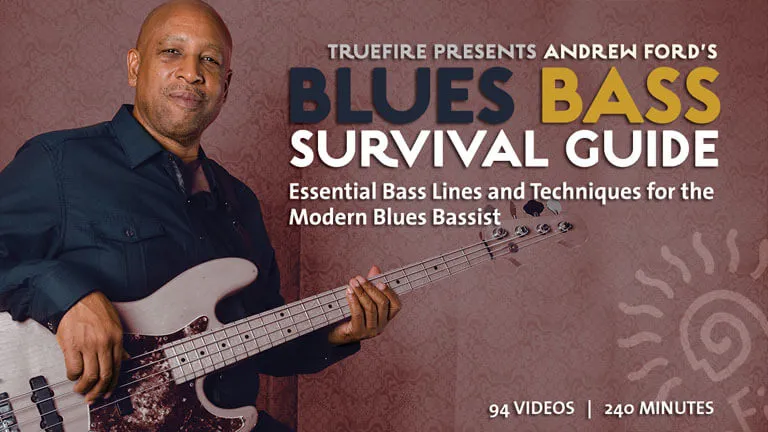
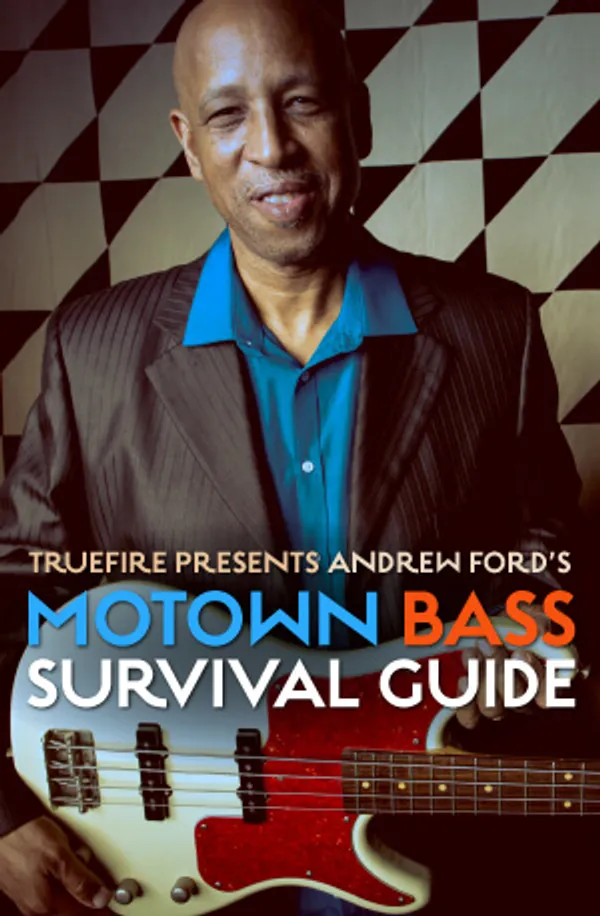
It's a well established fact that bass players must have command of a broad range of styles to stand out, work steady and get the big gigs. Ask any top bass player and they’ll also tell you that contemporary jazz, rock, soul, R&B, gospel, country and all of their derivatives root back to the blues in one way or another. In short, bass players MUST have a deep bag of blues chops and that’s exactly what Andrew Ford will help you develop with this Blues Bass Survival Guide.
“Blues is that one style of music that every bass player should aspire to play well. Bass players need to know how to play shuffles, funky blues, rocking blues, New Orleans-style blues, jazz-style blues, waltzes, soulful blues and many, many other varieties. With the blues, bass players drive the truck — we’re not only holding down the groove rhythmically with the drummer, we’re also playing melody and harmony in our bass lines, especially in a trio setting.”
As Albert King said, "Start at the roots to develop the fruits.” Throughout the Blues Bass Survival Guide, Andrew guides your exploration of the rich heritage of blues grooves and bass lines that originated with artists like Son House, Robert Johnson and Charlie Patton followed by artists like Willie Dixon, B.B. King, Albert King, Muddy Waters and John Lee Hooker who in turn influenced today’s blues artists like Eric Clapton, Stevie Ray Vaughan, Robert Cray, Robben Ford and many others.
Andrew organized Blues Bass Survival Guide into two sections. In SECTION 1, you’ll work through 30 essential concepts and techniques that are perquisite to mastering the blues: Basic 12 Bar Form, Triplet Rhythm, Shuffle Triplet Rhythm, Long & Short Shuffles, Simplified Notation, Simple Triad Patterns, Dominant 7th Chord, Mixolydian Mode, Basic Box Shape, Connecting the Dots, Adding the 6, Adding the b7, Walking Shuffle, Pentatonic Scales, Blues Scale, Muting, The Pivot, Chromatic Leading Tones, Double Stops, Alternate Forms, Intros, Breaks, Endings, Turnarounds, Straight 8th R&B Feel, Rock Feel, Jazz Progressions, Minor Blues, Rhumba Patterns, 12/8 Feel, 2 Beat Feel and the Funk Slap Style.
In SECTION 2, you’ll have a blast applying all 30 of those essential concepts and techniques across 19 Bass Studies covering the full spectrum of blues feels and grooves: Jig Saw #1 (Rumba feel with New Orleans vibe), Jig Saw #2 (Another Rumba with more syncopation), All Boxed Up (up-tempo SRV-type shuffle), Tee Boogie (straight 8th Texas-style feel), Rob’s Road (Crossroads riff-based groove), Cheap Thrill #1 (minor blues groove), Cheap Thrill #2 (minor blues with more syncopation), Ray’s Woman (two-beat blues), Scufflin’ Up (medium-tempo quarter-note shuffle), Satterday Night (12/8 blues), Stormin’ (Stormy Monday-type blues), Red’s Groove (medium jazz blues), Miss Molly (up-tempo boogie woogie), Slow Burn (12/8 blues), Blues for Willie (unison riff-style), Red White & Blues (funky 12/8 blues groove), It’s Not All Blues (blues in 3/4 time with a jazz waltz feel), Hop Skip Jump (up-tempo jump blues) and The Rev and Wine on the House (soulful blues).
For each of the 19 Bass Studies, Andrew first overviews the concepts and techniques that will be employed in the study, and then demonstrates the bass part over a rhythm track, which is designed to showcase those particular concepts and techniques in a real world musical context.
After the performance examples, Andrew breaks down the bass parts technique-by-technique, line-by-line. Use the performance video, breakdown and supplied tab/notation to learn the part as performed. Next step is playing the bass parts by yourself over the supplied rhythm tracks. The final step, and the mission of this learning experience, is to integrate Andrew’s key concepts, techniques and grooves into your playing.
Grab your bass and lets get busy!
What you'll learn
Navigate a modified blues form that stays on the V chord
Apply Mixolydian scale concepts to blues bass playing
Play a common blues ending with proper timing and feel
Play a driving eighth note rock groove based on triads
Use chromatic passing tones effectively in blues bass lines
Blues is that one style of music that every bass player should aspire to play well. It is the foundation of many contemporary music styles such as jazz, rock, soul, R&B, gospel and country. So if you play one of those styles of music, you have already been exposed to the blues because all those styles have borrowed from it. Let's say you find yourself on stage with an R&B drummer, rock guitar player, jazz piano player, and a singer, and you need to find a song to play together. The common thread is almost always the blues. When we think of blues bass the first thing that may come to mind is dum-da dum-da dum-da dum. Although that is a big part of the blues, in this course we will play a variety of grooves that make up the blues tradition current and past. The blues is very diverse, along with the shuffles, there are funkier blues, rockin' blues, New Orleans style blues, jazz style blues, waltzes, soulful blues and many other varieties. Don't let its simplicity fool you though, the structure may be simple but playing blues bass is not easy, though it can be fun and extremely valuable in developing your overall groove. As a bass player in the blues you are driving the truck, you are not only holding down the groove rhythmically with the drums, but often providing melody and harmony in your bass lines, especially in a trio setting. If you are going to be a well rounded bass player you have to get comfortable with the blues, it will surely pay musical dividends. There is a rich heritage of the blues, delta blues starting with artists like Son House, Robert Johnson, and Charlie Patton that lead to more modern artists like Willie Dixon, B.B. King, Albert King, Muddy Waters and John Lee Hooker who influenced today's artists like Eric Clapton, the late Stevie Ray Vaughan, Robert Cray, Robben Ford and many others. It's important to go back and get some historical perspective because like Johnny B. Gayden, bass player for Albert King and many others says "start at the roots to develop the best fruits".
In this 1st section I will give you the essential concepts of blues bass. We need to start with understanding blues form and then move on to foundational studies like triplets and the shuffle groove, chords and scales used in creating blues bass lines, common fretboard shapes, connecting chords together, walking concepts, muting, ghost notes, chromatic note useage and more. Then there are concepts like intros, typical endings, turnarounds and breaks that will give us a deeper understanding of playing blues bass in a band setting. We will then dive into the many styles of blues including shuffles, straight 8th grooves, the 12/8 feel, jazz, boogie woogie, rumba style and others. So let's get started digging into these foundational and essential concepts for playing solid blues bass.
Let's start with the most common blues song form, the 1-4-5 12 bar blues. The chord structure in the key of C for instance would consist of the 1 chord which is C for 4 bars then we move to the 4 chord, F. Now an easy way to figure out what note matches with each number chord is to take the major scale of the key you are in. As you play the scale give each note of the scale a number starting with the root, C in this case, being #1. The next note D is #2 or the 2nd, E is #3, and F, our next chord in our blues progression is #4 or the 4 chord in the key of C. With this knowledge you can figure out chord numbers in whatever key you are in. So we will play that 4 chord, F, for 2 bars. Next we will return to the 1 chord, C, for 2 more bars which makes 8 total bars so far. Now for the last 4 bars we will introduce a new chord, the 5(V) chord, which will be G and play it for 1 bar. Then we will return to the 4(IV), F, for 1 bar and finish by going back to the 1 chord, C, for our last 2 bars. This is our most basic 12 bar blues form. We will take a look at some of the many variations of this form later in the course.
At the heart of the blues shuffle groove is the triplet rhythm. Basically this rhythm is created by taking one beat and dividing it into three equal parts. Or another definition used is playing three notes in the same time span as two notes, in other words, taking two eighth notes and instead, playing three 8th notes in that same time span. Whichever definition helps you the best, but the bottom line is to be able to feel the triplet. If we have a groove that has a pulse 1, 2, 3, 4 then the triplets are counted tri-pl-et, tri-pl-let, tri-pl-let, or you can use any 3 syllable word or phrase, like my name, An-drew-Ford. Let's play this triplet rhythm over the basic blues form in the key of E.
The triplet figure used most often in shuffles is like the 8th note triplet we just practiced, but leaves out the middle syllable. So instead of, for instance, using the phrase dum-pa-tee, dum-pa-tee for our triplet, this new rhythm will be dum-tee, dum-tee. Almost like a horse galloping. Let's play this groove just using roots in the key of E over the standard blues progression.
Now this new triplet figure using the 1st and 3rd notes of an 8th note triplet can be played different ways. Two common ways are to play the rhythm short or long. Playing them long is notated by the quarter note with an eighth note triplet. The more staccato or short interpretation is notated by an 8th note, then an 8th note rest, and followed by another 8th note. There is a distinct difference between the sound of these two triplet figures and different times in which they should be used. The music, and, or the musicians will determine that. As you play more blues your instincts will tell you which one is appropriate for the groove you are playing. In this exercise I alternate playing the rhythms so you can clearly hear the difference in the two approaches.
As you can see in the previous examples these triplet figures can be a little tedious to notate, so a symbol was developed to indicate each group of two 8th notes should be interpreted as a triplet figure. That symbol shows two 8th notes and then an equal sign followed by a quarter note and 8th note triplet. You will find this symbol in the upper left hand corner of your score. So whenever you see two 8th notes together, you play them as if you were playing the basic triplet-based shuffle rhythm. This way of notating triplet rhythms for bass is much easier on the eyes and simplifies the notation. One of the first things to always do when handed sheet music is to first browse the upper left hand corner. This is where you will find critical information that will help you interpret the music correctly, things like key signatures, time signatures, style, feel, tempo, etc. Take a look at what that symbol looks like.
This is a great bass course using short lessons on individual topics to build a complete guide on playing bass. If you already can play a bit, you can use the earlier lessons as short practice or warmup periods.
M
Mhprutz1
Verified buyer
01/12/26
Great for "Getting You Going" on Blues Bass!
As someone who plays guitar and bass, I was looking for a course that would get me going on playing blues bass pretty quickly. This was the course! Andrew Ford gets you right into playing right away and having fun! Well structured and well produced course.
G
Giovannisoave
Verified buyer
11/23/25
Best video course I have purchased. Comprehensive and full of detail.
After 10 years of getting nowhere with the guitar, I decided to buy a U-bass and give it a go. Best choice I made
I have learnt a lot from Andrew Ford.
D
dave
12/08/24
Lots of great tips
Best part is at the end with the playalongs in a variety of styles.