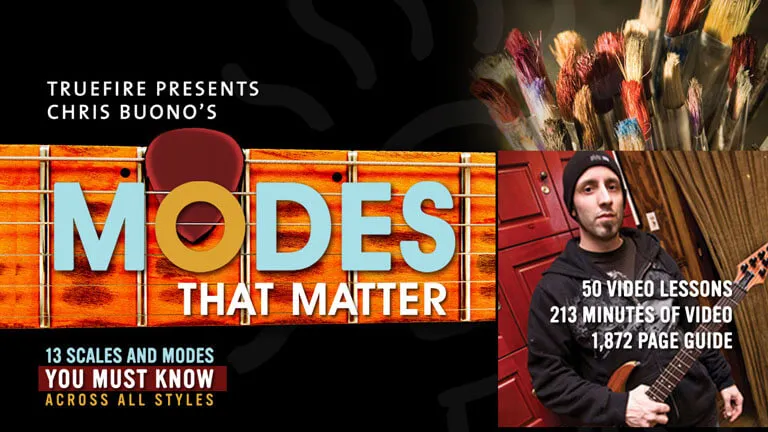
Modes That Matter

13 Scales and Modes You MUST Know Across all Styles

Marty FriedmanTommy EmmanuelSteve VaiEric GalesEric Johnson

Get this course and 1,000+ more with All Access

Try 14 days free. Cancel any time.

Purchase Individual Course for $14.99
Modes That Matter

About this course

Not a clue what a mode is? Or maybe you've studied modes and scales all your life? Either way, if your solos are sounding monochromatic and flat, consider this course of study mandatory. Seriously. But don't freak. This is NOT a theory or music history course. There won't be any lectures about the "Musica disciplina" by Aurelian of Réôme. Pronouncing 'Aeolian' correctly is likewise not a requirement. The only prereq is desire to expand your tonal palette and the discipline to play your way through the Modes That Matter curriculum from beginning to end.

You'll learn just 13 scales and modes. You'll learn how and when to apply them. You'll learn how to shape, color and texture your solos across a variety of styles with them. You'll learn where to find, and how to finger, these 13 scales and modes all over the fretboard. Straight up, get a solid grip on these 13 and your soloing prowess will grow quicker and further than you would have ever imagined.

Don't be thrown by the seemingly few number of scales and modes covered herein. Yes, we know you've seen (and probably own) one of those telephone book-sized encyclopedias of scales and modes. But here's the deal; odds are real good that 99% of the guitar solos that you'd sell your soul to be able to play yourself, only use one or more of the 13 scales and modes covered in Modes That Matter (Disclaimer: unless you're a heavy jazzer, outside modern classical genius, or just happen to really dig quarter-tone-indo-Asian world music).

You likely already know a few of these 13 scales and modes; Ionian mode (commonly referred to as a Major scale), Dorian mode (commonly referred to as a minor 7th scale), Phrygian mode, Lydian mode, Mixolydian mode (commonly referred to as a Dominant 7th scale), Aeolian mode, Melodic Minor scale, Lydian b7 scale, Altered scale, Harmonic Minor scale, Phrygian Major mode, Whole Tone scale and Symmetrical Diminished scale.

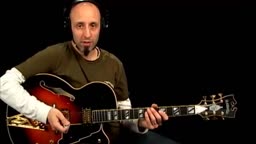
Your Modes Maestro could only be our resident Professor of the Deep and Revealing, Chris Buono. "As an academic, I've studied and taught hundreds of scales and modes in thousands of guitar lessons. The most common misconception students have about scales and modes is that you have to master all of them. And that's fine for fellow academics and theory freaks, but in the practical real world, if you're playing blues, rock, metal, country, pop, funk and even jazz, you're playing one of the thirteen scales and modes covered in Modes That Matter."

Buono's format is straight-forward and interactive. You'll play through 13 video lesson sets, one for each scale and mode. You'll first learn how to spell the scale or mode in simple "scale degree" language - no fancy theory math. Chris then demonstrates the scale or mode over distinctively styled jam tracks, emphasizing the tonal qualities and key notes to target while soloing. Now it's your turn: Roll the practice rhythm track and work it until you've captured the sound and feel of that mode or scale in a musical context. Once you can "hear" it under your hands (the easy part), you'll also need to learn that scale and mode in as many places as possible across the fretboard (the hard part).

All of the scales and modes work in multiple styles such as blues, alt-country, rock, funk, jazz, fusion, bossa, metal, surf and even Klezmer. Buono will demonstrate each scale or mode across at least two different styles although endless style variations are virtually unlimited.

Lesson Sets & Rhythm Tracks
Ionian: Alt-Country-Rock, Jazz & Rock
Dorian: Funk, Jazz & Minor Blues
Phrygian: Metal & Latin Rock
Lydian: Modern Rock, Fusion & Jazz
Mixolydian: Funk, Jazz, Blues & Southern Rock
Aeolian: Rock, Metal & Slow Jam
Melodic Minor: Funk & Fusion
Lydian b7: Funk & Jazz
Altered: Funk & Jazz
Harmonic Minor: Metal, Bossa & Surf
Phrygian Major: Jazz, Surf & Klezmer
Whole Tone: Jazz & Fusion
Symmetrical Diminished: Funk & Jazz
As previously mentioned, you will need to learn how to play these 13 scales and modes all over the fretboard for maximum firepower. That's where the shed time and discipline come into play. But fear not; Buono prepared a 1,872-page manual of charts (no typo; that's one thousand, eight hundred and seventy two pages) of alternative fingerings all over the neck for these 13 scales and modes.

1,872 page PDF "I've prepared a chart to end all charts of fingering possibilities. Starting with a single scale the options go all of the way up to four-note-per-string variations. What's more, every scale and mode is also broken down into a unique pentatonic scale whose five-note formula is made up of the core components ensuring the correct sound and vibe with a two-note-per-string pentatonic feel." Chris also prepared 34 practice rhythm tracks charted as both PDF and Power Tab files. So, if you want to go deep geek on Modes That Matter - and we hope you will - there's absolutely nothing stopping you.

So get cracking on this one right away. Start incorporating even a few of these 13 scales and modes in your improvisations and then buckle up as your solos explode in full living panoramic color.

What you'll learn

  • Play Phrygian major scale in multiple positions
  • Navigate chord changes horizontally with one scale
  • Play melodic minor in 7th position with proper fingering
  • Understand the melodic minor scale formula and how it differs from natural minor and Dorian
  • Recognize the characteristic sound of the major 7 against the b3
Release date: 09/09/2010 • 3h 34m runtime
Start Course
Sample lessons
Ionian
Ionian
Rock
Dorian
Dorian
Funk
Phrygian
Phrygian
Latin Rock
Lydian
Lydian
Jazz-Fusion

What's included

50 lessons • 13 charts • 34 Jam Tracks

Modes That Matter
Looking to expand your palette of single-note tonal colors? A great way to do so is to delve into modes and alternative scales. While that's a worthy endeavor it's rife with obstacles. Often guitarists don't know really know what the new scale or mode is all about and as a result they don't know where to apply them. Guitarists are often presented concepts related to scale study that seem too good to be true and in time prove to be just that. And, guitarists in becoming frustrated with said methods also never gain a full neck vision of these new sounds. That all ends here: Welcome to 13 Scales and Modes That Matter.

This course is designed to present new single-note sounds into your playing. The idea is simple: Introduce the new scale or mode by scale degree formula and then get right down to showing how to apply it. Each scale or mode is played for you over style-specific jam tracks with in-depth explanation all the way through. In essence, I literally talk you through it. While the number 13 may not strike you as poetic this collection of scales and modes is one that really matters. These are the scales and modes everyone from rock stars to working stiffs use everyday and so should you! They are:

Ionian
Dorian
Phrygian
Lydian
Mixolydian
Aeolian
Melodic Minor
Lydian b7
Altered
Harmonic Minor
Phrygian Major
Whole tone
Symmetrical Diminished

Throughout 13 Scales and Modes That Matter you're going explore various concepts including style-specific phrasing, parent scales, parallel major comparison and scale formulae. But don't let that list fool you--this course is not about theory and not about licks. It's all about the application. It's about when and where to play these scales and modes you hear so much about.

To help get you up and running with the 13 scales and modes contained in the course I've prepared a chart to end all charts of fingering possibilities. Starting with a single scale the options go all the way up to four-note-per-string variations. What's more, every scale or mode was broken down into a pentatonic scale whose five note formula is made up of the core components ensuring the sound and vibe of the scale or mode is present with a two-note-per-string pentatonic feel. Coupled with the 34 jam tracks that have accompanying Power Tab and PDF charts you have a sizable launch pad in which to take off from.

So, what are you waiting for? Let's play some music that matters!

*** A big thank you goes to Steve Jenkins for laying down the stellar bass lines in every last jam track. Also big thanks to Chris Donlon of Beta Monkey for the completely cool drum loop libraries. Because of these two guys your jam tracks rock!

Modes That Matter
Scales can be fingered in so many ways it will make your head explode. A single vertical position alone can garner myriad ways to play the same scale. Throw in surrounding vertical areas, horizontal and diagonal approaches as well as unique fingering patterns and you'll start to see what I'm talking about. To attempt to know them all is beyond impossible. And, is it really necessary? Here's the simple answer: Absolutely not. What you need to know is whatever system of fingerings will enable you to see the neck in its entirety. Attached to this segment in PDF form is a scale fingering compendium that spans the gamut. Seriously, there's a LOT of scale fingerings to choose from here, folks. But, notice I used the phrase "to choose from" as opposed to "to know" or "to learn", or worse, "to memorize". This collection is meant for you to peruse and choose. Find a system (or two) that feels good and works for YOU. Find one that makes the most sense when it comes to what you want to play both physically and stylistically. You may discover certain scales work better for you within one approach as opposed to another for another scale. What's more as you explore all the options you may even come up with a system all your own! There's no rules here; go with whatever works for you. If it means knowing them all--that's cool, tooAfter finding a set that works for you make sure you "play" them as opposed to "practice" them. Dig right in and start constructing lick and riff ideas. And, when doing so make sure you force yourself to immediately start applying all the guitar-istic phrasings we love to utilize--legato techniques, bending, etc. Make the scales become part of your playing right from the start and not something that feels like an exercise or task. This will help you get these new sounds into your music that much faster. Aside from the initial learning of the scale(s), if you catch yourself going into robot mode playing them from bottom to top over and over and over and more: STOP. It shouldn't feel like you're trying to memorize them. Remember: Play music! Make if fun!!Now, let's hear what they sound like…
Ionian
Ionian is the modal name for the venerable major scale--a melodic and harmonic bearing device that has been the backbone of Western music for over five hundred years! The resultant organized group of notes breeds a simple, yet timeless sound that has created an innumerable amount of music. What ties each and every melody and/or chord progression composed in major is the overall good vibes. If that wasn’t enough, the major scale is also the parent scale to six other scales known as the church modes--many of which will be explored throughout this course.

The following three segments will find the major scale thriving within a laid-back country rock vibe in C, a straight ahead jazz feel in G and a completely rockin’ three-chord progression in F. The upcoming lesson set will set the stage for what’s to come here in 13 Scales and Modes That Matter so be sure to listen up.
Ionian
At its core the major scale is made up of series notes separated by an order of whole (W) steps and half (H) steps. They are as follows:

W-W-H-W-W-W-H

Those same notes can be assigned numbers called scale degrees with the first note--the root--being 1 and the rest sequentially assigned their corresponding number. For instance, the second note is 2, the third is 3 and so on. Throughout this course all 13 scales or modes including major will be organized with this numeric system albeit every one of them will have a formula where one or more notes will be altered as compared to the major scale. This process of scale construction is called Parallel Major Comparison and is very effective. That all said, the scale degree formula is: 1 2 3 4 5 6 7 making it the only heptatonic (7-note) formula that has no alterations. Every scale and/or mode will have at least one raised (sharp) or lowered (flat) degree from here on in.
Ionian
In the playing of the major scale it’s best to avoid resolving a melodic idea on the 4th degree as it’s widely agreed its an unwanted dissonance. Not to worry you still have six other notes that will sound great in almost any capacity. At the same time, if you can make it work, by all means: PLAY IT! A good approach is to use the 4th as a passing tone. When done correctly it contributes to some very catchy phrases. In the end, it’s all in how you play them.

Speaking of: phrasing is the all-encompassing term used to describe how you play a melodic figure or lick. It is phrasing that makes a mode come to life and be heard as a sound all its own and not just a scale starting on said degree of a parent scale. In fact, improvising is all about phrasing!!
Ionian
As you check out the various segments pertaining to each scale or mode take notice of how the phrasing changes from style to style. Just think back to how the Ionian mode was approached in the previous segment where a straight-ahead jazz vibe was employed while you view the very different approach to this more modern rock feel. Be it bending compared to no bending, the manner in which you apply legato techniques or even how you use the tone you’re playing with to your advantage; the style you’re playing in will absolutely affect how you play. That said you might find yourself using a certain set of fingerings from the PDF charts for one particular style while going for another set that’s completely different when playing another style. Conversely, you might grab onto a certain fingering scheme but rely more on phrasing variations to match the style you’re playing in. There’s no rules!
Dorian
As you're about to see the modes are much more than just scales starting on specific degrees of their parent scales. Every mode has a color unto itself that can be used by you to paint myriad audio images. While this course will examine each mode through its relationship to whatever parent scale from which it came, the real bread & butter is in the mode's own formula. Let's start with Dorian.

The Dorian mode is the second mode of the diatonic modal system also known as the "church modes". Therefore it's built on the second degree of the parent major scale, which in this case is referred to as the Ionian scale. In order for Dorian to be part of the system the notes have to be exactly the same as the parent major scale's notes. To do that a major built on the 2nd degree of the parent scale will have its 3rd and 7th degree lowered a half step. The resultant formula is as follows: 1 2 b3 4 5 6 b7.

+ 43 more lessons

Start Course

Reviews

6 results

Kenneth D.

02/22/25

40 years of bewilderment resolved

After years of trying to figure out the modes in any manner of easy way. This course has worked for me. I'm only halfway through, but I am thrilled to be able to sit down and easily move between several modes with a single key fluently. I have little to no theory background, and everything in the course is explained in an easy-to-understand way. I'll never get through every page of the supplied PDF, but it's worth its weight in gold, and I can get exactly what I need from it. Well done, bravo, thank you X 1000.

OrangeDragon

Verified buyer

10/25/21

awesome course

This course is very easy to follow along and makes sense of the different characteristics of the modes presented Very helpful

ArtemIV

Verified buyer

03/24/21

Really helpful course. Every guitarist should know this scales.

Revman2015

02/28/21

Eye Opener

Chris Buons Modes that matter is a fresh perspective. Really Fresh. His groove and playing style are very much his own and not other players on this site. Eye opening perspective at high level equals great course. I love his phrasing he uses and his explaining and breaking things down to a level so that you can get it shows he real is a master technician.. Jump on board

Alan S.

12/20/19

TrueFire True Awsomeness

I’ve be been downloading TrueFire lessons for nearly 10 years and have built up a large collection of absolute gems in that time. My guitar playing has gone in leaps and bounds since my first purchase which was Modes That Matter by Chris Bueno who is a force of nature for electric guitar studies. Whether looking for something specific or just browsing for inspiration my musical tastes are always intrigued by the stuff I discover here. I particularly love the sales - the huge discounts offered allow for exploration of a Miriad of styles and lessons which I could only dream of owning on at full price and these serve as a taster into deeper studies. TrueFire are continually developing their interface which really adds quality to the experience and ease of overcoming the more challenging lessons. Highly recommended to any guitar players whatever level you are at.

Stop searching. Start improving with All Access.

Try 14 days free. Cancel any time.