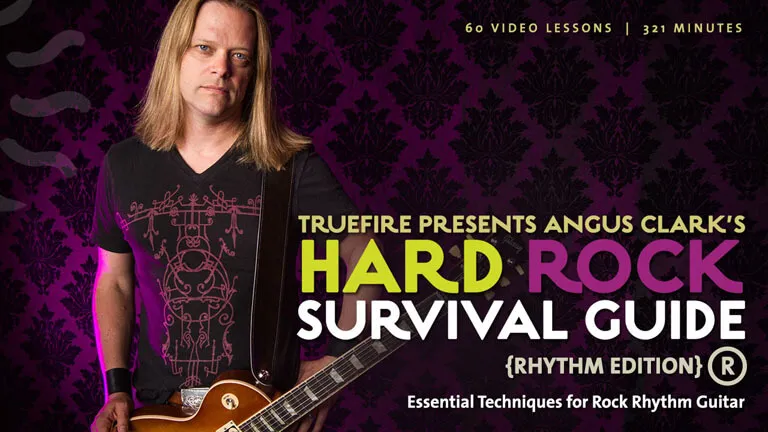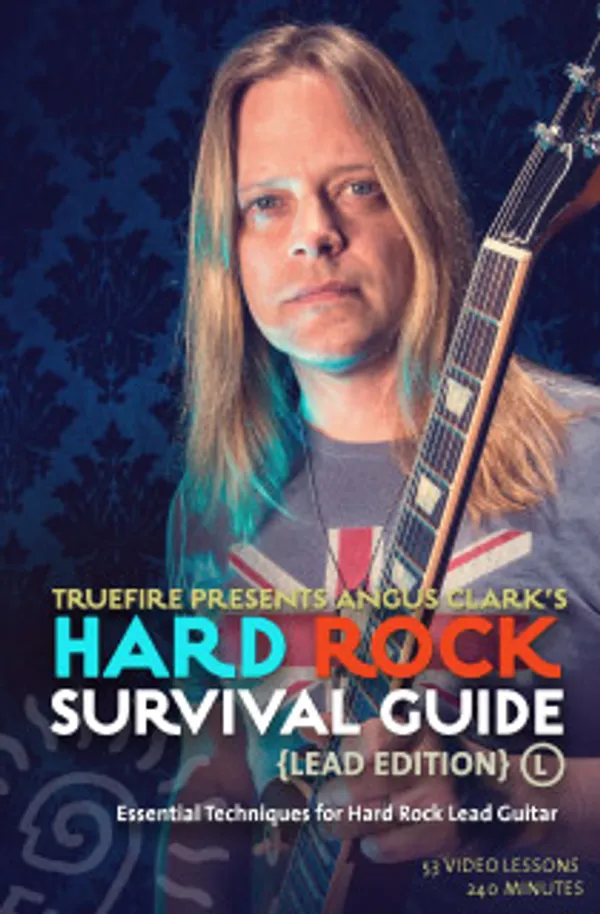

Hard Rock Survival Guide: Rhythm

Essential techniques and concepts for hard rock rhythm guitar

Marty FriedmanTommy EmmanuelSteve VaiEric GalesEric Johnson

Get this course and 1,000+ more with All Access

Try 14 days free. Cancel any time.

Purchase Individual Course for $19.99
Hard Rock Survival Guide: Rhythm

About this course

Your buddy got you the audition. His brother’s in the band. They all have day gigs but they rock hard on the weekends working local venues, making decent money and having a blast doing rock covers from the 60’s all the way through the 90’s and beyond. They need a second guitar and it sounds like a perfect gig for you. You’re a little nervous ‘cause the other guitarist is the local hot shot with blazing pyrotechnic lead chops and that can be a little intimidating.

Fear not... we have good news and really good news for you. The good news is they’re really looking for someone with killer rhythm chops because the other dude can’t even spell the word. The really good news is that Angus Clark will hone your rhythm chops to perfection with this Hard Rock Rhythm Survival Guide.
"This course is packed with great ideas and concepts for classic rock rhythm guitar. Angus has exactly the right tempo with this tutorial and gets right to the point immediately he never misses to explain the essentials as well as his tricks of the trade to get the right sound for example. With a role model like him you just want to grab your guitar and follow a few miles in his footsteps, no matter what musical genre you come from. Absolutely convincing, great fun to work it through, thumbs up!" - Jens H., TrueFire Student
We’ve said it before and we’ll say it again... killer rhythm chops gets you the gig every single time. Players with blazing lead chops are a dime a dozen today and most of them skipped all their rhythm classes to develop those chops. Their loss is your gain. Bandleaders, jammers, singer-songwriters, musical directors and the like will always pick the solid rhythm player over a skilled lead player. So yeah, its all about rhythm.
"I'm an old school hard rock/metal guy from way back, and Angus has put together a great program leading through some of the styles that the masters used to get their riffs sounding amazing. I have actually thrown this course on in the background to listen to at work or home, just because of the quality of the riffs, the playing and the tone. I think it is one of the better survival guides." - Mike P., TrueFire Student


Angus organized this Survival Guide curriculum into two main sections. In the first section, Angus will guide you through 22 essential concepts and techniques. In the second section, you’ll play your way through 17 rhythm studies that Angus prepared to cover a wide variety of feels and grooves.

The 22 essential concepts and techniques include: Tunings, Big Chords, Rhythmic Subdivisions, Choking the... Chord, Drop D Tuning, Power Chords, Power Chords in Rhythm, Syncopated Rhythms, Triplet Rhythms and Shuffles, Power Chords in Drop D, Stylistic Touches, The "Other" Power Chord, Triads, Sixths and Thirds, Open String Pedals, Pedals in Drop D, Additional Chord Vocabulary, Accompaniment Figures, Other Time Signatures, Acoustic Applications and Hard Rock Secrets.

All of the concepts and techniques are demonstrated in context over 17 rhythm studies, which will utilize real-world rhythm tracks across a variety of keys, feels and tempos: Punk Pop Chords, Classic Hard Rock, Alice's Grunge, Kurt's Grunge, Nu Metal Ostinato, The Man In Black, Since You've Been Rockin', Downstroke Workout, Hot For Shuffles, Drop D Bullet, Ben's Staccato, Ben's Overdub, Shore Leave Shuffle, Math Rock Shuffle One, Math Rock Shuffle Two, Crazy Triads, Mean Combo.

Angus demonstrates the rhythm parts and then breaks them down measure-by-measure, technique-by-technique. You’ll play along with Angus to first learn the parts as presented and then work with the rhythm tracks on your own to craft your own rhythm parts. Everything is tabbed and notated for your reference purposes.
"Hard rock and metal is my passion so I really liked this one. Angus is a cool cat and knows his stuff. There is a lot fun stuff in Hard Rock Survival Guide and some really good tips that he offers. Definitely improved my playing. Angus is a great teacher and I learned a lot of different concepts from this course along with helpful tips that I wish pro players would share more. Thanks Angus!" - Scott J., TrueFire Student


Hard rock influences practically every other rock genre and so, whatever style of rock you play; classic, grunge, metal, alternative, indy, grind core, stoner, psychedelic, blues-rock, power pop, folk rock and the list goes on; you’ll extract enough insight and technique from the Hard Rock Rhythm Survival Guide to whip your rhythm chops into serious jaw-dropping shape.

The gig is yours!

What you'll learn

  • Apply chord vibrato shake for stylistic effect
  • Use barre chords with major thirds in hard rock context
  • Navigate complex rhythmic figures without getting turned around
  • Execute alternate strumming patterns with proper eighth-note feel
  • Understand how string gauge affects metal tone in drop D
Release date: 10/15/2013 • 5h 20m runtime
Start Course
Sample lessons
Stylistic Touches
Stylistic Touches
Concept #12
Additional Chord Vocabulary
Concept #18
Classic Hard Rock
Classic Hard Rock
Performance
Classic Hard Rock
Classic Hard Rock
Breakdown

What's included

60 lessons • 36 charts • 17 Jam Tracks

Hard Rock Survival Guide: Rhythm
Hello and welcome to the Hard Rock Survival Guide Rhythm Edition. I'm really excited to be doing my first Survival Guide for TrueFire. We gave a lot of thought to how to make this as universally appealing as possible while also making it personal to what I'm really good at. We decided to focus on fundamentals, and to that end we are taking a pan-decade approach to Hard Rock. What does that mean? It means that we're focusing on rock that has an edge to it, all the way from the 60's to the '90's, the present and beyond. In all examples, we're really examining a fundamental of music and how to execute it on the guitar: From fundamental rhythmic subdivisions to fundamental harmony, from fundamental picking and strumming to the fundamentals of keeping your guitar sounding in tune. Along the way we'll explore the nuance and flair that rock demands of a guitarist: Using gain and volume for dramatic effect, muting and pinch harmonics, pick slides and everything else that made you want to strap on a guitar in the first place. As for my personal take on all of this, you'll get the benefit of my 20 years as a working guitarist who's played on stages around the world. Everything I demonstrate in this course is based on a real world need to deliver the goods on a gig. That's it. There is no disconnect between the fundamentals and the execution. These are the skills that are employed by guitarists on records that have sold millions of copies. You can master them. Do it.
SECTION 1: Essential Concepts
The Essential Concepts section of this course is very diverse. Some of the segments are very basic, some are more nuanced or advanced. When a player works, you refine elements of your technique in order to meet the needs of the various gigs you get hired for. At the same time, it's mastery of the fundamentals that gives you the flexibility to get the gig in the first place. Refining an element of your technique is easy when you control the fundamentals. Without the fundamentals you are sunk. So don't skip around - take some time with this. You can always jump to the performance section and then jump back to these concepts for the explanation of the fundamentals at play in the various performances. That's ok. But at some point you'll have to visit all the concepts and just let it all sink in, even the triads.
Choose Your Weapons
There are a lot of guitars to choose from out there and hard rock and metal have been played on just about every one of them, from Blackmore on a Strat, to Iommi's SG, Breaking Benjamin on a PRS, Schenker on a Flying V, Good Charlotte on a Music Man, Malcolm Young on a Grestch, Hetfield on an Explorer, countless players that use Kramer, Jackson, ESP, the list goes on. At the end of the day, the ultimate argument settler is going to be the Gibson Les Paul, so the bulk of this demonstration is going to be done on one. We're going to be going down to drop D and back up a lot throughout the course, so a fixed bridge is the way to go. For your amp and effects the bulk of the demonstrations are going to be done using a crunch sound. The defining characteristics of a crunch sound are there is enough gain to create sustain and possible feedback, but those elements are well under control, because silence is half of rhythm playing. You should be able to get the sound to clean up when you roll your guitar volume down. Too much gain and you will get feedback between the notes or just hiss or hum from the amp that is above the noise floor of the rest of the band. Too much gain often causes a lack of definition between the strings when you are playing chords, and actually reduces the impact of the low end of the ringing notes. If it's a one channel amp with gain, you should be at full crunch when your guitar is on 10, and then need a pedal like a Tube Screamer, OverDrive, or Booster to push you into lead territory. If it's a multi-channel amp, well the world is your oyster. If it's an amp with no gain then why did you buy it? This is a rock course!
Tunings
I will be demonstrating everything on a standard tuned guitar or standard with drop D. This is not really representative of what is currently happening in the industry, because a large number of the more successful bands in hard rock from the 90's through the 2010's like Breaking Benjamin, Crossfade, Five Finger Death Punch, The Sword, etc. are taking a page out of Sabbath's book and tuning the whole guitar down anywhere from a minor third (C#) to a fourth (B) with the corresponding "drop whatever" (C# with a drop B, C with a drop Bb, etc.). The shapes and so forth are all the same as in these demonstrations, but there are some issues that you will need to address if you decide to tune down. Get the right string gauge (I use .012 - .054 for a C# standard guitar) and you might have to get your guitar modified (nut width and height, bridge notches) and adjusted (truss rod, etc.). You definitely need a separate guitar or guitars to handle this kind of duty. And you need to practice on them because it actually requires kind of a light touch and pick attack to keep a guitar in that kind of tuning from sliding out of tune. To explain the tunings concisely: Standard indicates that the strings are in the standard relationship to each other. 4th, 4th, 4th, Maj 3rd, 4th. Drop means that the sixth string is a whole step lower than it would be in standard. So Eb standard means you tune each string down a half step. Eb drop C# would be the whole guitar tuned down a half step and then the sixth string tuned down another whole step further. Sabbath used C# standard a lot. Five Finger Death Punch tune to B standard. Breaking Benjamin are in C drop Bb, the Sword are in C standard, just as some examples. The entire Jailbreak record is done on Eb tuned guitars. Van Halen used Eb tuning, and sometimes with drop tuning. I mean, even Hendrix tuned down to Eb, so this is nothing odd, or new, it's how the pros get the job done.
Big Chords
Let's start simple. We're going to play big open position chords in whole notes. One thing I've learned from being in the studio is that while gain may cover up a host of ills it won't fix tuning. And while your guitar may be in tune, the way you are fretting your guitar may be pulling it out of tune. Big chords that incorporate open strings are a hallmark of the hard rock sound. From Foreigner to Tool and everyone before and since, when you want to sound big, play a big chord! We're playing one chord a bar and holding them just to make sure we can hear that we're in tune and everything is ringing out. Gibson style guitars are notorious for tuning issues and these stem largely from the nut being too low, too high, cut wrong, misaligned, etc. You can correct for certain deficiencies in intonation simply with your fingers, but you really have to be listening. When you are tuning your guitar you really need to listen to it and play a few chords. There's a big difference in checking your open E chord and your open G chord. Similarly with your open A, D, and C chords. You have to find a compromise in the tuning of the instrument and the way you fret the chord in order to get it to ring true. We're also going to look at the most popular barred shapes of major and minor chords. If you haven't seen these already, get 'em down! If you have, still work through the lesson because there may be some hot tips along the way. The exercises here are just a few examples of popular chord progressions that use the shapes we just discussed. Play through them to make sure you're changing chords in time with zero down time between chords.
Rhythmic Subdivisions
Rhythm is the organization of sound over time. The time is marked by the tempo, which is measured in beats per minute. The beats are grouped into measures. The measures are grouped into phrases. The basic grouping of beats per measure is called the time signature. Most of the examples in this course will be in 4/4 time, which is a grouping of four beats per measure. The beats are called quarter notes. Quarter notes can be further subdivided into eighth notes and then sixteenth notes. Quarter notes can be combined to create half notes and whole notes.

Because music is played by humans, the way you play these subdivisions of the beat is what creates your feel. There are just as many versions of right as there are wrong. We're going to do all of these concept exercises vs. the metronome. The metronome is a guide to show you if you are keeping time. You are the one keeping the time. Not the metronome. Don't get it twisted. If you are doing this right, you should be able to turn the metronome down low enough so that you'll only here it if you get off of it, or if you are not playing on the downbeat.

Again, make sure that you have zero dead air between chords, make sure that you target the next chord shape so that you nail it in time, every time.
Choking the... Chord
Silence is half of rhythm playing. This is a simple concept that addresses creating negative space. Big chords need to be choked in order to get them to stop ringing. There are a lot of things that can go wrong when you do this. Your right hand can cause a scratching noise against the strings. Your left hand can cause a woof. Depending on your type of guitar and your level of gain and proximity to the amp the action required to get the chord to mute will be different. Let your ears be your guide.

Chukka is an imitative (or onomatopoeic) word for the sound of a down-up stroke on the muted strings. The muting is primarily done with the left hand, but you may need to mute with your right as well. You will see that at various frets the string will sound a harmonic or a pitch, so be sure there is more than one finger touching each string, and then if it's still causing a problem you'll need to bring your right hand palm in contact with the string as well. I've organized these muted figures using the following imitative words. This may seem simplistic, but this is often the fastest and easiest way to communicate what you want to other band members: Chuk - muted downstroke Chukka - muted down-up stroke (eighths or sixteenths) Ga-Chukka - muted up-down-up stroke (usually sixteenths, think "Hymn 43" by Jethro Tull)

+ 53 more lessons

Start Course

Reviews

44 results

BanjoRobb

Verified buyer

12/21/25

Hard Rock Survival Guide course review

Great course and really enjoy Angus' teaching style and pace for the course.

Gtr P.

Verified buyer

12/03/25

Great teacher and materials. Top quality.

Rjslpplyr

Verified buyer

04/03/25

So far so good

Vincent

Verified buyer

12/30/24

Good course

It eye opener for me, even though I am not a beginner, but in the rock and metal genre I am consider new, this give me idea on how to go about writing riffs.

Mikaleus

Verified buyer

12/18/24

Recommendation

Great lesson!!!

Stop searching. Start improving with All Access.

Try 14 days free. Cancel any time.