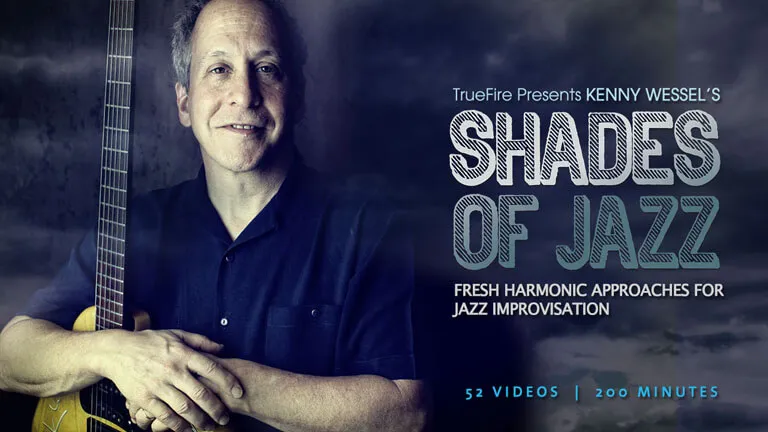
Shades of Jazz

Fresh harmonic approaches for jazz improvisation

Marty FriedmanTommy EmmanuelSteve VaiEric GalesEric Johnson

Get this course and 1,000+ more with All Access

Try 14 days free. Cancel any time.

Purchase Individual Course for $5.00
Shades of Jazz

About this course

Gemstone broker Roy Whetstine paid $10 at a Tucson gem show for what his trained eye thought to be the world`s largest star sapphire, which he later valued at $2.28 million. Guess the seller didn't really appreciate what he had in his possession?! Students of jazz guitar can likewise be blind to the value of what they may already have in their possession.

Most players coming up tend to ignore the basic triads, minor/major pentatonics and blues scales that they rocked out to in the past, in favor of erudite jazz modes and exotic scales. Net result? Too much time in the shed chasing their tales searching for sounds that were already under their fingertips.

Kenny Wessel’s Shades of Jazz will open your eyes and ears to a virtually endless stream of creative and very sophisticated jazz harmonies -- all generated simply by tweaking basic triads, pentatonics and scales. Kenny will show you how take those basic scales and tweak a single note here or there, or move them up a whole step, or down a half-step, or simply work them over a different tonality to create those hip harmonies you hear in your head but haven’t yet worked out on the fretboard.

Kenny’s curriculum will appeal to players across all genres. “We're going to explore how to use some of the basic tools and vocabulary that we all have as guitarists and apply them in new ways to expand our harmonic language and open up our playing. Jazz, rock, jam, world and blues players will be able to put these approaches to work immediately in their improvisations.”

Kenny kicks things off with an insightful series of voice leading lessons in Section 1. He discusses scale tones, chord tones and then shares some valuable voice leading applications with demonstrations and a playalong.

Section 2 focuses on using Phrygian mode (built on the 3rd degree of a major scale) to craft a dominant sound. You already know a major scale and so you already know the Phrygian mode. D Phrygian, Bb Major, F Mixolydian and C Dorian -- they’re all the same exact notes! Kenny shows you how to take those same notes and shape them to work over II-V-I in ways you likely haven’t discovered yet. More demonstrations and playalongs here as well.

The Minor Pentatonic concepts in Section 3 will blow your mind. Kenny will show you how to move that most familiar of scales down a half-step to generate a Lydian sound, up a step for further extensions, up a 5th for a sus sound, and up a flat 3rd for an alternate dominant sound. More demonstrations and playalongs over a II-V-I to put it all to work in context.

Major Pentatonic is next in Section 4. Flat the 6th for altered dominant over a II-V-I progression. Flat the 3rd for a minor or altered dominant sound. Section 5 digs in to applications for minor and major triads to create lydian, sus and altered dominant sounds. Don’t put the box down -- more demonstrations and II-V-I playalongs for you to work with.

All of the demonstrations are presented over a rhythm track for context. Kenny then breaks down the application in a clear and very accessible manner. Everything is tabbed and notated, plus you'll also get all of the rhythm tracks to practice the applications on your own.

While it turned out that Whetstine’s sapphire wasn’t all he claimed it to be (very poor gem quality) that is NOT the case with Shades of Jazz -- if you improvise, you’re but a click away from the mother lode.

What you'll learn

  • Navigate between arpeggios and pentatonic scales for tension and release
  • Use altered tensions as leading tones to resolve to minor chords
  • Contrast chord tones with altered tensions for musical expression
  • Identify which altered tensions are created (b9, #9, 3rd, b7, b13)
  • Build a minor pentatonic scale a flat 3rd up from any dominant chord root
Release date: 06/11/2013 • 3h 17m runtime
Start Course
Sample lessons
Voice Leading: Chord Tones
Demonstration #2
Phrygian: Dom. Over II-V-I
Overview
Phrygian: Dom. Over II-V-I
Demonstration #1
Half-Step Down: Lydian Sound
Overview

What's included

52 lessons • 26 charts • 30 Jam Tracks

Shades of Jazz
Hi, thanks for checking out Shades of Jazz! What we're going to explore in this course is how to use some of the basic tools and vocabulary that most of us already have as guitarists and to apply them in new ways in order to expand our harmonic language and open up our playing. We'll take simple building blocks like pentatonic scales, blues scales, phrygian modes, major and minor triads, and put them in different contexts to enter into some new musical territory. Some of the areas that we will be investigating by using these tools are: altered dominant functions, Lydian modes, suspended sounds, and playing over II-V-I progressions. I also hope to expose some of you rock and blues players to the harmonies and beauty of jazz, and to find ways to use the techniques and understanding that you already have to gain entry to this world.

I've been playing jazz guitar and teaching for a number of years and this course presents material that I think will open a door for some of you into some new and exciting ways of playing, and expose you to some new sounds and techniques. I've worked with a number of musicians from the jazz, world music and pop universe, including, Ornette Coleman, Badal Roy, Donald Fagen, Karl Berger, Adam Rudolph, John Abercrombie, Debashish Bhattacharya and many others. We all share a common language: music, soul and expression.

Watch the videos, play with the backing tracks, trade phrases and licks with me, study the fingerings, positions and transcriptions included in the course and have fun practicing! I hope you enjoy checking out the material as much as I did getting it together for you.
Voice Leading Applications
Voice leading is a very important skill to have when playing melodies over chord changes. I consider it to be an organizing principle of my approach to playing and teaching as it allows a musician to create smooth, singable, musical lines over chord progressions. Guitarists are notorious for bad voice leading because of the visual shapes and grips that many of us gravitate towards, instead of visualizing how the notes change when the harmony changes. As many of us visualize the fretboard in patterns and shapes, its challenging to approach the guitar more musically, and see how the scales and keys relate to each other from the inside (from note to note), but its essential that we do this if we want to develop and deepen our playing and improvising.

A good guideline to strong voice-leading would be to not move more than a whole step between pitches when chords change. This can always be done w/ any two scales! Many beginning improvisers switch positions or jump back to the beginning of a scale or pattern when chords change. Try to connect the chords by not moving more than a whole step as the progression changes. You can also stay on the same note, play a common tone to both chords/scales, if that note is in both scales. It's also important to be able to play the different scales without moving up or down the fretboard more than a fret or so. If we can visualize both scales in one position or area, this will open up the fretboard and allow us to connect our phrases and play more musical lines.
Voice Leading: Scale Tones
In this segment, I going to illustrate how to connect or voice lead G major and Bb major scales. If we have to shift positions between scales or keys we're in trouble connecting the two. Lets try to play both scales in the same area or position on the fretboard. By the same position, I mean not moving more than a fret up or down to play both scales, keys, etc. All 12 notes are always available to us in any position on the guitar (this is how the fretboard is designed, so get used to it and get familiar with it - you don't have to shift to play different keys, scales, chords, etc.!)

Play an ascending line, step wise, when the chords change, continue to ascend, but don't move more than a whole step (do this without shifting around the fretboard, try to stay in position). Practice this with 4 notes in G major, 4 notes in Bb major, and so on, alternating keys/scales every 4 notes... ascend to top of position, then descend. Create linear, ascending step-wise lines.

Then add the element of time to this exercise - 2 bars of each key, playing half notes in time, linear, ascending lines... music happens in time! This is of course more challenging, but we have to be able to think in time to improvise over music.
Voice Leading: Chord Tones
Now we're going to apply the same principle to chord tones. Chord tones are the resolved notes (consonant notes) over the harmony that we're playing, and the ability to connect chord tones melodically is crucial to playing over changes. We want to be able to connect chord tones by moving a whole step or less. Any 2 chords can be connected, or voice-led, by moving a whole step or less. (If you don't find a chord tone within a whole step's reach, you are on a common tone, which is a chord tone that is common to both chords.) To do this we first have to learn our arpeggios up and down the fretboard, in all positions, as we have to be able to play both keys/chord tones without shifting more than a fret up or down in order to visualize smooth voice-leading. We should eventually be able to play both arpeggios in position all over the neck (5 positions).

The exercises in this section involve playing chord tones over Gmaj7 and Bbmaj7 and connecting them without moving more than a whole step as the harmony changes. First we'll attempt this out of time, then we'll introduce the element of time and endeavor to connect chord tones in tempo. This is a great way to play over changes, as you'll be outlining the harmony, but in a smooth, singable, connected fashion.
Voice Leading
In order to improvise fluently, we need to be familiar with the whole fretboard of the guitar. This section deals with breaking down the fretboard into sections so we can cover the whole neck without any holes or dark areas.

I like to divide the neck into 5 positions, as it allows for us to deal with a segment of the neck at a time, and is a bit more attainable if we're trying to learn the fretboard. 5 positions will cover the whole fingerboard (after that the positions repeat). I'll demonstrate this with major scales, specifically the G major scale. Each of these positions doesn't necessarily begin and end on the root, it is our responsibility to know where those roots are (the Gs), and to be able to target them in each of the 5 scale positions. These scale positions are included in the course material, so you can immediately start to dig in.

We also want to be able to target and isolate the chord tones or arpeggios in each of these scale positions - the root, 3rd, 5th and 7th (G major 7 chord). After we are somewhat familiar with the 5 scale positions, then start to attack grabbing the chord tones as they fall in each of the positions. As improvisers, we need to ability to outline the harmony that we're playing over, and this involves being able to play the chord tones, or resolved notes over the chords that we're connecting with (in this case, the G maj7 notes - G, B, D and F#).

In order to change keys we can move these scale positions up or down the fretboard (as long as there are no open strings) and transpose by position. We do eventually need to still find the pitches to be a more complete player, though!
Voice Leading
For this play-along, we're going to play over a 4 bar progression: G major7 for 2 bars, then Bbmaj7 for 2 bars. We'll try to play the scales, by playing in position - not moving more than a fret up or down when the harmony changes, and also by voice leading the notes over the harmony - not moving more than a whole step up or down when the chords change. Start with scalar voice leading, then we'll get to voice leading chord tones later in the track. I'll play 8 bars, then you can practice playing over the track for 8 bars. We'll practice this in different positions on the fretboard to try to develop some fluency with this important technique.
Phrygian Application
The Phrygian mode is the mode built on the 3rd degree of the major scale. It is one of the seven modes that are derived from our major scales. In other words, the notes in a phyrgian mode are identical to the parent major scale that it's derived from. What differentiates the phyrgian mode from the parent major scale is semantics - the notes that we choose to accent or target. If we target the chord tones from the Phrygian mode (root, b3, 5, b7), and the phrygian colors/tensions (b9, 11, b13), we will get a Phrygian sound and start to leave the “major” feeling behind. For example, a D Phrygian mode is a Bb major scale starting on (or targeting) the third note in the major scale, or the D. The seven notes in the two scales are identical, but if we target the Phrygian root - the D, and the Phrygian chord tones, D, F, A, C, we will get a minor sound, not a major sound.

It's important to get the Phrygian mode (and all the modes) under our fingers and understand it across the whole fingerboard. Since it's the same notes as the Bb major scale, we should already be familiar with the positions (5 of them, as I lay it out in the course material) across the neck. The crucial thing is to now play the scales, but target and identify the notes central to the Phrygian sound. Its like looking at the same material from a different angle, but this is central to getting the sound and feel of the modes. What we choose to emphasize is going to affect the sound and shape of our lines. Something in music is always something else, so context is key!! Bb major is D Phrygian; it's also F mixolydian, or C dorian, etc. So get these notes under your fingers - take responsibility for finding the pitches, chord tones... no more skating unconsciously on the fretboard! (Well once in a while, that's ok.)

+ 45 more lessons

Start Course

Reviews

5 results

owenerz

Verified buyer

05/04/20

Great Cousre

Everything explained in easy to comprehend ways. Loads of material to get your teeth into.

MattIsaac

Verified buyer

05/04/20

Reapply your not Jazz knowledge!

Some interesting concepts, reapplying existing guitar specific ideas gives some fresh sounding stuff

Tappertit

Verified buyer

05/01/20

Crossover course

Good course for blues and rock players who want to capitalise on their existing skills when soloing in jazz. But it really is for advanced players.

Stop searching. Start improving with All Access.

Try 14 days free. Cancel any time.