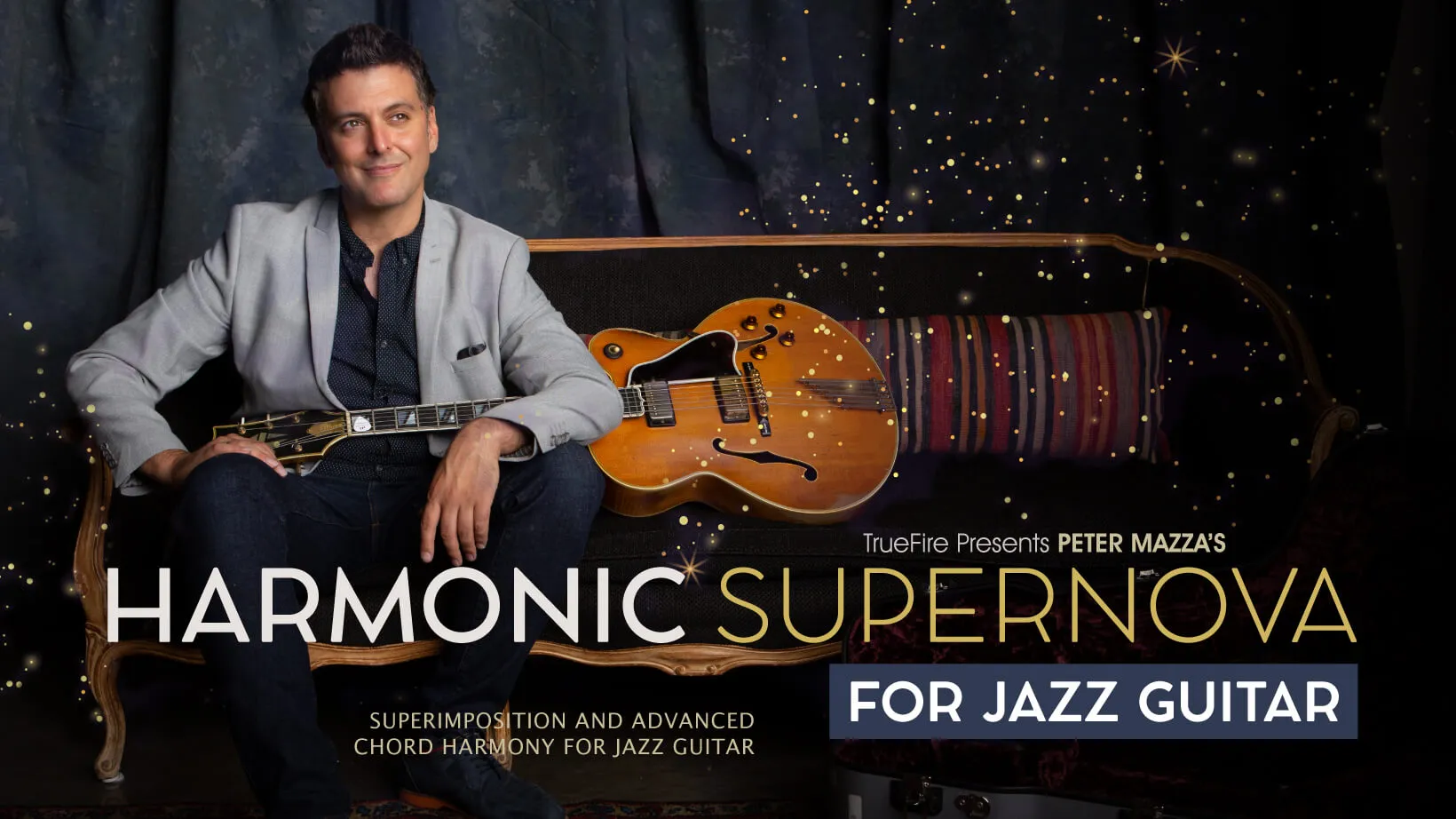
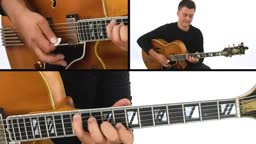
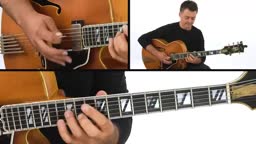
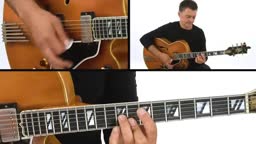
Whether you compose or arrange for solo jazz guitar, or play in ensemble settings, Peter Mazza’s Harmonic Supernova for Jazz Guitar will significantly enrich your harmonic palette with a comprehensive range of grips, superimposed chords, superimposed arpeggios, and a versatile vocabulary of chords voiced with specific tones voiced on top.
Peter Mazza is widely recognized for his creative and virtuoso interpretations of jazz standards as well as his own thoughtful compositions. "Blending clean and fluent lines with colorful chord voicings and driving pulse, he creates imaginative ensemble arrangements as well as lush solo guitar pieces.” We’re thrilled to welcome Peter to the family with his first TrueFire course, Harmonic Supernova for Jazz Guitar!
Peter kicks the course off with a quick jazz rhythm primer focusing on the Charleston Feel, Swing Feel, Triplet Feel, and Mixing Jazz Rhythms.
”While lush harmony often stands on its own in rubato playing, it takes on a whole new dimension when played with a deep swing feel and command of the rhythmic language of jazz. In this segment, I discuss the feeling of swing eighths, beat emphasis on 2 & 4 in 4/4, and the overview of three essential rhythms/rhythmic feels that will clarify yet deepen your sense of swing, time and rhythm while giving even more vitality to your harmonic choices.”
In the second and third sections, you’ll focus on several chord grip variations for both major and minor 2-5-1’s using approaches like raising or lowering a voice, using passing notes, adding simple melodic connections, and ascending voices.
”One of my teaching "mantras" is "advanced playing is mastery of basic things, not a basic understanding of advanced things". When it comes to voicings, this starts with knowing what Tuck Andress calls the "grip chords" for II V I VI progressions. I have two main ways I group these II V I VI progressions which I demo here. Then I move them through all 12 keys down in steps. We'll use these grips to delve into some advanced and interesting chords and techniques. We’ll also work with essential grip chords for IImi7b5 V7alt Imi VI7alt progressions in two main positions. I share some colorful voicings and sight some basic but creative chord-scale relationships that are a vital step towards thinking and playing advanced harmony.”
In the fourth and fifth sections, Peter introduces superimposed chords and arpeggios for minor and major 2-5-1s using drop two inversions, superimposed arpeggios, and consecutive voiced 7ths.
”I really drive home the concept that in advanced jazz harmony, that each chord in a II V I VI is its own key. I take a II V I VI progression in C Major and I sight the 4 keys used. Then I proceed to spell each chord up from its R 3 5 7 9 11 to 13. Any 4 consecutive notes inside a 13th chord, spell a seventh chord of some kind. I call the seventh chord arpeggios inside a 13th chord, arpeggio superimpositions. This concept has simultaneously been the most comprehensive in mastering harmony, and yet a fast track to accessing that mastery. It turns out that it's a great ear training and fingerboard study, plus it applies to both lines and chords! I’ll also perform the "golden sequence" of superimposed chords played in several ways. First in consecutive/root position, then as 1st then 2nd inversion drop 2 voicings. I blend arpeggios and chords to get a pianistic effect, and further spice it up with some cool rhythms!”
In the sixth section, you'll focus on expanding your vocabulary of chord voicings with specific tones voiced on top of the chord. We’ll voice thirds, fifths, sevenths, ninths, elevenths, and thirteenths on top as options. We’ll apply those options using a progression with both minor and major 2-5-1s.
”The backbone of many jazz standards is the diatonic cycle, or what we know as the first 8 bars of "Autumn Leaves". I break down this progression in detail. As part of that, I teach you secondary dominant 7th chords. I then spell out the notes in each chord in the progression played as 13th chord arpeggios so you have full access to all the notes on each chord. As part of this, I clarify some scale choices for dom7s. I also sight the use #11 on Major and Dom7s, and natural 9s on minor chords (including min7b5). I explain the importance of 13th chord knowledge to melodic soloing, given that chords change in jazz tunes, quickly. Add in how important it is to play with a swing feel and use space, I explain that it is infinitely more useful to think about intervals rather than scales on each chord, when setting out to play lyrical, motivic and swinging solos. In our final section, we’ll put all of the key approaches to work by applying our Harmonic SuperNova knowledge over a set of 4 performance studies.”
In the 7th and final section, you'll put all of the key approaches to work by applying your Harmonic Supernova knowledge over a set of 4 performance studies: Major Two-Five All Keys, Minor Two-Five All Keys, Bb Blues, and F Blues.
Peter will explain and demonstrate all of the key concepts and approaches along the way. You’ll get standard notation and tabs for all of the key examples and performances. Plus, you’ll be able to use TrueFire’s learning tool to sync the tab and notation to the video and can also loop or slow down the videos so that you can work with the lessons at your own pace. All the backing tracks are included to work with own your own as well.
Grab your guitar and let’s get our Harmonic Supernova on with Peter Mazza!
What you'll learn
Navigate voicings across different string sets and positions
Apply chord substitution concepts to create richer voicings
Use thumb fretting technique for bass notes in complex voicings
Understand how to superimpose arpeggios over chord progressions to create upper extensions
Recognize and apply upper structure triads within extended chords
Hi, I'm Peter Mazza. Welcome to Harmonic Supernova for Jazz Guitar.
Whether you compose or arrange for solo jazz guitar, or play in ensemble settings, this course will significantly enrich your harmonic palette with a comprehensive range of grips, superimposed chords and arpeggios, and a versatile vocabulary of chords with specific tones voiced on top.
In the first section, we'll start with a quick jazz rhythm primer focusing on the Charleston feel, swing feel, triplet feel, and mixing jazz rhythms.
In the second and third sections, we'll focus on several chord grip variations for both major and minor 2-5-1's using approaches like raising or lowering a voice, using passing notes, adding simple melodic connections, and ascending voices.
In the fourth and fifth sections, we'll work with superimposed chords and arpeggios for minor and major 2-5-1s using drop two inversions, superimposed arpeggios, and consecutive voiced 7ths.
In the sixth section, we'll focus on expanding your vocabulary of chord voicings with specific tones voiced on top of the chord. We'll voice thirds, fifths, sevenths, ninths, elevenths, and thirteenths on top as options. We'll apply those options using a progression with both minor and major 2-5-1s.
In our final section, we'll put all of the key approaches to work by applying our Harmonic Supernova knowledge over a set of 4 performance studies.
All the key examples are tabbed and notated. Plus, you'll be able to use TrueFire's learning tools, which sync the tab to the video and allow you to loop or slow down any segment of the video so you can work with the lessons at your own pace.
Grab your guitar and let's get started!
While lush harmony often stands on its own in rubato playing, it takes on a whole new dimension when played with a deep swing feel and command of the rhythmic language of jazz. In this segment, I discuss the feeling of swing eighths, beat emphasis on 2 & 4 in 4/4, and the overview of three essential rhythms/rhythmic feels that will clarify yet deepen your sense of swing, time and rhythm, while giving even more vitality to your harmonic choices.
This simple one bar rhythm is a great choice for comping and is a surprisingly accessible doorway into the language of infinitely more advanced swing/hard bop rhythms. In this segment, I teach you this basic feel and demonstrate some of its useful implications.
While there is no "universal rhythm" we agree that this is "the" swing feel. The composition of this 2 bar rhythm is so fundamental to swing/bop/hard/bop, that once it becomes second nature, it will open up your groove and reveal many other useful jazz rhythms. Mastering this rhythm will make other rhythms easier to learn and play. Inflection and the kinds of pick strokes are discussed, as they will make a huge difference in your playing. Watch this segment to refine your touch and groove so you sound like a "native speaker" of this language.
Triplets drive the feel in jazz and blues, whether in a blues shuffle, 12/8 rhythm or in swinging cymbal beat. In addition to being a soulful groove, this rhythm will challenge and help you get your triplet subdividing together.
With the ability to play the Charleston, swing and triplet feels, this video further explains and demonstrates how these rhythms can be applied, mixed and matched in a "call and response" musical dialog that emulates the interaction between the horn sections in a big band, condensed onto the guitar. As part of the presentation, my performance on blues changes uses some really colorful chord substitutions. I often tell students that harmony and rhythm are deeply interconnected!
One of my teaching "mantras" is "advanced playing is mastery of basic things, not a basic understanding of advanced things". When it comes to voicings, this starts with knowing what Tuck Andress calls the "grip chords" for II V I VI progressions. I have two main ways I group these II V I VI progressions which I demo here. Then I move them through all 12 keys down in steps. We'll use these grips to delve into some advanced and interesting chords and techniques.
Peter is throwing concepts at the speed of light. If we would be able to get all what he says on the fly we provably won't be here taking this curse. The fact that the platform provides tools to slow down o rewatch can't be an excuse to explain so much so fast. Rewatch several pieces multiple times because he's rushing is a terrible experience and says a lot about the teacher. I'm sorry but he could learn a couple of things about Frank Vignola's teaching style. Frank is indeed is a great teacher.
T
tjgqbyron
Verified buyer
08/11/21
This is an excellent deep dive into Jazz Harmony as applied on guitar and will pay dividends for years.
O
Osokin
Verified buyer
03/29/21
A Masterclass In Jazz Guitar Harmony!
Peter Mazza is a a superb jazz guitarist, and equally talented as a teacher. His approach to explaining harmony on the guitar is both clear and inspiring, and there is an enormous amount of valuable material to work through. This is a real masterclass in jazz guitar harmony, and one of the best courses on TrueFire!
M
mbon008
01/11/21
Genius at work
The guy is a genius. He knows all the chords and arepggios within split seconds, his technique is beyond most guitarists, highly intelligent, ina few seconds he can explain something puzzling you for years such as what to play on the autumn leave chords, not just the scales but the arpeggios and thousands of chord variations.
M
MAROBTON
Verified buyer
05/06/20
Excellent advanced jazz course
If you're already familiar with playing jazz and chord subs/tritone subs and looking to extend your chordal harmonic content, this is a great, well laid-out course. Huge amount of information. Some very unfamiliar but great chord voicings/leading. I have been waiting for a truefire course like this for a long time.