



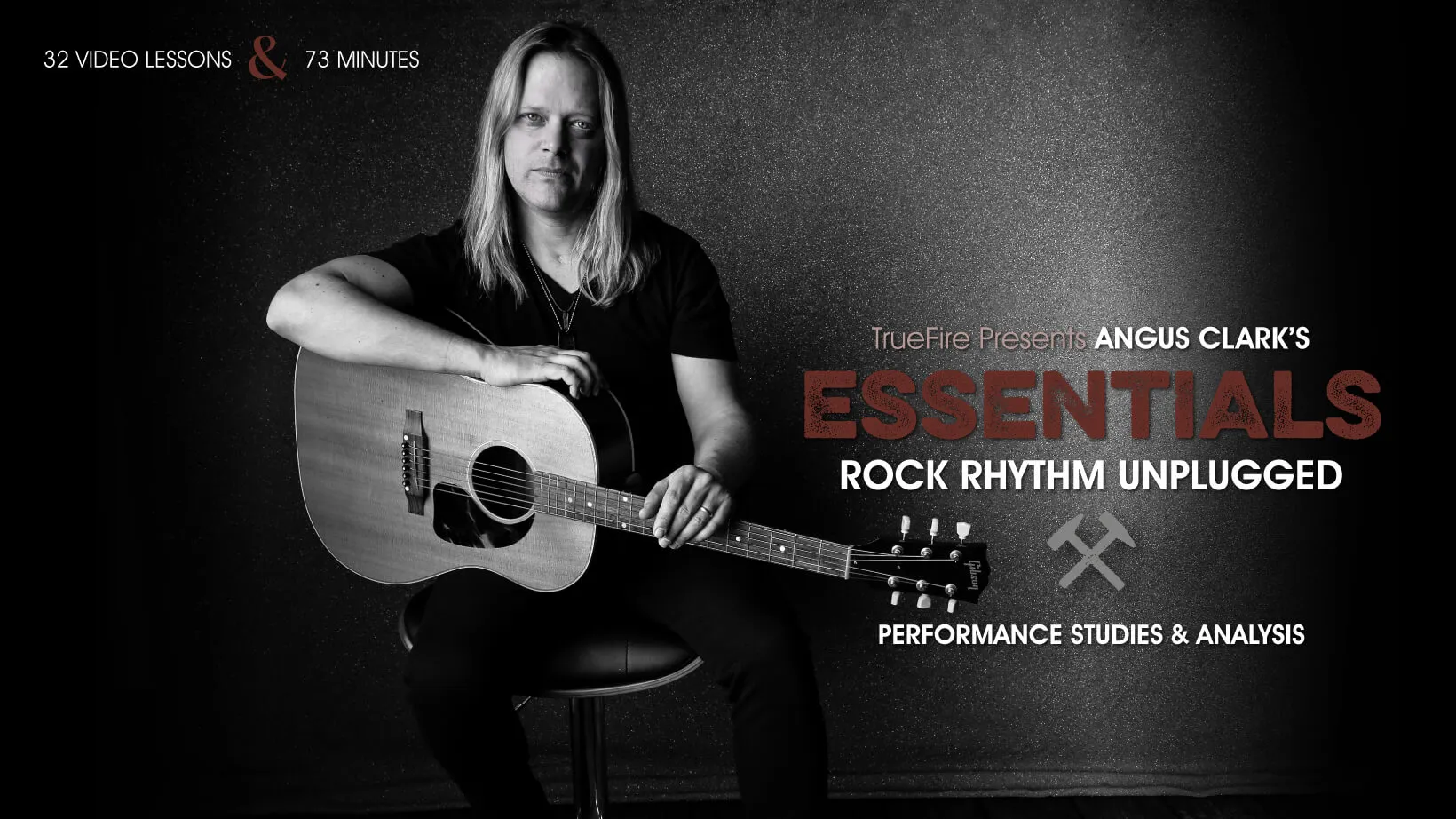

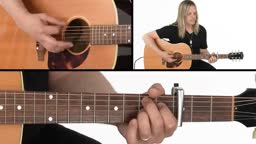

Essentials: Rock Rhythm Unplugged

Creative Approaches for Acoustic Rock Rhythm Guitar

Marty FriedmanTommy EmmanuelSteve VaiEric GalesEric Johnson

Get this course and 1,000+ more with All Access

Try 14 days free. Cancel any time.

Purchase Individual Course for $9.99
Essentials: Rock Rhythm Unplugged

About this course

Whether you’re the sole accompanist to a singer or part of an acoustic ensemble, you’ll have to approach your guitar arrangement with a much different mindset than you would in an electric setting.

In this Unplugged Rock Rhythm edition of Essentials, Angus Clark guides you through 10 performance studies that cover the essentials of acoustic rock playing with an eye towards crafting “unplugged” versions of songs originally produced in a full electric band setting.

“I was inspired to take up the guitar by rock music. So, the electric guitar became a part of how I connected to the music I loved, and the acoustic guitar was always 'second fiddle.' I had to play catch-up on my acoustic rhythm playing once it became apparent that everyone relies on a guitar player to be able to deliver a song on a solo acoustic guitar, or come up with an appropriate part should the ensemble need to deliver a song 'unplugged.'

We're going to focus on some fundamentals, as well as some advanced concepts for creating acoustic guitar arrangements. We're also going to look at the acoustic guitar playbook and work on tricks of the trade for an acoustic player that are not so commonly used on electric.”

Angus designed the following 10 performance studies to help you master key acoustic rhythm guitar concepts and techniques such as right-hand rhythmic approaches, syncopated accents, fingerstyle approaches, arpeggiated picking patterns, building up speed and precision, moving intervals against open strings to create color chords, percussive right-hand techniques, getting the most out of riffs and power chords, and crafting unplugged versions of electric guitar productions.

Angus will first demonstrate the performance study and then break it down for you emphasizing the key concepts and techniques. All of the performance studies are tabbed and notated for your practice, reference and study purposes. You’ll also get Guitar Pro files so that you can play, loop and slow down the tab and notation as you work through the lessons.

Grab your guitar and let’s get “unplugged” with Angus Clark!

What you'll learn

  • Use chord muting for percussive effect
  • Create a driving rock rhythm on acoustic guitar
  • Create dynamic unplugged versions of songs
  • Transform a complex track into a solo guitar arrangement
  • Develop versatile acoustic guitar techniques
Release date: 08/02/2017 • 1h 11m runtime
Start Course
Sample lessons
Just Talking
Just Talking
Performance
Disco
Disco
Overview
Disco
Disco
Performance
Disco
Disco
Breakdown

What's included

32 lessons • 10 charts

Essentials: Rock Rhythm Unplugged
Hi, I'm Angus Clark, and welcome to Essentials: Rock Rhythm Unplugged. I, like a lot of people, was inspired to take up the guitar by rock music. So, the electric guitar became a part of how I connected to the music I loved, and the acoustic guitar was always "second fiddle". I had to play catch-up on my acoustic rhythm playing once it became apparent that everyone relies on a guitar player to be able to deliver a song on a solo acoustic guitar, or come up with an appropriate part should the ensemble need to deliver the song "unplugged". That's what this course is about.

We're going to focus on some fundamentals and some advanced concepts that deal with creating a guitar arrangement. We're going to address some common mistakes that electric guitar players make when getting on an acoustic guitar. We're also going to look at the acoustic guitar playbook and what the tricks of the trade are for an acoustic player that are not so commonly used on electric, like the capo.

None of this is meant to be overly challenging, but the devil is in the details. String noise, dynamics, consistency, and precision are all fundamentals that some of us get lazy about when bashing away on an electric guitar surrounded by a band where there are cymbals ringing and lots of other instruments are covering our being sloppy in one way or another. So, let's get back to basics and see how we can have fun with the acoustic six-string.

I'm using a Gibson J-45 for this course, with light gauge strings (.011 is the top string I believe). For an electric player, there's no reason to make this overly hard for your hands. Gibson’s have turned out to be my top choice for a combination of ease of play and tone. I am a long-time Martin fan, and I still love the sound and the vibe, but they are usually a bit more challenging to play. The audio here is a combination of mics and the LR Baggs pickup in the guitar, which is a great pickup system.

I'll perform every piece and then break it down for you. I'll show you the techniques used, and the decision-making process that goes into crafting your own unplugged versions. All my performances are tabbed and notated as well. So, grab your guitar and let's get started!
Cowboy Chords
"I'm just a cowboy, lonesome on the trail..."

When Phil Lynott sang these words on Thin Lizzy's Jailbreak (the greatest album ever made), it makes you think of that beat up six-string being played by the light of a fire on the open range.

Let's look at what's really at steak (get it?) in creating that magic all by your lonesome self, and conversely how in an ensemble the expectations regarding your right hand are so different than they would be on an electric guitar.
Cowboy Chords
This etude is in two sections. The A section is a typical strumming pattern with sixteenth note subdivisions, the B section is a more eighth note driven build. The chords used are all open voicings, what I usually refer to as the "cowboy chords", and they should be some of the first chords you ever learned on the guitar. In revisiting some of this material, I want you to take a fresh look at how precise you can be in changing chords, and how there's a real difference between a Cadd9 chord and an ordinary barnyard C.

In the right hand, we're going to focus on how to avoid accenting the upstrokes. This kind of strumming gets its relaxed vibe from the emphasis on the 1-2-3-4, rather than anything in between. The subdivisions are there, and we want them in the pocket, but we don't want the offbeat accents to stick out. I've been called out on this more than once by singers or bandleaders that want the acoustic guitar part just tucked in the mix like a tambourine. Keep it smooth, people!
Cowboy Chords
Lessons in this breakdown:

Right Hand - do not accent the up-strokes.
Left Hand - shoot for "zero time" between the chords. Mute any unused low strings.
Transition to the B section - watch out for your feel (speeding up or slowing down) when you transition from the A section to the B section and back again.
Up High
In this example, we'll start adding some accents and look at some voicing that use open strings as common tones across chords.
Up High
The first section features a more accented right hand part than the last example, but the downstrokes still get more emphasis than the upstrokes, so keep it smooth, people!

Keep track of the changing tones in each chord voicing:
Aadd9 to A major - open B string changes to fretted C#.
E major to E sus - G# changes to A on the third string.
Dadd9 to Dm7add9 - D changes to C# on the 2nd string.

The second section uses chord inversions and open strings as common tones, with a less accented strum. Pay attention to the anticipations (chords that come before the downbeat).

E/G# - notice the muted 5th string.
Aadd9 - notice the muted 6th string.
F#min7add11 - muted 5th string.
We're using the open 1st and 2nd strings across the whole progression! Great way to keep your hand from getting tired.
Up High
We're actually in A major, sorry.

Lessons in this example:

Syncopated rhythms - keep the tempo and feel together while keeping it light!
You're backing up a singer.
Open string chord voicings - actively seek out opportunities to use open strings.

+ 25 more lessons

Start Course

Reviews

13 results

Addahia

Verified buyer

11/13/24

Nice practice for acustic

Angus is a grate teacher. This course thas not have the complexity of other Angus clasess but it is a good companion as warm ups befoer doing other kind of lessons and it is an all around enjoyable, fun and chill journey.
ArminNiewisiewicz

Verified buyer

10/22/22

Great course with great lesson

DanieleBenedetti

Verified buyer

08/24/21

very recommended if You want to improve your rock acoustic guitar style and approach

I really like Angus teaching style as it is always direct and clear and provides often direct reference to real "musician life" and how to apply the provided material to the musician real life. Examples and studies are, as usual from Angus, very high quality and, most important, real fun to learn and play! I highly recommend this course to anyone wants to improve his/her approach on rock acoustic guitar and on guitar in general.

Gonzarelli

Verified buyer

01/27/21

Rock Rhythm Unplugged

This course is really good in getting the difference in approach to acoustic from electric in a rock setting. From watching Angus I get the importance of proper timing in playing this style. This course has been invaluable in learning how to play rock acoustically.

PowerPop K.

01/01/21

Best TrueFire Surprise Ever, Sequel Please!

If there was one TrueFire course that went far beyond any expectations I had, it’s this one. Angus teaches solid strategies with an emphasis for situations were you may need to develop an acoustic guitar arrangement for a song that perhaps didn’t have an acoustic guitar focus. By the time I finished this course, my confidence in dealing with those situations improved dramatically. I can’t count the number of times I’ve applied what I learned here in a real-world situation. The best advice I can give for this one, is don’t get so immersed in learning how to play one of the lessons properly that you miss the concept that Angus is trying to get across. Having said that, I now use many of the lesson “etudes” as either warmups, or in the case of the more challenging ones, items to pull out occasionally to brush up on technique. The short story though is that this course far exceeded my expectations and continues to pay off dividends. And if anyone from TrueFire happens to read this, I believe a follow-up “part 2” for this course would be a very welcome addition!

Stop searching. Start improving with All Access.

Try 14 days free. Cancel any time.