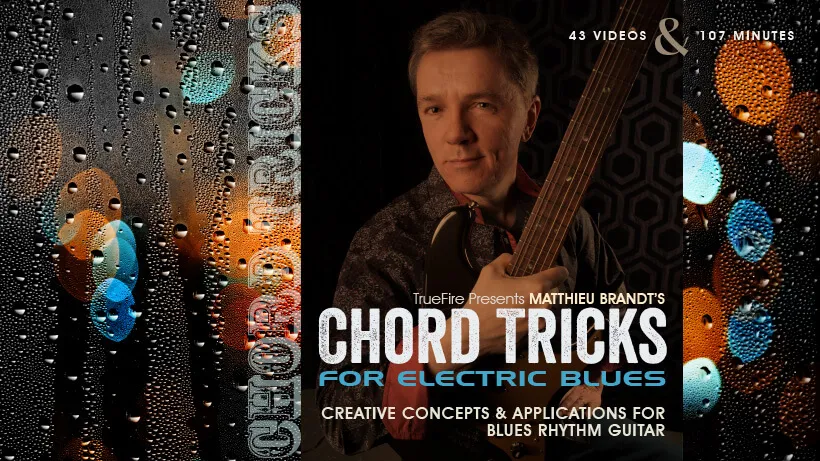
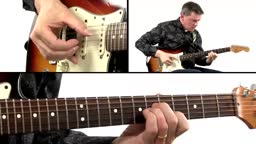
Blues guitarists play a lot of rhythm guitar parts across a wide variety of tempos, feels and ensemble settings. Because most blues tunes follow a fairly similar I-IV-V format, players need a large vocabulary of creative rhythm approaches to keep the tunes distinctive and engaging to the ear.
Matthieu Brandt’s Chord Tricks for Electric Blues Guitar focuses on chord concepts and tricks that give you fresh and original ideas to create backup parts for jamming and playing with your band.
”We'll look at tricks to add melodies to a chord progression and create alternatives to cliche strumming parts, learning to adjust the tricks you use to the rhythm of the song. We'll also borrow chord tricks from the Hammond organ and piano players, dig into chord tricks that are pitch range specific, and study chord concepts used by players like Robben Ford and Eric Johnson. We'll also examine Western Swing influenced backup parts and use triads from the parent key to create beautiful textures.”
Matt organized the course into two sections. In the first section, he overviews all of the chord tricks covered in the course: Arpeggiate, Dominant Seventh Triads, Mixolydian Triads (Parent Key), Thick Backup, Rhythmic Pattern Playing, Pluck and Divide, Shaping Melodies, Open Up The Neck, and Green Triads.
In the second section, you’ll work through 14 Rhythm Performance Studies where you’ll apply all of the chord tricks covered in the first section.
CHORD TRICK #1: Bayou - “For our chord trick in 'Bayou', we'll be arpeggiating the chord in a clear pattern while filling up the harmonic space gradually.”
CHORD TRICK #2: Thick Mash - “In this example, we interact with the bass player by playing thick inversions of dominant 7th chords and using rhythmic pattern playing to create space.”
CHORD TRICK #3: Funky Robben - “Robben Ford is known for his inventive use of chords in a blues setting. He often colors his chords with extensions, leaves out the root and plays partial chords harmonized within the scale.”
CHORD TRICK #4: Western Swing - “Blues guitarists borrow chord tricks from all kinds of sources. Western swing has had a huge influence on the chord tricks used in jump blues, rockabilly, and other danceable blues styles.”
CHORD TRICK #5: New Orleans Gumbo - “This example shows you how to tackle a New Orleans type groove with dominant 7th triads. Playing improvised patterns with small triad shapes gives you the best chance to be heard, but not get in anybody's way.”
CHORD TRICK #6: The Parent Trap - “Here's one of the more complicated examples of a chord trick in action. We're working with triads from the parent key in an uptempo train type groove.”
CHORD TRICK #7: Lock And Wood - “A number of Chicago blues players from the 50's were real pioneers when it came to using chord tricks on guitar. Robert Junior Lockwood was surely one of them. His backup parts featured some inventive melodic chord work that still stands tall today.”
CHORD TRICK #8: Up Or Down - “Choosing a pitch range has a huge influence on how good a backup part will sound. You can go low and match your accompaniment with the bass player, or go high and create melodies without being in anybody's way.”
CHORD TRICK #9: Minor Infringement - “In this example, we'll be using inversions and chord voicings to create melodies on top and in the middle of a chord in a minor blues.”
CHORD TRICK #10: Help My Onions - “You can use the open strings as a pedal bass note, play melodies on the top strings, play barre chords without a barre, and color chords up the neck with the open strings.”
CHORD TRICK #11: Green Groove - “In thick arrangements or when you're playing uptempo, it doesn't make any sense to play full barre chords or chords with extensions.”
CHORD TRICK #12: One Chord Power - “Here's a trick you can use when you're playing backup on top of a one-chord vamp.”
CHORD TRICK #13: Major Upset - “Chord tricks can be used in a so-called "special chorus". This is a part of a song that is composed, where everybody plays a specific rhythm or solo riff.”
CHORD TRICK #14: Piano Organ Boogie - “When you want to lay low but still play some intense colors, you can target the tritone intervals of the dominant 7th chords you're on.”
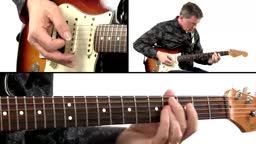
Matt will demonstrate all of the Performance Studies for you and then break them down part-by-part. All of the key examples and Performance Studies are tabbed and notated, plus you’ll get all of the jam tracks to work with on your own. You’ll also get Guitar Pro files so that you can loop and/or slow any section as you work through the lessons.
Grab your guitar and let’s trick up our blues rhythms with Matt Brandt!
What you'll learn
Play complex 7th and 9th chord voicings on middle and upper strings
Apply voice leading principles to chord progressions
Execute Freddie Green style rhythm guitar technique
Play rhythm guitar appropriate for thick arrangements and uptempo songs
Understand how ear memory creates compound harmonic sounds
Hi, I'm Matthieu Brandt and welcome to Chord Tricks for Electric Blues Guitar. As blues guitarists, we need to adjust our rhythm parts to the situations we play in. This course focuses on chord concepts and tricks that give you fresh and original ideas to create backup parts for jamming and playing with your band. All the chord tricks to fit in and stand out!
We'll look at tricks to add melodies to a chord progression and create alternatives to cliche strumming parts, learning to adjust the tricks you use to the rhythm of the song. For instance, dominant seventh triads work great in a New Orleans type second line groove.
In this course, we'll also borrow chord tricks from Hammond organ and piano players, dig into chord tricks that are pitch range specific, and study chord concepts used by players like Robben Ford and Eric Johnson. We'll also look at Western Swing influenced backup parts and use triads from the parent key to create beautiful textures.
In the first section, I'll start out by giving you an overview of all the chord tricks in the blues book. In the second part, I'll give you 14 original songs showing you the tricks in action. And as always, this course comes with backing tracks, tabs, and extra information. Let's get busy!
The easiest trick in the book to extend your blues backup playing is to play the notes of the chord individually instead of strumming the whole chord. Pick and choose your notes and stick to the pattern.
A dominant seventh triad is a four note dominant seventh chord (root, major third, perfect fifth, and flatted seventh) of which one note is removed. The remaining notes form triads that can be found all over the neck.
Triads from the parent key can be added to your dominant seventh chord to add colors to it. A dominant seventh chord functions as the V chord in what is called a "parent key" (e.g. C is the parent key of G7, because G7 is the V chord in C).
Thick inversions of dominant seventh chords can be used to create a "special chorus", and are very suitable for smaller settings.
Where you play is even more important than what you play. The trick is to know where to stick the chords and to create patterns.
Playing partial chords is easy when you use your fingers to pluck and divide the chord. It's a simple technique to create melodies on top of chords and also create bass lines.