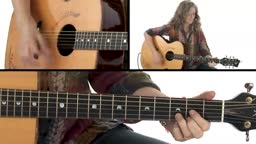
If you’re playing covers or composing your own original songs, you’ll eventually reach a point where your acoustic guitar parts start to sound bland and uninspired. That’s the time to pull out Vicki Genfan’s Acoustic Rhythm Guitar Cookbook for an immediate fix and a healthy dose of creativity and inspiration.
Because most songs use the same basic chords and progressions, you need to apply other creative approaches to spice up your guitar parts. Applying harmonic and rhythmic embellishments is the most common and effective way to make your parts sound distinctive and interesting.
”I designed this course to introduce you to 23 harmonic and rhythmic embellishments that will add new flavor and new possibilities to your guitar parts. I've chosen 10 popular chord progressions across 20 performance studies to give you an idea of how you might put these "ingredients" to use in songs you're working on, already playing, or writing.”
Vicki organized the course into 10 sections. Each section features a popular chord progression and two performance studies. The performance studies demonstrate how to apply one or more harmonic and rhythmic embellishments to breathe new life and energy into your acoustic guitar parts.
Over the 20 performance studies, you will learn how to apply: Color Tones, Syncopated Strums, Muted Strums, Hammer-Ons, Muted Plucks, Body Percussion, Bassline & Hammers, Muted Bassline, Fingerpicking Pattern, More Complex Fingerpicking, Half-Barre Chords, Simple Melody Line, More Complex Melody Line, Open String Hammer Fills, Harmonic Slaps, Travis Picking Pattern, Harmonics, Simple Chicken Scratches, and Syncopation & Scratches.
For each progression and set of performance studies, Vicki will first show you the basic guitar part for that progression and then demonstrate the performance studies with embellishments applied. All of the performance studies are followed by a detailed breakdown
All of the performance studies are tabbed and notated. You can also loop or slow down any of the videos down so that you can work with the lessons at your own pace.
Grab your guitar, and let’s cook up some cool guitar parts with Vicki Genfan!
What you'll learn
Execute barre chords at the 7th and 3rd frets
Execute quick hammer-on and pull-off combinations within trills
Use pinky for hammer-ons while maintaining volume consistency
Transition smoothly between chords while maintaining melodic flow
Incorporate additional eighth notes into melodic lines
Hi, I'm Vicki Genfan. Welcome to the Acoustic Rhythm Guitar Cookbook! I designed this course to introduce you to 23 harmonic and rhythmic embellishments that will add new flavor and new possibilities to your guitar parts. I've chosen 10 popular chord progressions across 20 performance studies to give you an idea of how you might put these "ingredients" to use in songs you're working on, already playing, or writing.
Listen to what this progression might sound like with the "basic" chord shapes and a very basic strum. In the first study, we'll add color tones and a new strumming pattern, and in the second study we'll add a bit more syncopation to the strumming pattern.
Can you tell which beat the accent is on? How do the color tones change the feeling of this progression? Does it seem more interesting to you?
Just play the strumming pattern over an Am chord and work on getting the accents down on the 1st and 3rd beats. Then, you can work with changing chords. Since we're playing 16th notes, we count using the syllables, "1-e-and-a-2-e-and-a..." etc. You can use a pick or just your fingers to strum. Try not to hit the 5th and 6th strings when you're strumming the D chord, with its root note on the 4th string!
Our second "accent" is now one 16th note earlier! Because it's no longer on a down-beat, it adds a feeling of syncopation or a more complex rhythmic feel.
Our first accent remains on the "1". Our second accent comes on the "a" of the second beat. If it helps you to count out loud, or in your head, then do so. For some of you, it just works best to listen to what I'm playing and then copy it.
Here's one example of a "basic" version of this progression. In the first study, we'll add color tones and right hand muting technique. In the second study, we'll add hammer-ons.
This is a great all-arounder for acoustic guitarists, which shows you a lot of common chord progressions and how to strum them and spice them up with various techniques. Very fun.