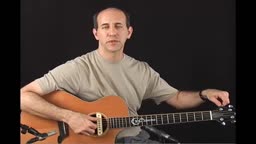
The polyphonic, melodic and rhythmic characteristics of guitar supply a never-ending source of inspiration, creativity, and invention. Triggering the creative process, however, is not easy — we've all experienced the guitarist's equivalent of "writer's block" in all aspects of our playing. If your creative juices have been a little drippy lately, rejoice because your fix is in hand. Fingerscapes' rut-busting, invigorating curriculum will cure all that ails your originality.
Fingerscapes is a cerebral course of study for guitarists across all styles. For the left brain; a palette of tools and techniques for rousing creativity. For the right brain; an "imaginarium" to stimulate invention.
Fingerscapes is also chock-full of paradoxes. You'll learn fingerstyle moves, but this is not necessarily a fingerstyle course — flatpickers are more than welcome. You'll work with open tunings, but this is not an open tuning course. You'll learn how to compose original tunes, but no harmony and theory here. The entire curriculum is presented on acoustic guitar, but feel free to plug in the electric, pump up the volume and wail away.
Your Fingerscapes tour guide, Richard Gilewitz is widely respected as one of the most graceful fingerstyle guitarists on the contemporary scene. Gilewitz has collaborated and appeared in concert with the likes of John Renbourn, Mose Allison, John Fahey, Leo Kottke, Adrian Legg, The Little River Band, Taj Mahal, John Hammond, Rory Block and Jorma Kaukonen. Richard is also an excellent instructor with an innovative approach for communicating and demonstrating conceptual approaches for guitar-centric composition, improvisation, and performance.
During your Fingerscapes adventures, you'll play your way through a variety of motifs and "grooves" to learn how to develop your own twists, turns, and original inventions. You'll improve your creations in multiple tunings, spanning open G, C, and D — as well as Drop D and standard. You'll discover how to push yourself out of the comfort zone and propel yourself to the creative zone.
You'll learn how to texturize and colorize your compositions and improvisations using techniques such as note accenting (for vivid 3-D effects), right-hand arpeggiated patterns, finger pairings, pinch patterns, hammer-ons, rolls, pull-offs and alternating bass styles. You'll even learn a little slide to spice up your Fingerscapes.
Rejuvenate with Fingerscapes!
What you'll learn
Play complete fingerstyle compositions in multiple open tunings
Play with dynamic contrast and phrasing
Apply finger substitution to avoid right-hand tangles
Understand how to compose using positional concepts
Develop personal variations on written arrangements
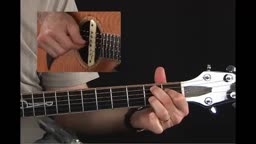
This exercise performs one of the most common patterns in fingerstyle guitar. The rolls. An inside and forward roll, common in banjo picking, blues and country picking and a multitude of other styles such as ragtime should be played repeatedly until it is virtually second nature.
Here I have used a simple E, A and B7 chord progression for the inside and forward roll patterns but feel free to use many other chord formations as long as you remember the concept of the two rolls. Also, remember to use your right hand fingers m and a for strings 2 and 1 respectively. A metronome would be of great benefit, particularly with this exercise.
The goal of this simple exercise is to allow the right hand fingers to flow from a stable right hand position. It is a great idea to practice a shift in the right hand from positions one, to two, to three as well as moving the thumb between strings 6, 5, and 4 while maintaining a first position for the right hand fingers.
Do not forget to attempt multiple variations of the arpeggio with different chords as well keeping in mind that as long as there is at least two fingers following a thumbstrike it can qualify as an arpeggio fragment.
This exercise performs one of the most common patterns in fingerstyle guitar. The rolls. An inside and forward roll, common in banjo picking, blues and country picking and a multitude of other styles such as ragtime should be played repeatedly until it is virtually second nature.
Here I have used a simple E, A and B7 chord progression for the inside and forward roll patterns but feel free to use many other chord formations as long as you remember the concept of the two rolls. Also, remember to use your right hand fingers m and a for strings 2 and 1 respectively. A metronome would be of great benefit, particularly with this exercise.
The goal of this simple exercise is to allow the right hand fingers to flow from a stable right hand position. It is a great idea to practice a shift in the right hand from positions one, to two, to three as well as moving the thumb between strings 6, 5, and 4 while maintaining a first position for the right hand fingers.
Do not forget to attempt multiple variations of the arpeggio with different chords as well keeping in mind that as long as there is at least two fingers following a thumbstrike it can qualify as an arpeggio fragment.
This exercise utilizes the left hand fingers to perform a hammer on and pull off technique. This is very common among fingerstyle players and there are often multiple variations with this technique such as double hammer ons, slides and bends.
It is very important during the hammer ons to have the right thumb strike the bass note precisely at the time the left hand hammer on note occurs such as on beat 2 in measure 4.
This exercise utilizes the left hand fingers to perform a hammer on and pull off technique. This is very common among fingerstyle players and there are often multiple variations with this technique such as double hammer ons, slides and bends.
It is very important during the hammer ons to have the right thumb strike the bass note precisely at the time the left hand hammer on note occurs such as on beat 2 in measure 4.
The entire purpose of this exercise is to teach the importance of the right hand position and remind the student to extend the thumb to the left so as to avoid interference with the right hand index finger. You can also maintain a steady 'thumping' sound and consider accenting one right hand finger louder than another for depth.
An E, A and B7 chord is utilized on the left hand to create some movement and fluid changes are a goal to strive towards along with an optional right hand shift from more of a classical position to a percussive attack.
The entire purpose of this exercise is to teach the importance of the right hand position and remind the student to extend the thumb to the left so as to avoid interference with the right hand index finger. You can also maintain a steady 'thumping' sound and consider accenting one right hand finger louder than another for depth.
An E, A and B7 chord is utilized on the left hand to create some movement and fluid changes are a goal to strive towards along with an optional right hand shift from more of a classical position to a percussive attack.
... piecses with different open tunings ... really fun to play ...
i like it very much - good job richard ;-)
I
IvanGuselnik
08/31/19
Rejuvenate with Fingerscapes!
Richard Gilevich is a wonderful guitarist, original composer and a great teacher. In this course you will find a lot about open tuning, finger picking, chord progression, rhythm and much more. It is unlikely to suit you if you just picked up a guitar, but if you have some experience, you will discover a lot of new things.