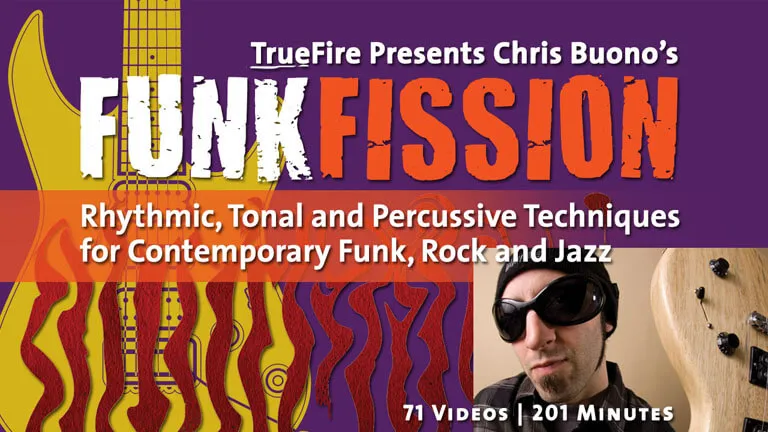
Funk Fission

Rhythmic, tonal and percussive techniques for contemporary funk, rock and jazz

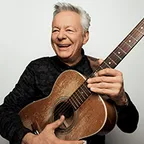
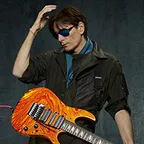
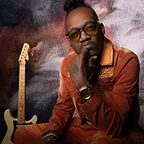
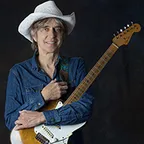
Marty FriedmanTommy EmmanuelSteve VaiEric GalesEric Johnson

Get this course and 1,000+ more with All Access

Try 14 days free. Cancel any time.

Purchase Individual Course for $9.99
Funk Fission

About this course

Welcome to the percussive, rhythmic, textured, chicka-whacka world of Funk Fission from monster player and top educator Chris Buono. Don't let the title of this study program fool ya -- this is NOT a "funk" course (although funk guitar freaks will indeed flip over this one). Rather, Buono's curriculum of funk guitar lessons is designed for intermediate to advanced players who dig and play any form of "groove-based" music; be it rock, blues, jazz, R&B, and of course funk.

Many of the techniques, rhythmic and percussive concepts that you will learn how to play in Funk Fission are culled from the combined genius of Jimmy Nolen, Catfish Collins, Wayne Krantz, Dave "Fuze" Fiuczynski, Avi Bortnick and Mick Goodrick. Tweaking tonal textures with motion control, sequenced filters and other effects follow in the footsteps of The Edge, Vernon Reid, Bill Frisell, Nels Cline and Oz Noy. Buono has devoted many years to studying, documenting and assembling this comprehensive one-of-a-kind curriculum.

Today's groove-based musical landscape is generously spiced with a wide variety of new techniques, syncopated rhythms and tonal textures. Funk Fission covers the full palette of techniques, grips, moves, voicings and effects required to color your rock, blues and jazz grooves with that distinctive contemporary funkified flavor.

Chris teaches you how to play great funk guitar by taking you to school on scratches, string percussion, super-staccato hybrid picking, punch comping, single note hybrids, thumb slaps, pops, combination palm punches, percussive snaps, down-stroke picked muted bass notes, chord stabs, fret-hand finger smacks, thumb mutes, single-note chromatic approach tones, pitch modulation, whammy bar expressions, ring modulation, motion controlled effects, frequency sweeping, time-based effects, amplitude modulation, sequenced filters and pitch shifting.

If the preceding list of key learnings reads like a foreign language to you, fear not - Buono, a former top instructor at Berklee College of Music, is extraordinarily gifted at breaking it all down in easy-to-digest bite-size chunks. Chris has organized the course true to TrueFire form where you'll play your way through the material, learning something new and then immediately applying it in a musical context working with the practice rhythm tracks, tab, and notation he has prepared for students.

Whatever your preferred style, Funk Fission will supply all of the individual elements you'll need to bring texture, groove and rhythmic energy to your compositions, performances, and improvisations.

What you'll learn

  • Play second inversion triads and extended chord voicings
  • Apply chromatic voice leading within chord progressions
  • Use geometric diagonal patterns for efficient chord transitions
  • Add organic feel through quarter-step pitch modulation on chords
  • Analyze complex chord voicings from multiple theoretical perspectives
Release date: 06/12/2009 • 3h 20m runtime
Start Course
Sample lessons
The Basics
The Basics
String Percussion
The Basics
The Basics
String Percussion Performance
The Basics
The Basics
String Percussion Breakdown
The Basics
The Basics
Punch Comping Performance

What's included

71 lessons • 29 charts • 12 Jam Tracks

Funk Fission
Hello and welcome to the effect-laden, chicka-whacka world of Funk Fission. In this course you will discover the ins and outs of playing in today’s groove based musical landscape with some uniquely innovative tools. Many of the concepts presented in this course are culled from the genius of modern day warriors like Wayne Krantz, Dave “Fuze” Fiuczynski, Avi Bortnick and Mick Goodrick; as well as hearkening back to pioneers like Jimmy Nolen and Catfish Collins. These approaches are somewhat like a Transformer—there’s [way] more than meets the eye. Within the tornado of syncopated chaos that makes up the music I present throughout this course is my own set of gig-tested concepts that are adorned with quirky titles such as string percussion and punch comping.

While some of the techniques are in your face, many interdependently lurk beneath the surface and come together to create a head-scratching approach that leaves anyone within earshot not exactly knowing what just happened, but lovin’ it nonetheless. These underlying subtleties help make this entire approach the funk-ified fission-like event that it is. Like nuclear “fission,” the various techniques that comprise this approach produce a significant synergistic discharge of groove-approved energy that is released into the galaxy where all funk breaks loose!

With carefully chosen effects of strange nature like motion controlled and sequenced filter effects, the alternative playing techniques of Funk Fission are extended tenfold. These concepts follow in the footsteps of modern day ‘sonicavengers’ such as The Edge, Vernon Reid, Bill Frisell, Nels Cline, and Oz Noy by enhancing the guitar-centric techniques contained in Funk Fission with forward-thinking brainstorms that were assembled to help bring out the sonic deviant in all of us. To give you a real-life glimpse as to what you can do with these ideas, along with the content created for Funk Fission are various tracks I played on in different scenarios that feature the conjecture being presented.

So suit up, plug in, and get ready to work. Throughout Funk Fission you’re hands will be busy as will your mind. From complex pick hand maneuvers to conscientious fret hand antics to advanced whammy bar wrangling—we’re gonna get fonky!
The Basics
In this first series of lessons dubbed "The Basics" the goal is to get you off on the good foot. Starting things off is an in-depth probe into an often overlooked rhythm technique I call “scratches” where your fret hand lightly rests on top of the strings, thus dampening them, while your pick hand rifles through a 16th note alternating up and down motion. You know, that chicka-whacka thang! But, hold on, there’s more to it than you think. From closely examining the angle in which the pick hand makes contact with the strings to learning about “chord stabs” within consecutive 16th note forays, we go deep while preparing for the jam track in the following segment.

After defining the art of the scratch and exploring it’s finer details, I will turn you on to two of my favorite alternative voicings for stock min7 chords—the min7(4) and the min7(4/11). These combinations of stacked 4ths and 5ths will be utilized throughout this course so be sure to get them under your fingers.
The Basics
Here’s where you can put those scratches into action while testing out the min7(4) voicing I showed in the previous segment. With a simple drum sequence comprised of consecutive 16th notes played by a snare and kick drum, I play a 5th position Dm7(4) as a chord stab for two bars at a time emphasizing a specific 16th note subdivision that is marked by the snare. Throughout the drum sequence the snare’s placement within the set of four 16th notes per beat shifts every two bars. Starting with a ‘downbeat stab’ for two bars, I continue stabbing the Dm7(4) through the next three subdivisions within the remaining six bars.

Take note, while the term downbeat is used universally to describe the actual pulses to which we equate beats, I, along with most of the working musician community, also use the term to describe just the first pulse of an organized group of beats (meter). Keep that in mind throughout this course as I often freely interchange between the two meanings.
The Basics
In this breakdown I make sure the concept of the chord stab is clearly defined. The catapult-like interaction between the striking of the strings by the pick hand and the almost immediate release of the chord held down by your fret hand is what makes this technique so funky. With this tight, super-cool tool in your arsenal don’t be surprised if Sco is calling you when Avi Bortnick can’t make it!

John Scofield
Avi Bortnick
The Basics
Did you know, in addition to all the possible pitches you can produce with your axe, you hold in your hands a wealth of percussive tones, too? While laying your fret hand over the strings to mute them, scratch-strum different sections of the six strings and listen to the ensemble of string percussion that awaits. By varying the location of where you strike the strings when utilizing scratches to propel the groove, you open up a whole new set of tones that enhance the overall sonic picture. This approach comes especially handy when playing one chord vamps so common to groove based music and injects some variation without interrupting the almighty pocket to which you’re ultimately responsible to deliver and maintain.

Speaking of those one chord jaunts, in addition to varying the locations where you scratch the strings, this approach will open the doors to playing various chunks of the chord making that static harmony sound like so much more.
The Basics
Combing an enhanced scratch approach with some clever fingering embellishments on each chord played, this segment will provide you some very cool ideas for one-chord vamp playing as well as fodder for new riffs and maybe even harmonic soloing ideas.

Played over a very cool, scratchy vinyl record induced backing track, I explore the ideas introduced in the previous segment and more. For instance, in addition to the Dm7(4) and Dm7(4/11) chords, you see how the tried-and-true drop 3 Dm7 to Dm9 idea can be made to sound fresh. If that wasn’t enough, the last time around (fifth set of four bars) I introduce ways to utilize a chord’s full potential, in this case the Dm7(4/11), by injecting added notes that create an array of small harmonic chunks that are exploited within this technique of strategically attacking various registers of the six strings.

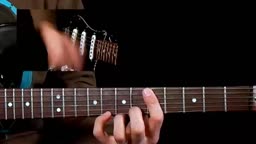
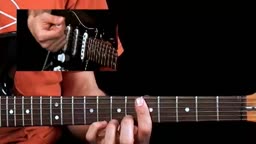
Keep a close eye on my pick hand and check out how I consistently employ a 16th note up and down motion whether I’m making contact with the strings or not. This approach is vital to establishing and maintaining a solid, deep pocket as well as helping me keep good time. Lastly, watch for the open strings I sneak in occasionally to throw in a timbral curve ball!
The Basics
After checking out the String Percussion Performance, hopefully you got down with the backing track on your own and went off on a scratching binge or maybe experimented with embellishing a given chord to the point you forgot what chord it is your embellishing in the first place. But now let me reel you back in and establish the concept of order by way of moments comprised of mini composition that are fueled by calculated variations. Huh? Let me explain …

The idea is to choose and capture sets of cool scratch and embellishment ideas and repeat them within a certain amount of bars—usually in even numbers divisible by two—thus creating mini compositions (see Fig. 1). From there, you can either slightly permutate the idea or move forward and improvise a new idea all together. Either way, by creating and repeating recognizable chunks contained within two-, four-, or eight-bar boundaries you are conveying chordal ideas that will be memorable and will stick like audible glue. Whether you’re playing with just drums and bass, a full ensemble that includes horns and keys, or even just laying grooves to accompany yourself singing, memorable parts is good stuff for everyone including your listeners.

+ 64 more lessons

Start Course

Reviews

4 results

dwa79

Verified buyer

12/08/23

Not Just Funk

Lots to learn and Chris not only breaks it down but makes it fun
TheWolf2103

Verified buyer

03/13/21

Funk Fission

Great ideas to freshen up and expand your funk chops - great demonstration and presentation.

A M.

Verified buyer

02/16/18

Mr Buono's effortless ways to, both, playing and teaching come from his heart. This course is a revelation to open your mind to a world of groove and funky rhythm. One of the best rthym guitar video I've always found.

Mehdi M.

Verified buyer

05/30/14

what a brilliant course, worth every penny and more. Chris Buono is an awesome teacher and an even more awesome player,l he explains everything thoroughly. so many cool riffs here fun for days, years, decades to come. true fire is truly the best guitar site and course are out there, they all come with full jam sessions breakdowns powertabs, nothing left to chance, amazing stuff, keep up the great work guys. cheers Ed North Vancouver, BC, Canad

Stop searching. Start improving with All Access.

Try 14 days free. Cancel any time.