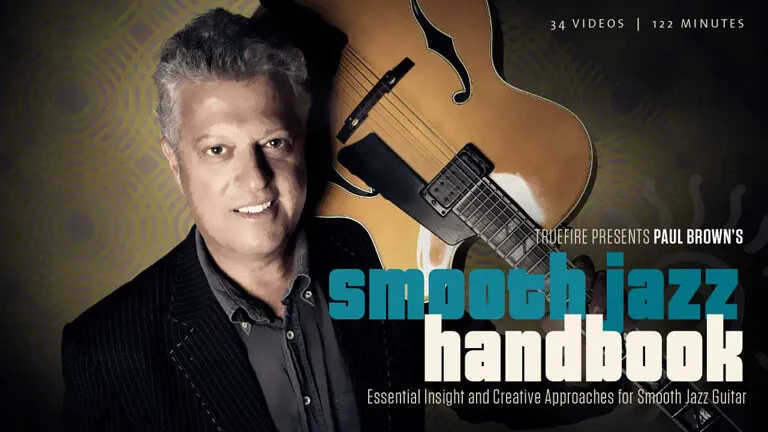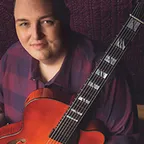

Smooth Jazz Handbook

Essential insight and creative approaches for smooth jazz guitar.

Marty FriedmanTommy EmmanuelSteve VaiEric GalesEric Johnson

Get this course and 1,000+ more with All Access

Try 14 days free. Cancel any time.

Purchase Individual Course for $19.99
Smooth Jazz Handbook

About this course

The term ‘Smooth Jazz’ was originally coined by radio executives to describe the then new genre that fused blues, jazz, R&B, funk, rock and pop influences. Smooth Jazz tracks are generally down-tempo instrumentals favoring melody and smooth grooves over the sophisticated rhythms, faster tempos and long improvisations typical in jazz.

Musicologists would likely trace the origin of what’s known today as ‘Smooth Jazz’ back to a series of three Wes Montgomery records produced by Creed Taylor in the late 60’s. All three were very commercially successful, which enticed many other accomplished musicians of that era to release records in the format including Freddie Hubbard, Chet Baker, George Benson, Stanley Turrentine, Bob James, David Sanborn, Grover Washington Jr, Herb Alpert, Al Jarreau and Chuck Mangione.

Guitarists Larry Carlton, Stanley Jordan, Earl Klugh, Chuck Loeb, Kevin Eubanks, Michael Landau, Pat Metheny, Lee Ritenour and many other contemporary guitarists have also all enjoyed critical acclaim and much commercial success from their Smooth Jazz projects.

One other extraordinarily talented guitarist of note, Paul Brown started his music career as a producer and engineer. He earned two Grammy Awards and an impressive string 40+ number one hits. Paul has worked on projects with George Benson, Al Jarreau, Patti Austin, Norman Brown, Luther Vandross, Larry Carlton, Boney James, and many, many other top artists and musicians. With such extensive experience as a producer, engineer AND guitar player, who better than Paul to guide you through the Smooth Jazz Handbook?!

Paul organized the Smooth Jazz Handbook into two sections. In the first section, Paul presents what he considers to be the 12 guiding musical principles of Smooth Jazz for guitarists. In the second section, Paul steps you through six soloing studies, which put all of those principles to work, in a musical context, over a variety of rhythm tracks (top notch tracks!)

Paul demonstrates all of the musical examples and then breaks them down in detail. All of the soloing studies are tabbed out and notated, plus you’ll get Guitar Pro files as well (Windows & Mac compatible). You’ll also get all of the rhythm tracks to work with on your own.

No tedious theory or boring exercises to struggle through — you’ll play your way through Paul Brown’s Smooth Jazz Handbook and have a blast doing it.

Grab your guitar. The smooth groove is just a click away…

What you'll learn

  • Learn to create melodic concepts that transcend scales and arpeggios
  • Discover how to balance traditional and modern sounds
  • Understand the components of a warm jazz guitar tone
  • Understand the role of delay in filling melodic space
  • Develop strategic performance choices based on strengths
Release date: 06/23/2014 • 2h 02m runtime
Start Course
Sample lessons
Less is Much, Much More
Concept 3
Reacting To Music
Reacting To Music
Concept 4
Study 4: Brother Earl
Overview
Study 4: Brother Earl
Performance

What's included

34 lessons • 6 charts • 14 Jam Tracks

Smooth Jazz Handbook
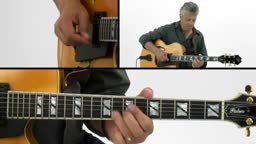
Hi I'm Paul Brown, and thanks for checking out the Smooth Jazz Handbook. The roots of smooth jazz can be traced back to the late 60's when Wes Montgomery did a series of albums where he was playing pop music instrumentally. No one had really done that before and those great records laid the foundation for smooth jazz. Over time the genre evolved with great musicians like Grover Washington Jr., Bob James and George Benson. One of the things I really love about smooth jazz in the combination of elements: blues, jazz rock, pop - it's really got it all in there. I've organized the course into two sections. In section one, we're going to be taking a look at some of the key concepts of playing smooth jazz. In section two we'll work through six performance studies showcasing some of my own personal tunes. You'll get all the tab and notation, as well as all the rhythm tracks for you to play along with. But that's enough talk, let's get goin'!
SECTION 1: Key Concepts
In Section one we are going to cover 12 concepts that I think will really help get to the core of what smooth jazz is and how I approach it. Things like the difference between jazz and smooth jazz, the use of restraint, how less is more and really thinking like a producer. We're going to discuss approaching melody like you're telling a story and you can sing the melody. You'll see how important it is in smooth jazz to continue a melody and when you get to a solo section and to have a beginning, a middle and an end. We're going to have some fun with this and get to the nuts and bolts of smooth jazz.
Smooth vs. Jazz
There are a lot of similarities in smooth jazz and jazz and there are also a lot of differences. For me, jazz is more about improvisation, and smooth is more about the song itself, the main melody. In jazz a lot of musicians say goodbye to the melody and start to experiment with the chords and the harmonic structure and take that to wherever they want to take it. Sometimes it has to do with the song and sometimes it doesn't. In smooth jazz, in the solo sections you are taking the melody and expounding on a theme and coming back to the melody. There is a lot more theme involved like pop music. Typically in a pop song you'll have the A section. like a vocal song, you have a little verse and then a pre-chorus, and then a hook or a chorus. And then a second verse and a second pre-chorus and a second hook, set up like a pop sing, or an R&B song. Where a jazz song is more set up with an A section, the head. Then they usually go into soloing and sometimes that soloing has a reflection of the song and sometimes it doesn't. The basic difference between the two is the smooth jazz is more rhythmic oriented and jazz is more harmonic oriented. When you're soloing you're actually thinking about the harmonic structure and where you can go and where you can take it. In smooth jazz you are sticking more within the boundaries of the harmonic structure and thinking more rhythmic ideas. I think that opens up a big world for a lot more musicians because I think it's a lot more difficult and cerebral to go off on these tangents in terms of the harmony of the song. In a pop song you are sticking to the structure and seeing how you can weave your way through it and tell a story through the melodic structure that's laid out. That to me is the biggest difference. You can dig into a song and it doesn't have to be complicated. The use of restraint is very important in smooth jazz. There's a lot of musicians in smooth jazz, like a Bob James or a Bony James. They have the ability to play jazz or play anything. It just flows out of them, but they have an incredible amount of restraint in their playing and it really works well within smooth jazz because you can do a lot with a little. You can say a lot with a few notes, you don't need a million notes, you don't need something to be dissonant or somehow angular and in smooth jazz everything is a little bit less angular and smoother.
Think Like a Producer
What I mean by that is to take into consideration everything that is going on with the music, with the other musicians, how everybody is approaching things. I produced a lot of great guitar players like George Benson, Larry Carlton, I've worked with Luther Vandross a lot. What these guys do is they fit into what's there. They don't just tkae over the track, they blend with the track. It's really important to find your way in the music and do your thing but everything needs to complement each other. That's another difference between jazz and smooth jazz. Where in jazz, when it comes to your section to play, all bets are off you can pretty much do what you want. In smooth jazz we are constrained by the other musicians and what's going on and the way the song is being set up. So it's important to take these things into consideration. Like the arrangement of the song, what the bass player is playing, where are your melodies going to fit.
Less is Much, Much More
Here we look at the idea of using restraint and the idea that the rest is just as important as a note. When you are playing an arpeggio and playing any melodic structure, the rests need to have their complete length. You hear about people who rush when they play or cramming in too many notes. Those rests are really important. It's super important as a drummer, when you are playing on beat 2 and beat 4 - the rest of beat 3 has to be the correct length. It's the same with guitar, when you are playing a melodic line the rests are very important. They give more importance to the note that follows and the one that went before so they don't get all cramped together. When that note comes it has impact. You can say a lot with a little. Restraint is extremely important in smooth jazz. You have to pick your notes and they have to be the right notes, and they have to have the right duration, and the rests have to have the right duration.
Reacting To Music
Reacting to music is similar to thinking like a producer - when you are going to play your part you're listening closely to the other instruments and reacting to what they are doing, not just going on with nothing on your mind in terms of the music that's coming at you. Sometimes I like to go right with the music, and sometimes the melody hits right with the chords and sometimes it reacts off the chords.
Make the Melody Yours
This is the most important thing as an artist or guitarist. What separates smooth jazz from jazz is you really have to tell the story and make this melody count for something, you have to feel it. There are little things that you can do to make it individualistic. Some things that I do are using octaves, how you play the actual melody, of course we are using restraint, we are making sure our rests are the correct length, and we're making sure there is a reason for our notes to be there. Every note has to have a purpose.

+ 27 more lessons

Start Course

Reviews

14 results

david335

Verified buyer

01/05/25

Paul brown, Smooth Jazz Handbook.

Paul brown is EXCELLENT guitarist and teacher. HIlighly recommend this course.

lockednut

Verified buyer

12/06/24

Smoothness

Covers a lot of detail and lots of good performances

Osokin

Verified buyer

10/09/22

Sound Advice!

This is a great course for anyone interested in jazz guitar playing! Paul Brown presents and explains many key musical principles, and then plays some tasty solos to demonstrate their application in a musical context. Some very useful advice, and lots of excellent playing.

Anthony B.

07/23/22

A Great Course

Paul Brown teaches what has made him and others he has worked with successful as a writer, producer and artist. Some things appear simple but are so important to understand. There's a reason artists work with him and you'll see why in this course. This class is great for beginners. I have been into smooth jazz my whole life. Being able to learn from talent like him is awesome! It has definitely inspired my playing.

Bubmanboone

Verified buyer

06/10/21

Good beginning!

Love this so far. I am only part of the way through the course. Very good beginning in jazz for an old rocker.

Stop searching. Start improving with All Access.

Try 14 days free. Cancel any time.