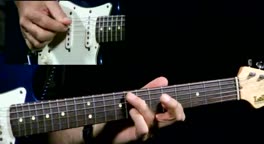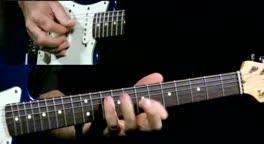
You unlock this door with the key of imagination. Beyond it is another dimension -- a dimension of sound, a dimension of sight, a dimension of mind. You're moving into a land of both shadow and substance, of things and ideas. You've just crossed over into the Verheyen Zone.
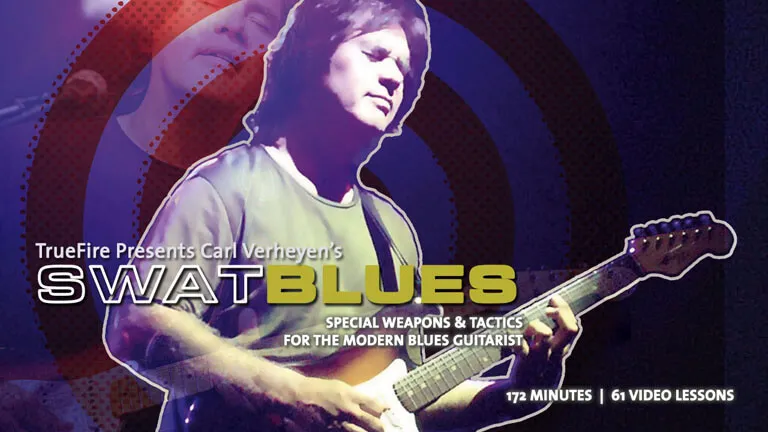
We couldn't have said it better and so a big thanks to Rod for the perfect description. Carl Verheyen's SWAT Blues is indeed supernatural stuff. You will see and hear things within this series of 61 video lessons that will blow your mind from here to Timbuktu. And if you dig playing the blues, these 'special weapons and tactics' will inspire, excite, transform and invigorate your chops way beyond your wildest expectations.
As impressive as Verheyen's pedigree may be, it doesn't even come close to accurately reflecting the monster technique, extraordinary intelligence and imaginative creativity that comprises his signature style. Carl Verheyen is the quintessential guitarist's guitarist and a quick Google will prove that pudding.
Fortunately for we students of guitar, he is also an incredibly articulate educator with a knack for making even the most challenging material very accessible. Consequently, SWAT Blues will take you deeper, wider and further than any blues course you've ever worked through by applying influences from bluegrass, rumba, rockabilly, jazz, rock, western swing, Texas-style, Delta-style and just about everything in between.
Whatever your level of play, you will love how Verheyen steps you through his curriculum. You will work through six distinctive blues grooves ranging from low, down and dirty up-tempo shuffles to smooth and moody slow blues. Verheyen performs three solos over each groove, each solo demonstrating a distinctive approach.
After each of these 18 solo/demonstrations, Carl breaks down the 'special weapons and tactics' utilized in the solo including intervallic lines, double-stop soloing, Myxolydian thirds, melodic chords runs, slide lick emulation, open string leaps and ornamentation, vibrato, zing harmonics, open position leaps, timing, big major third bends, modern inversions and voicings, motific and melodic development, picking-hand techniques, mixing minor and major Pentatonic lines and many more modern blues tools.
You will certainly stock up on killer licks and other tricks of the Verheyen trade BUT you don't even have to pick up the guitar to reap the key rewards of SWAT Blues; Verheyen's concepts, creative approaches and harmonic insight alone will majorly fire up your blues bag.
What you'll learn
Execute hybrid picking with coordination between pick and fingers
Play chicken-picking licks with proper muting and articulation
Use minor third/major third combinations for authentic country sound
Combining minor and major pentatonic scales in improvisation
How to use open strings as pivot points for navigating the fretboard
The blues is a huge part of a lot of the music we make, whether it's pop, rock, country or jazz. In this course my goal is to present for you many alternatives to the typical blues-based material. Your playing will jump to the next level if you work on these concepts and try to get some of the lines under your hands. The linear approach will help to open up the range of the guitar and for many of the "top 3 strings-1 position" blues players, you'll find a lot of new territory to mine for melodic ideas.
2Diamond Blues 1
Three different fundamentals for playing minor blues are demonstrated in this chapter: Bending and vibrato, chord voicings and an intervallic deconstruction of the minor pentatonic and various minor modes.
3Diamond Blues 2
In this first example I demonstrate the value of bending in tune. I also show how the consistency of vibrato affects the overall vibe and feel of the solo. Nowhere is this more important than on a slow blues or a ballad.
4Diamond Blues 3
The four principles of bending are described here: 1) Straight to pitch with no vibrato. 2) Straight to pitch without vibrato then gradually adding some as the note fades. 3) Bending directly to a note with vibrato in motion. 4) Bending with all four fingers because all of the above bending principles can be applied to all four fingers. Remember, no two vibratos from two different players are the same. It is your sonic fingerprint!
5Diamond Blues 4
This chorus will be improvised using chords. I'll explain modal, modern, traditional and invented chord voicings and show how they can be used as an alternative to single line improvisation.
6Diamond Blues 5
Using harmonics, octaves and modern inversions I can create a mood and vibe that is completely different than the expected pentatonic blazing.
7Diamond Blues 6
Here I'll explain how I get "zing harmonics" by sweeping the pick across the strings 12 frets above the chord form. Instead of jazz chords or rock, blues or "cowboy chords," I use a modern approach based on a variety of intervals that create melodies. I also use modal chords that are based on a chord form that can be moved modally while retaining the same form across the neck.